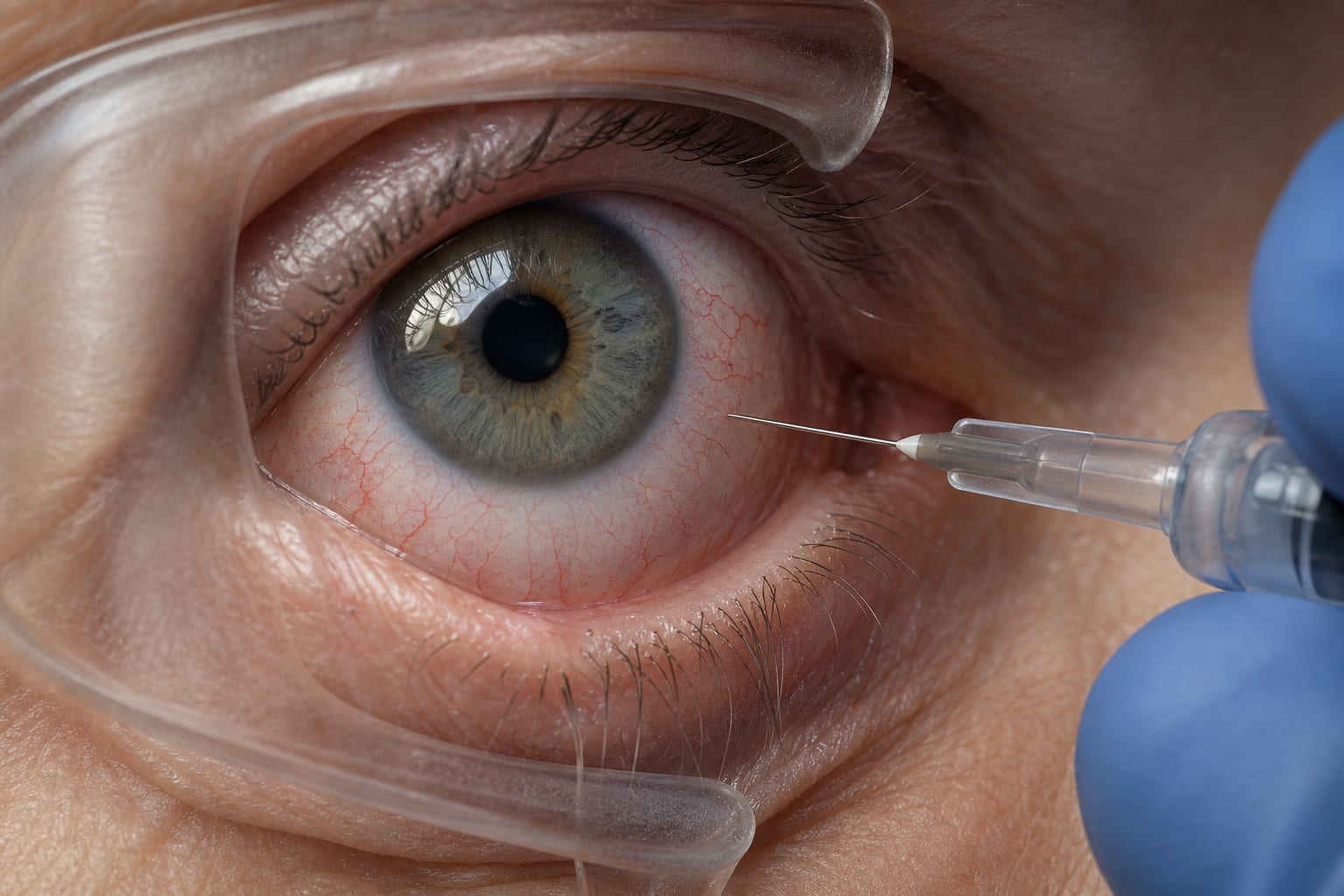
To evaluate the impact of two years of serial anti-VEGF intravitreal injections on ocular surface parameters.
Approach:
Patient Selection: Patients with neovascular age-related macular degeneration (nAMD) receiving unilateral intravitreal anti-VEGF injections were examined at two time points over two years.
Assessment Methods: Tear meniscus height (TMH), bulbar redness (BR), and meibomian gland (MG) loss were assessed using the Oculus Keratograph 5M, with the fellow eye serving as control.
Statistical Analysis: The related-samples Wilcoxon signed-rank test and paired-sample Student’s t-test were applied for statistical analysis.
Key Findings:
Significant increase in mean bulbar redness (BR) in untreated fellow eyes compared to baseline measurements (p < 0.001).
Median tear meniscus height (TMH) increased significantly in untreated eyes (p = 0.003), while treated eyes showed no significant change (p = 0.74).
Both treated and untreated eyes exhibited significant meibomian gland loss after two years, with no significant differences between treated and untreated eyes.
Interpretation:
Limitations:
The study design was observational and lacked a randomized control group.
At ASRS 2026, Dilsher S. Dhoot, MD, FASRS, shared additional phase 3 SOL-1 data on vision maintenance, rescue treatment, and safety with investigational OTX-TKI (Axpaxli) in neovascular AMD.
With phase 3 topline data for sura-vec expected later this year, Arshad M. Khanani, MD, FASRS, reflects on how gene therapy could transform long-term treatment for nAMD.