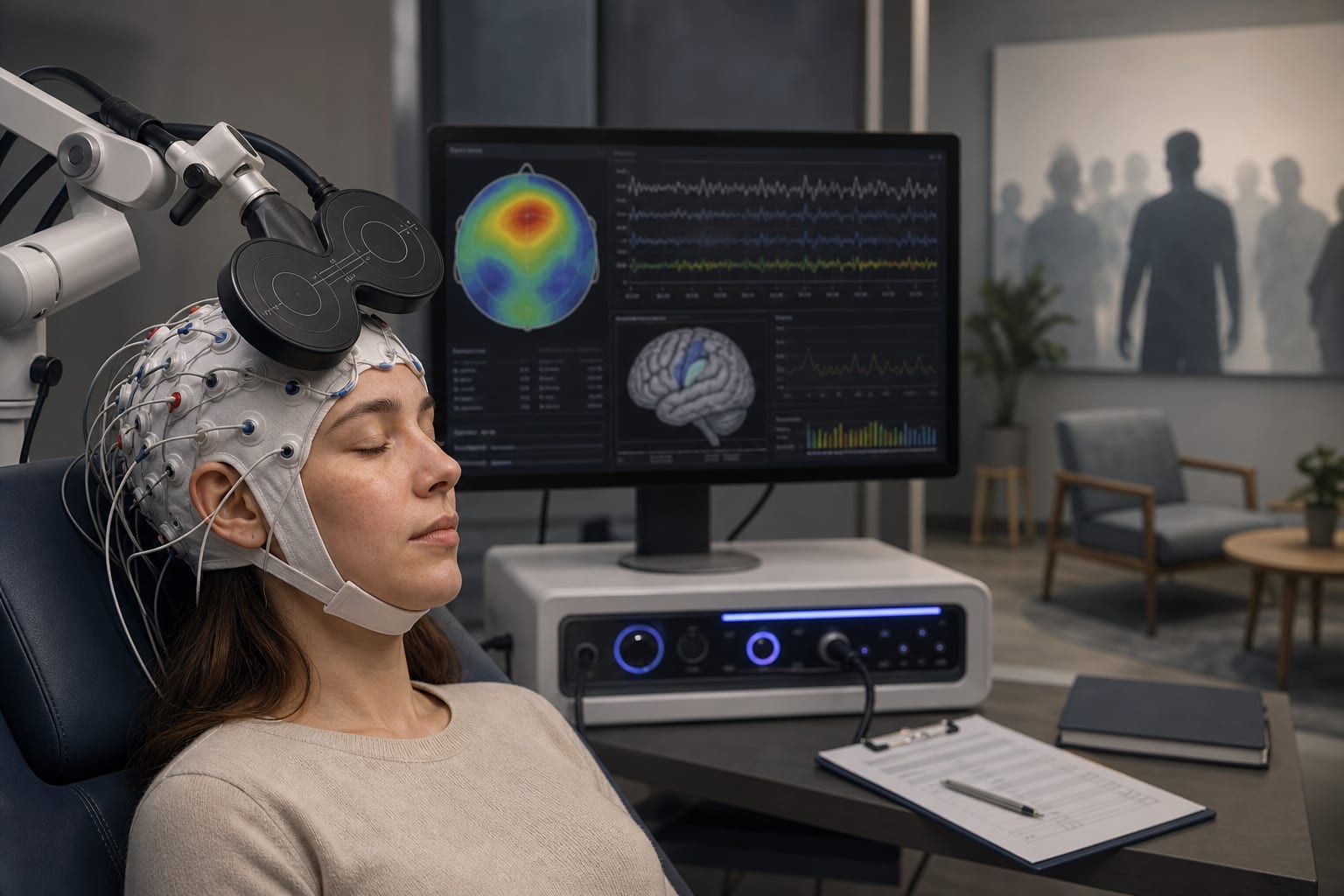
To explore outcomes following spectral EEG-guided personalized repetitive transcranial magnetic stimulation (PrTMS) in a patient with social anxiety disorder (SAD), performance-only subtype, emphasizing the innovative personalization aspect.
Key Findings:
Reductions in social anxiety intensity, avoidance behaviors, and negative self-appraisal were observed, indicating significant clinical improvement.
Improvements in mood and daily function were reported, suggesting enhanced quality of life.
Quantitative symptom changes were measured using LSAS, SPIN, PHQ-9, GAD-7, and Q-LES-Q-SF, providing a comprehensive assessment of treatment efficacy.
Increased alpha band power, decreased delta band power, and an increased alpha-delta ratio were noted on EEG, indicating neurophysiological changes associated with treatment.
Interpretation:
The findings suggest that PrTMS may be a feasible adjunctive treatment for SAD, indicating potential for practical application in clinical settings, warranting further investigation.
Limitations:
This is a single case study, limiting generalizability and introducing potential biases. Further large-scale, blinded, and randomized studies are needed to validate observations.
Conclusion:
PrTMS shows promise as a potential adjunctive treatment for SAD, but further research, particularly randomized controlled trials, is necessary.
by Mark Odron, Yatharth Mahajan, Vipul Reddy, Krrishika Saxena, Charles Vigilia, Brianna Dela Cruz, Jayleen Lu, Nisha Thunga, Kenneth Blum, David Baron, Keerthy Sunder