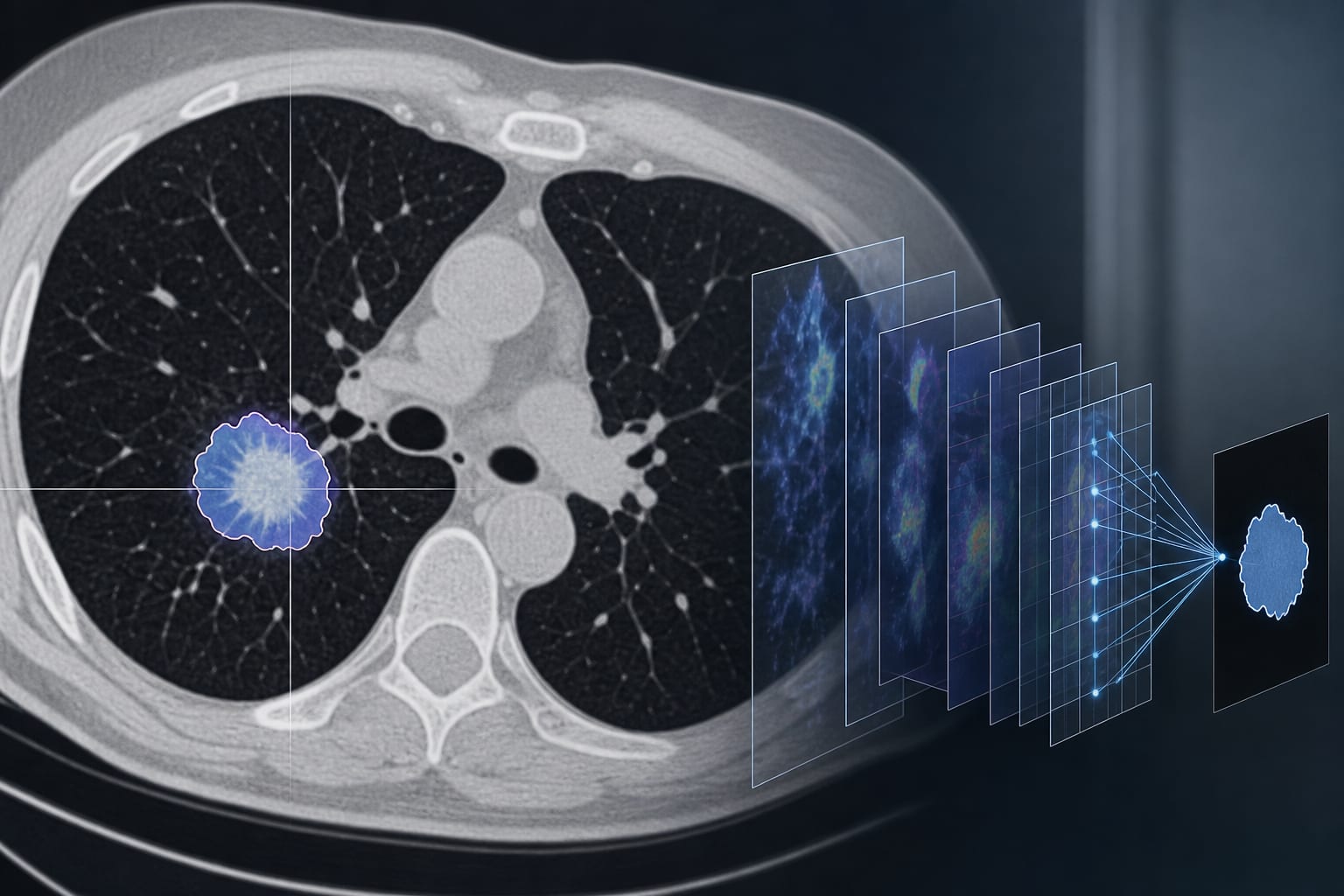
To develop a segmentation method for pulmonary nodules to improve segmentation accuracy and support clinical evaluation of lung cancer.
Approach:
Network Architecture: EGP-Net integrates a Res2Net-50 encoder, an edge-guided network, a global pyramid perception module, a dynamic attention fusion module, and a multi-scale contextual decoder.
Training and Evaluation: The model was trained and evaluated on the public LIDC dataset and a private clinical dataset, with performance assessed using IoU, Dice, F2-score, and F0.5-score.
Key Findings:
EGP-Net achieved an IoU of 88.32% and a Dice coefficient of 92.65% on the LIDC dataset.
The model outperformed state-of-the-art comparative segmentation methods.
Excellent performance was also noted on the private clinical dataset.
Ablation experiments confirmed the effectiveness of each component of EGP-Net.
Interpretation:
EGP-Net improves the accuracy and robustness of pulmonary nodule segmentation, facilitating precise nodule identification and quantitative analysis.
Conclusion:
EGP-Net provides reliable support for lung cancer detection and evaluation.