Measuring performance trajectories in lung cancer surgery: a longitudinal study using the French national hospital database from 2020 to 2024 - Summary - MDSpire

Measuring performance trajectories in lung cancer surgery: a longitudinal study using the French national hospital database from 2020 to 2024

  • By

  • Alain Bernard

  • Jonathan Cottenet

  • Pascale Tubert-Bitter

  • Catherine Quantin

  • June 22, 2026

  • 0 min

Share

Objective:

To conduct a national longitudinal analysis of performance trajectories in lung cancer surgery in France using advanced trajectory modelling approaches.

Approach:
  • Study Population: Included all adult patients (n=56,299) who underwent lung resection for primary lung cancer in 2020–2024 across 148 hospitals.
  • Outcome Measures: Primary outcome was severe complications including major postoperative complications and 30-day mortality.
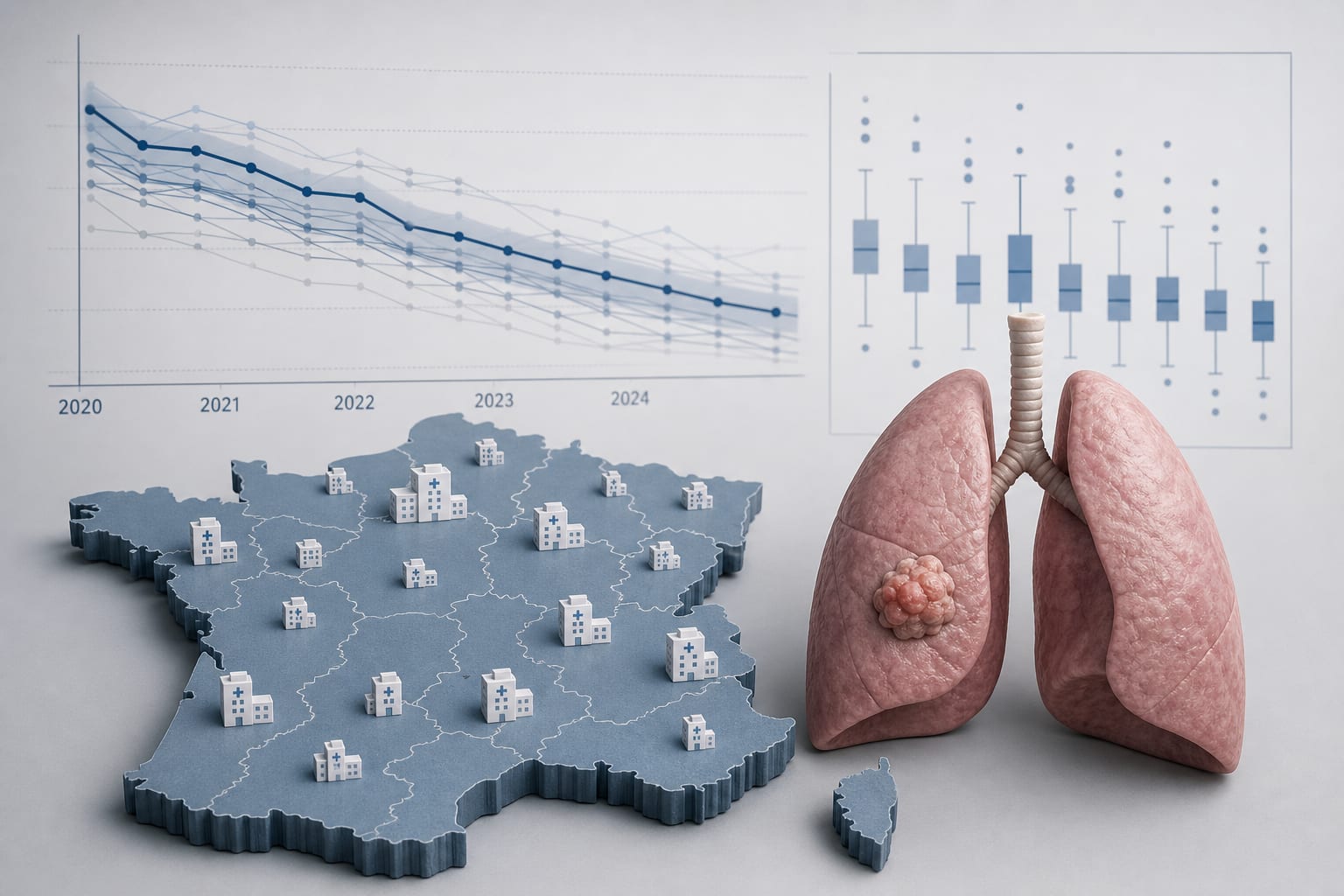
  • Statistical Analysis: Used annual logistic regression models for risk-adjusted rates, Hidden Markov Models for performance transitions, and group-based multitrajectory models for hospital subgroup analysis.
Key Findings:
  • Predictive models showed excellent discrimination (mean ROC curve=0.890).
  • Strong performance inertia was observed with persistence probabilities ≥78%.
  • Medium-volume hospitals had optimal improvement trajectories with a 45.4–45.8% reduction in risk-adjusted rates.
  • Some low-volume hospitals experienced a catastrophic deterioration (843% increase in RAR).
  • A subgroup of high-volume hospitals also showed concerning performance degradation (151% increase in RAR).
Interpretation:

The study reveals heterogeneous performance trajectories in lung cancer surgery across French hospitals.

Limitations:
  • The study relies on administrative data, which may have inherent limitations.
  • Findings may not be generalizable to other healthcare systems without similar data structures.
Conclusion:

The study highlights the value of systematic outcome monitoring using administrative data.

Original Source(s)

Related Content