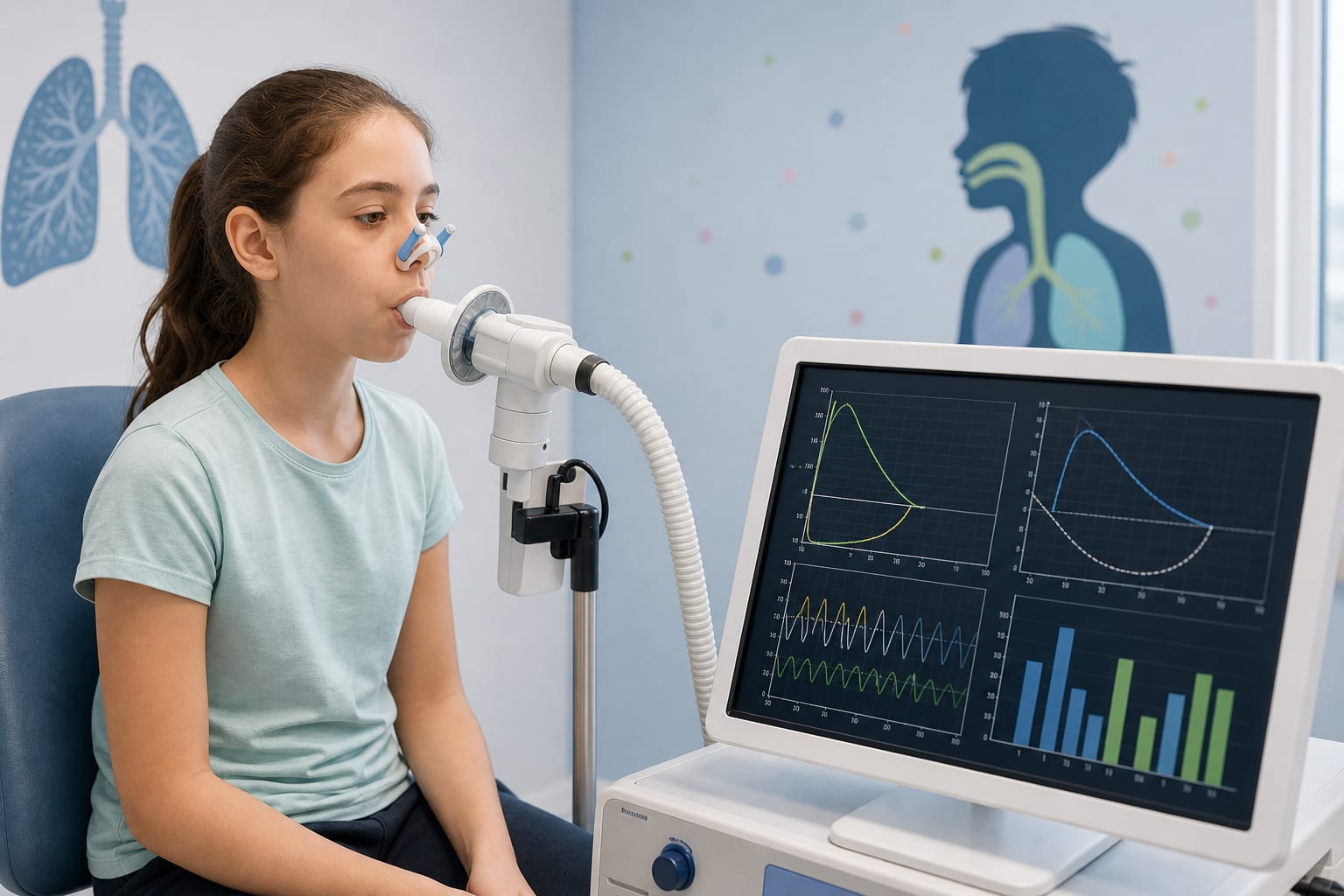
To compare impulse oscillometry (IOS) and spirometry to determine IOS parameter cutoff values specifically for detecting spirometry-detectable airway obstruction in children.
Key Findings:
IOS parameters significantly correlated with spirometry results, with R5−R20 showing the strongest correlation with FEV1 and MMEF (p < 0.05).
Cutoff values for AX and Fres were identified as 1.54 kPa·L⁻1 and 20.41 Hz for ages 6–11, and 0.54 kPa·L⁻1 and 13.77 Hz for ages 12–18, with confidence intervals provided.
Post-bronchodilator, Fres and AX decreased by 20% and 40% in 6–11-year-olds, and by 20% and 40% in 12–18-year-olds, predicting obstructive lung disease with accuracies of 62.2% and 60.2%, and 73.2% and 75.7%, respectively.
Interpretation:
The study identified IOS values that correspond to spirometric obstruction, aiding in the assessment of lower airway obstruction in pediatric asthma suspects.
Limitations:
Exclusion of patients with active respiratory infections or recent use of certain medications may limit generalizability to the broader pediatric population.
The study's reliance on specific age groups may not account for variations in IOS cutoffs across different populations, potentially affecting the applicability of results.
Conclusion:
The study successfully compared pre- and post-bronchodilator IOS and spirometry results, establishing IOS values that correlate with spirometric indicators of obstruction, which can aid in clinical decision-making for pediatric asthma management.