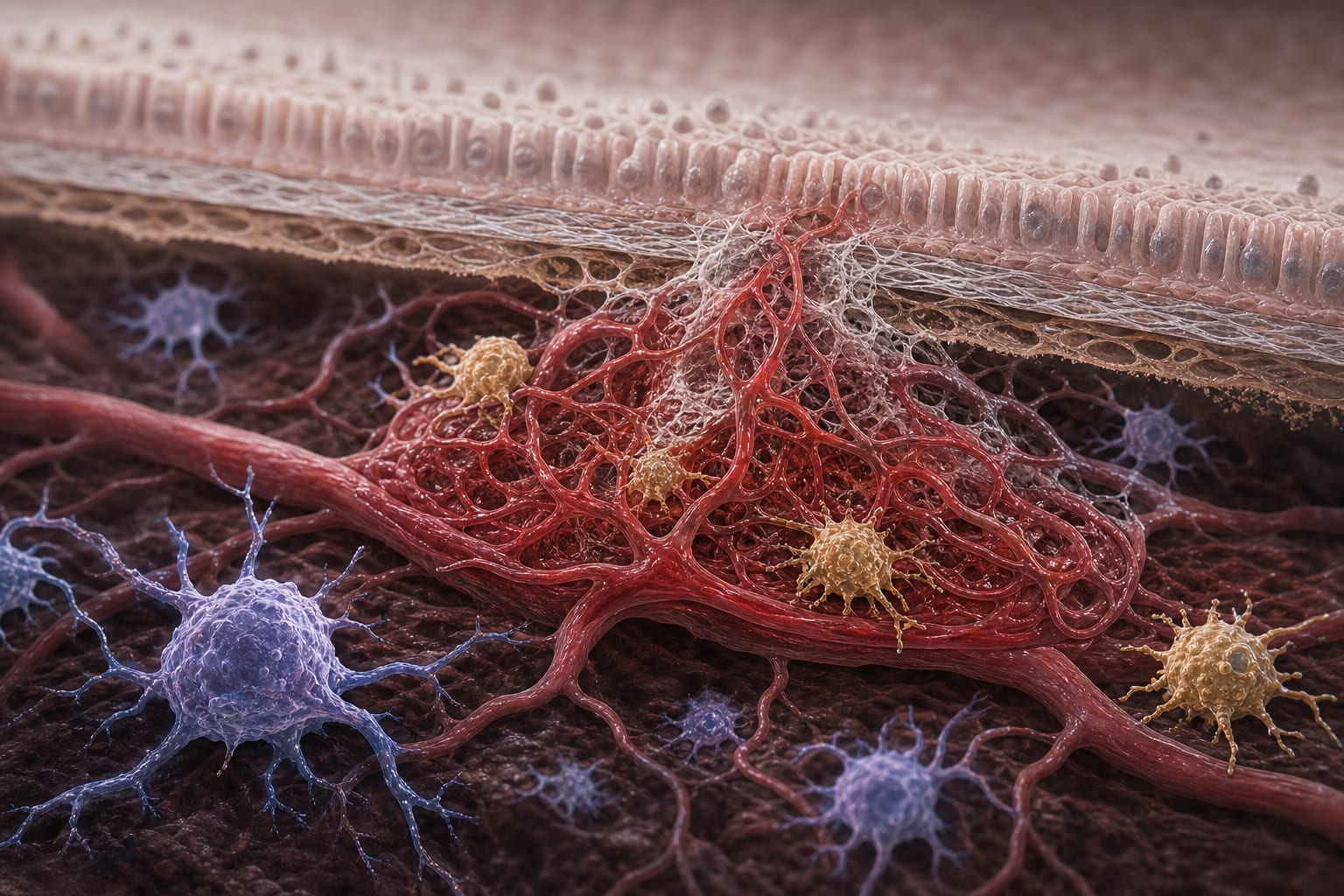
To investigate how endothelial TGFβ signaling interacts with mononuclear phagocytes to regulate choroidal neovascularization (CNV).
Approach:
Model: Utilized a laser-induced CNV model in mice with endothelial-specific Tgfbr2 deletion and concomitant mononuclear phagocyte depletion via PLX5622.
Key Findings:
Loss of endothelial TGFβ signaling significantly exacerbates CNV.
This exacerbation is fully rescued by mononuclear phagocyte depletion.
Fibrinogen alpha chain (Fga) is identified as a monocyte-derived factor upregulated in the absence of endothelial TGFβ signaling.
Interpretation:
The study identifies a TGFβ-dependent interaction between endothelial cells and mononuclear phagocytes that influences angiogenesis through Fga expression.
Limitations:
The study is limited to a mouse model and may not fully translate to human conditions.
Further research is needed to explore the exact mechanisms of TGFβ signaling and its interactions with other cell types.
Conclusion:
Endothelial TGFβ signaling plays a critical role in regulating CNV severity through interactions with myeloid cells.
by Anja Schlecht, Lisa Müllerbauer, Katja Fitz, Bianka Brunne, Nico Hofmann, Christian Müller, Jost Hillenkamp, Süleyman Ergün, Andreas Neueder, Barbara M. Braunger