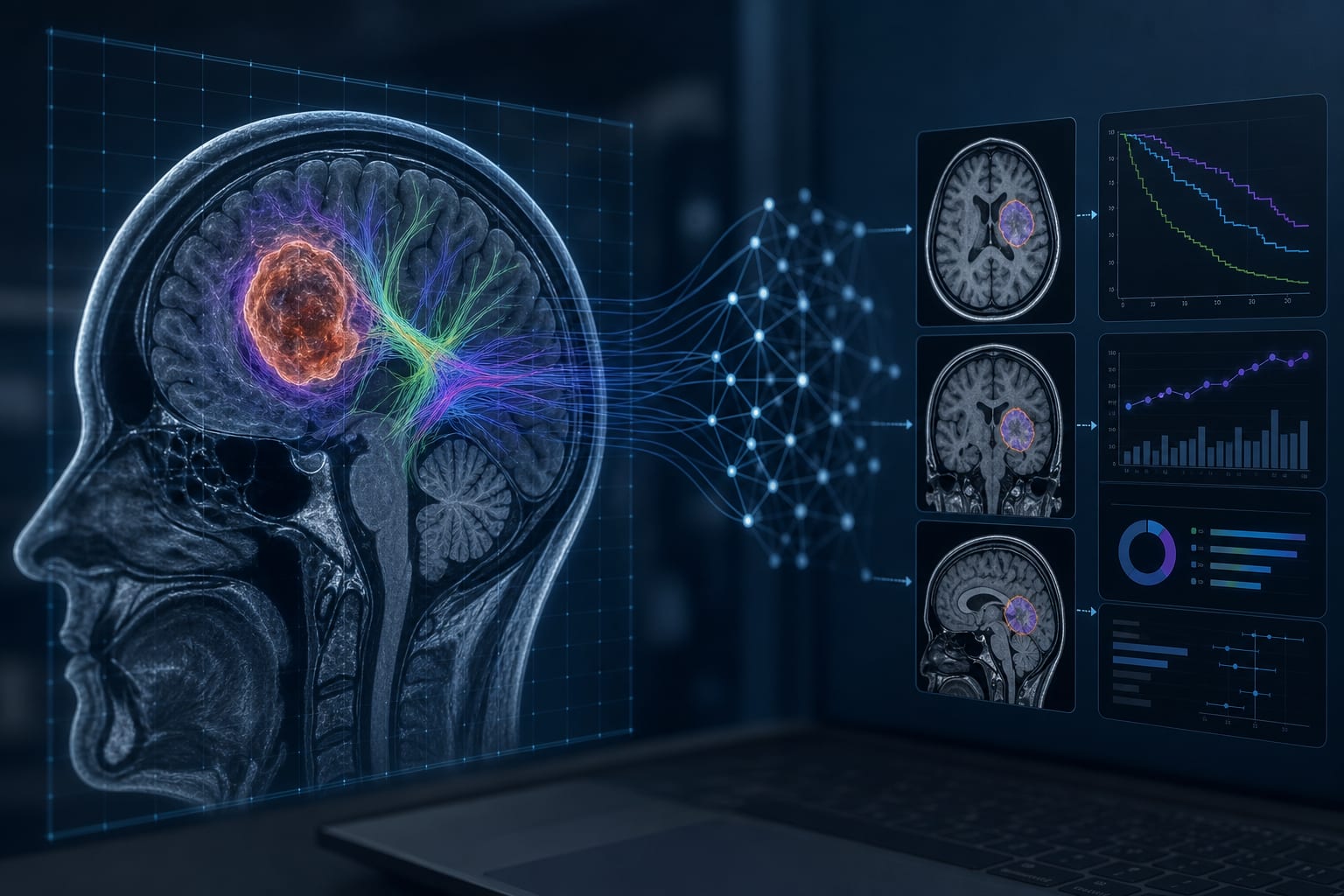
To evaluate the role of AI in neurosurgical care, focusing on its applications in diagnostic accuracy, preoperative planning, prognostication, intraoperative assistance, and postoperative management.
Approach:
Narrative Review: This article synthesizes existing evidence on AI in neurosurgery, focusing on its evolution from traditional severity scoring systems to AI-driven precision neurosurgery.
Data Sources: A targeted search of PubMed, Google Scholar, and Web of Science was conducted using terms related to AI and neurosurgery, prioritizing high-quality original research and expert consensus.
Key Findings:
AI enhances diagnostic accuracy and streamlines workflows in neurosurgery.
Performance metrics for AI applications include Dice scores of 0.82–0.84 for tumor segmentation and AUC values of 0.80–0.90 for molecular prediction.
AI serves as a cognitive collaborator, augmenting precision, efficiency, and patient-centered outcomes.
Interpretation:
AI is transforming neurosurgery by enabling dynamic, personalized prognostic insights and improving patient outcomes through advanced data analysis.
Limitations:
The review lacks a formal PRISMA protocol and predefined eligibility criteria, which may introduce selection bias.
Challenges in model interpretability, data privacy, and algorithmic bias remain significant.
Conclusion:
AI is positioned to enhance the capabilities of neurosurgeons, paving the way for a new era of precision neurosurgery.