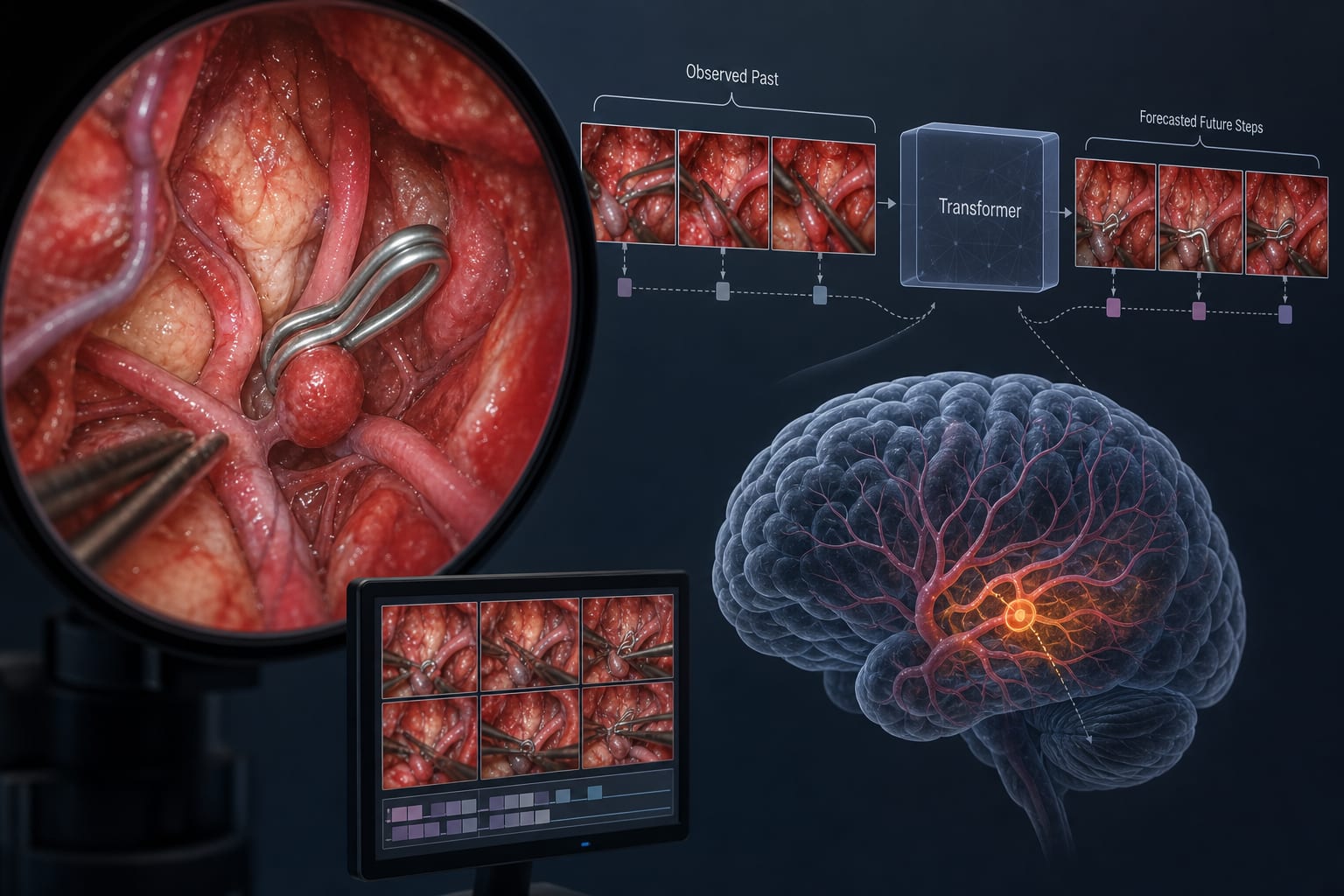
To evaluate the feasibility of fixed-horizon surgical step prediction in recorded microscope videos of middle cerebral artery aneurysm clipping operations, highlighting the potential impact of AI in enhancing surgical precision.
Key Findings:
The multimodal model achieved the highest mean accuracy of 0.683 and weighted F1 score of 0.673, indicating strong predictive capabilities.
The annotation-only model had a mean accuracy of 0.606 and weighted F1 score of 0.577, suggesting the importance of prior knowledge.
The video-only model had a mean accuracy of 0.477 and weighted F1 score of 0.447, highlighting the limitations of using video features alone.
The multimodal model showed the best sequence-level alignment with a normalized edit distance of 0.430, reinforcing its superiority in predictive performance.
Interpretation:
Fixed-horizon surgical step prediction during MCA aneurysm clipping is feasible under controlled input conditions, with multimodal modeling providing the strongest predictive performance, which could enhance surgical training and decision-making.
Limitations:
The study represents upper-bound performance and requires validation in fully automated recognition-to-prediction pipelines, as well as consideration of potential biases in the data.
The analysis was limited to a small sample size of 25 surgeries, which may affect the generalizability of the findings.
Conclusion:
The findings indicate the potential for improved predictive modeling in surgical procedures, suggesting avenues for future research to validate and expand upon these results.
The largest study of former National Football League players found excess persisted even after accounting for the lower overall mortality associated with elite athletic participation.