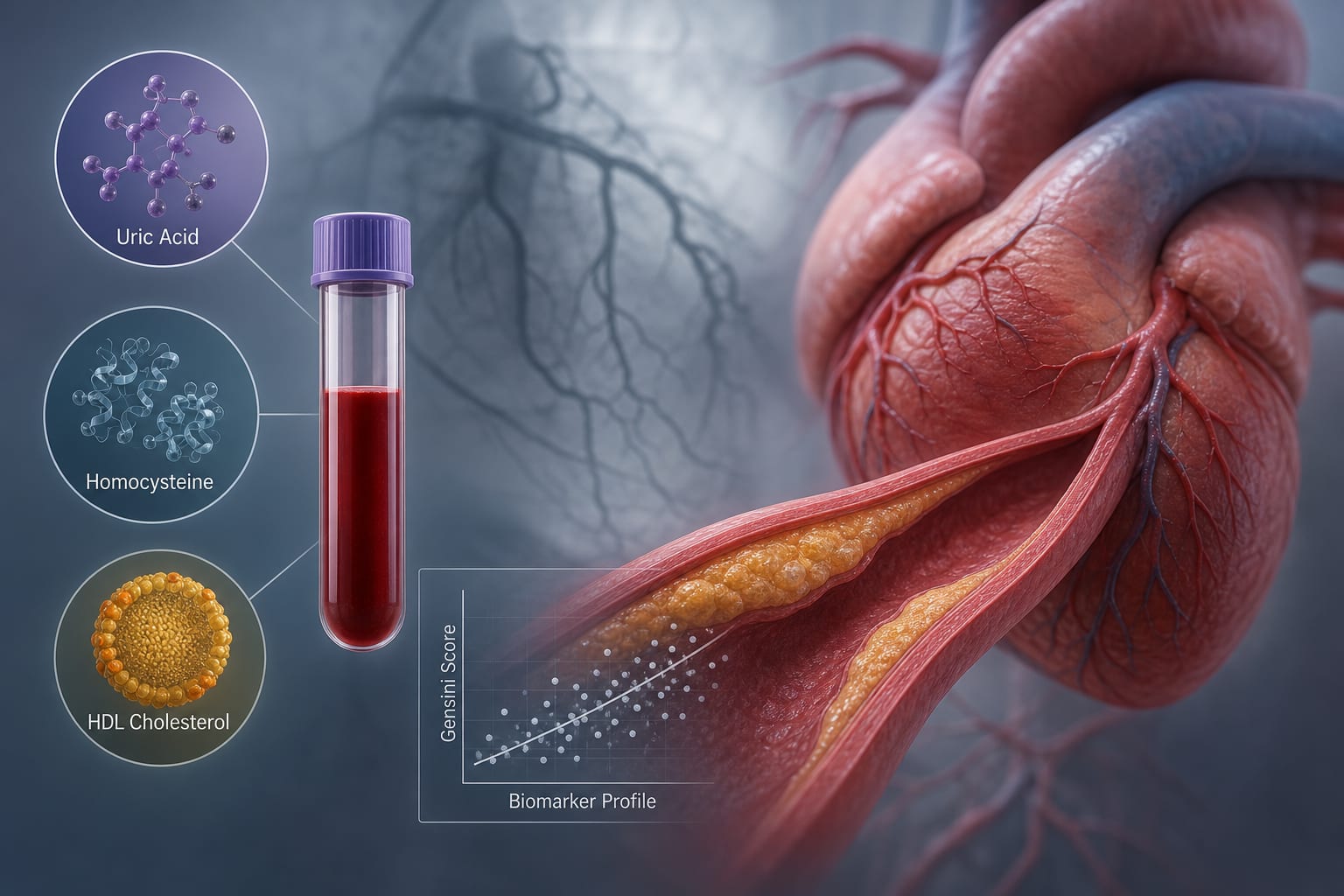
To investigate the associations of homocysteine (Hcy), high-density lipoprotein cholesterol (HDL-C), and uric acid (UA) with coronary heart disease (CHD) severity and evaluate the diagnostic value of their combined detection.
Approach:
Study Design: 100 participants undergoing coronary angiography were enrolled, including 58 patients with CHD and 42 controls. Serum levels of Hcy, HDL-C, and UA were measured, and coronary stenosis burden was quantified using the Gensini score.
Statistical Analysis: Spearman correlation and multivariable linear regression analyses were performed to identify independent predictors of Gensini score. ROC curves and reclassification indices were used to assess diagnostic performance.
Key Findings:
Hcy, UA, and HDL-C levels were significantly altered in CHD patients compared to controls (all p < 0.001).
Gensini scores positively correlated with Hcy (r = 0.314), UA (r = 0.307), Scr (r = 0.411), NT-proBNP (r = 0.294), and fasting glucose (r = 0.252), and negatively with HDL-C (r = -0.324; all p < 0.01).
Adding Hcy, UA, and HDL-C to clinical predictors increased explained variance of the Gensini score from 31% to 48%.
Hcy showed the highest diagnostic value (AUC = 0.794), followed by HDL-C (AUC = 0.767) and UA (AUC = 0.749).
The combined biomarker model achieved the highest discriminative performance (AUC = 0.803; sensitivity 69.8%, specificity 74.2%).
Interpretation:
Serum Hcy, UA, and HDL-C are significantly associated with both the presence and severity of CHD.
Limitations:
The study had a limited sample size of 100 participants.
Exclusion criteria may limit generalizability to broader populations.
Conclusion:
The combined assessment of Hcy, UA, and HDL-C may aid in early assessment of coronary stenosis burden.