A risk-scoring model for predicting late postoperative hemorrhage following pancreatoduodenectomy: development and external validation - Summary - MDSpire
Advertisement
A risk-scoring model for predicting late postoperative hemorrhage following pancreatoduodenectomy: development and external validation
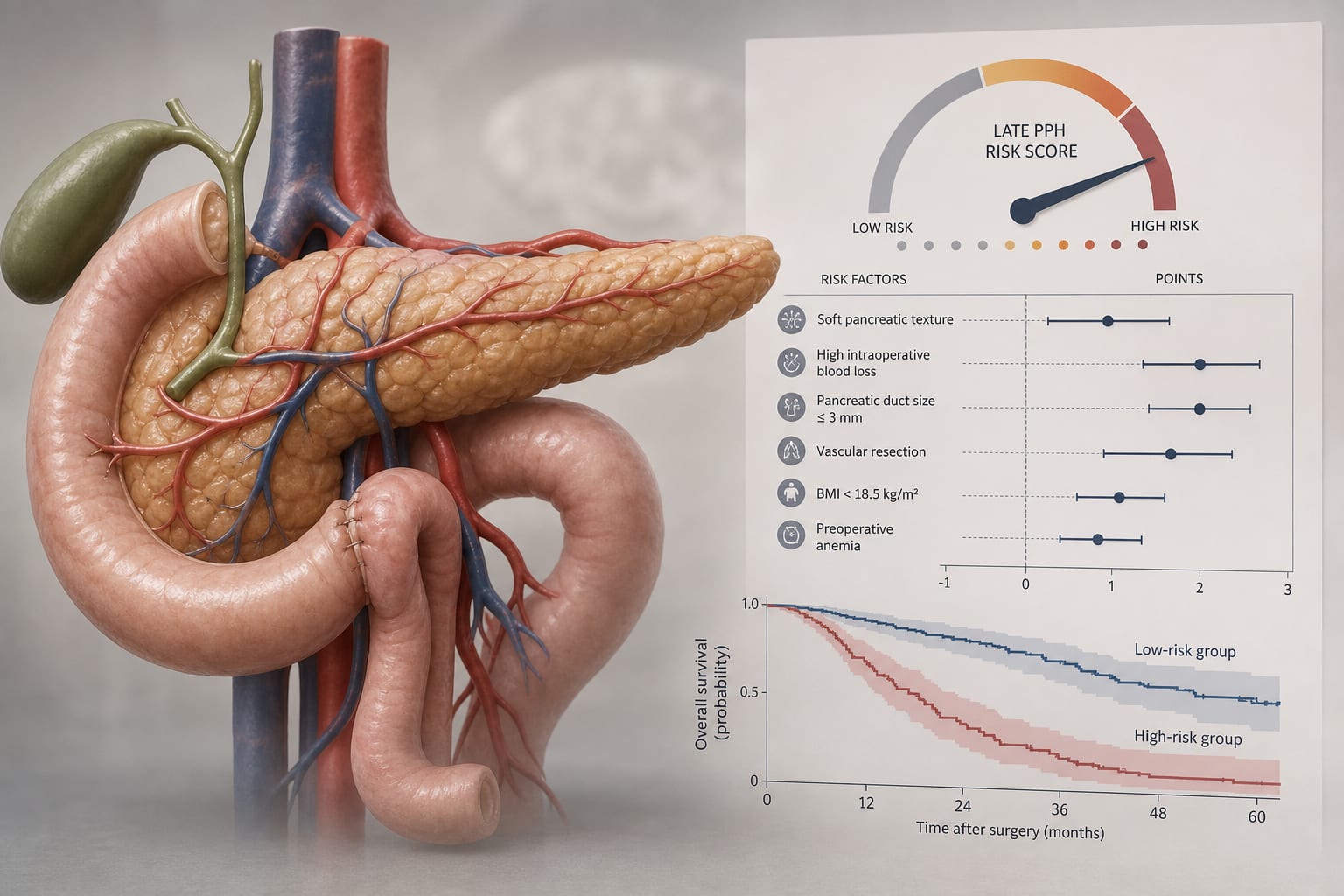
To develop and externally validate a clinically applicable risk-scoring model to predict late post-pancreatectomy hemorrhage (PPH) after pancreatoduodenectomy (PD).
Approach:
Patient Selection: Patients who underwent curative-intent PD were included, with a training cohort of 300 patients and an external validation cohort of 105 patients.
Model Development: The risk-scoring model was developed using multivariate logistic analysis to identify independent risk factors for late PPH.
Validation: The model's performance was validated in an external cohort, assessing its discriminative capacity by categorizing predicted probabilities into low-risk and high-risk groups.
Key Findings:
Late PPH occurred in 7.7% of the training cohort and 7.6% of the validation cohort.
Median survival was significantly lower in patients with late PPH (20.7 months) compared to those without (35.2 months, P = 0.009).
Independent risk factors for late PPH included BMI, preoperative total bilirubin, preoperative prothrombin time, and clinically relevant postoperative pancreatic fistula.
The predictive model demonstrated concordance indices of 0.863 in the training cohort and 0.825 in the validation cohort.
The most frequent site of hemorrhage was the common hepatic artery, accounting for 22.6% of cases.
Interpretation:
Limitations:
The study is retrospective and conducted at high-volume centers, which may limit generalizability.
The model requires further validation in diverse clinical settings.
Conclusion:
A simple risk-scoring model for late PPH after PD was developed and validated, facilitating risk prediction and potential preventive measures.