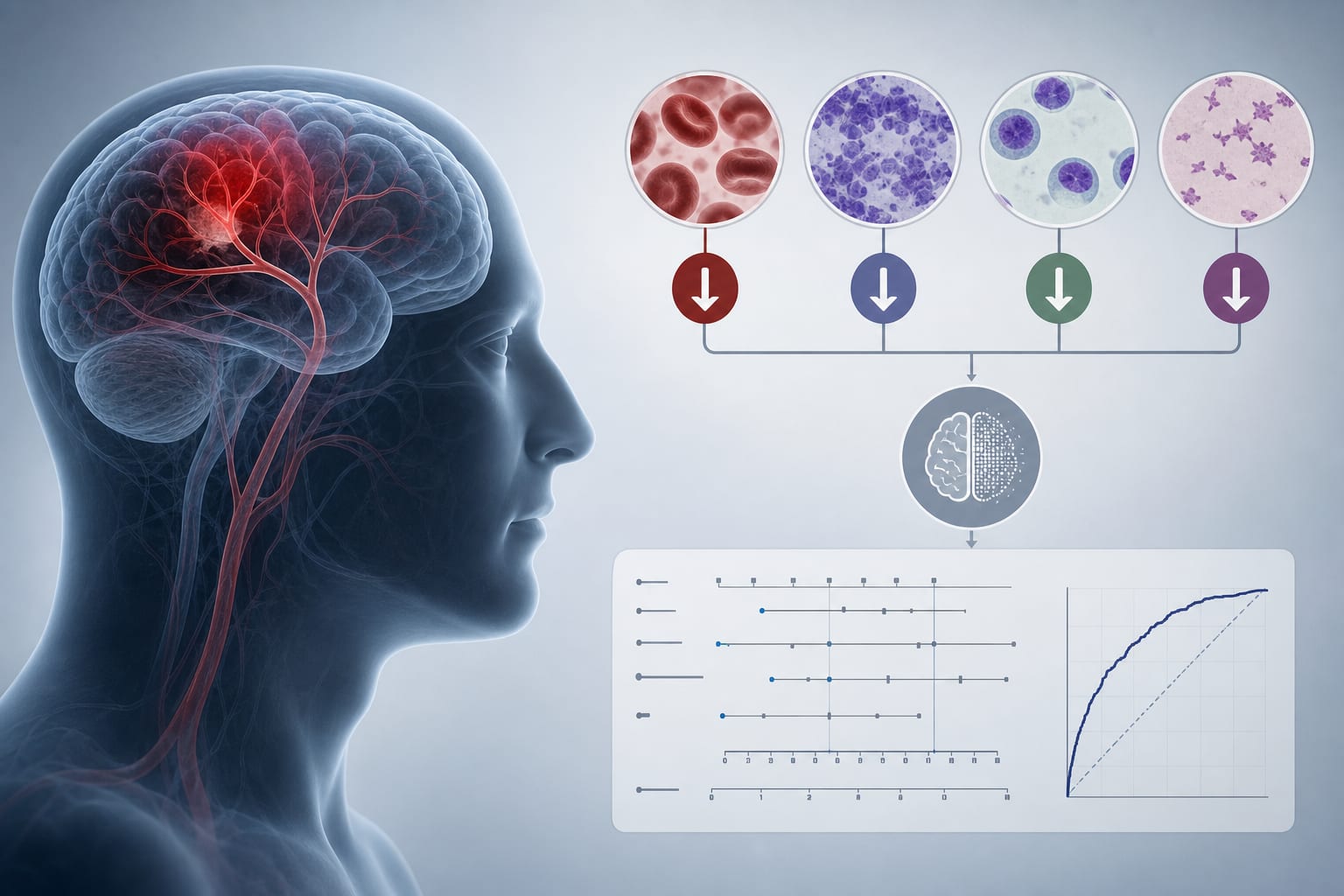
Hemoglobin-albumin-lymphocyte-platelet score and early neurological deterioration in acute ischemic stroke: a single-center retrospective cohort study - Summary - MDSpire
Advertisement
Hemoglobin-albumin-lymphocyte-platelet score and early neurological deterioration in acute ischemic stroke: a single-center retrospective cohort study
To investigate the association between the hemoglobin-albumin-lymphocyte-platelet (HALP) score and early neurological deterioration (END) in individuals with stroke and to develop an exploratory prediction model for END.
Approach:
Study Design: Retrospective analysis of clinical data from 595 patients with acute ischemic stroke (AIS) admitted to the Affiliated Hospital of Xuzhou Medical University.
Data Analysis: Patients were divided into training and validation sets. Multivariable logistic regression was used to identify END risk factors and build a predictive model.
Model Evaluation: Model performance was assessed using ROC curves and the Hosmer–Lemeshow goodness-of-fit test, along with clinical decision curve analysis (DCA) and SHAP method for predictor importance.
Key Findings:
31.3% of patients developed early neurological deterioration (END).
Independent determinants for END included large artery atherosclerosis (LAA) subtype, elevated baseline NIHSS score, and lower HALP score.
The association between HALP score and END remained significant after adjusting for various factors.
A nomogram incorporating HALP score, LAA subtype, and baseline NIHSS score showed moderate discrimination.
Interpretation:
A lower HALP score is associated with increased risk of END in patients with AIS, and the developed nomogram may aid in early risk stratification.
Limitations:
The study is retrospective and conducted at a single center.
The prediction model requires validation in a larger, prospective clinical study.
Conclusion:
The HALP score may serve as a useful tool for predicting early neurological deterioration in acute ischemic stroke patients.