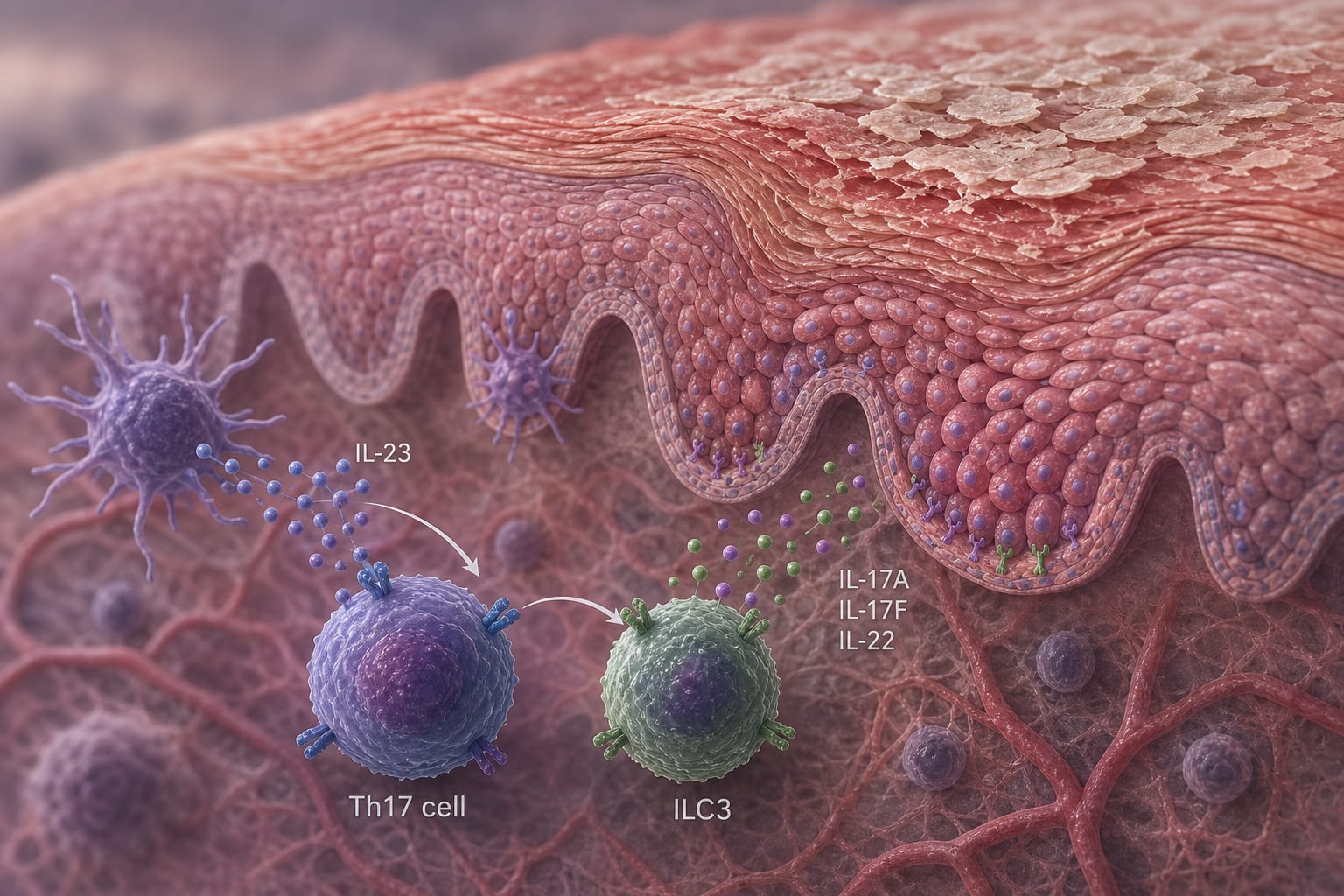
To explore the interactions between T helper 17 (Th17) cells and group 3 innate lymphoid cells (ILC3s) in the pathophysiology of psoriasis and their implications for disease stratification and therapy.
Approach:
Immunological Tipping Points: It identifies key immunological tipping points that regulate the balance between Th17 cells and ILC3s, including temporal dynamics, cytokine environments, and resource competition.
Key Findings:
Th17 cells and ILC3s both produce IL-17A, IL-17F, and IL-22, contributing to the inflammatory environment in psoriasis.
ILC3s provide a rapid, innate source of IL-17, while Th17 cells sustain chronic inflammation through adaptive mechanisms.
The balance between Th17 and ILC3s may influence clinical heterogeneity and responses to therapies in psoriasis.
Interpretation:
The interplay between Th17 cells and ILC3s creates a self-amplifying inflammatory circuit in psoriasis.
Limitations:
The article does not provide direct evidence for all proposed mechanisms, particularly regarding ILC3-Treg interactions in psoriasis.
Further research is needed to fully elucidate the roles of ILC3s and Th17 cells in different stages of psoriasis.
Conclusion:
Understanding the dynamics between Th17 cells and ILC3s may refine disease stratification and guide future therapeutic approaches in psoriasis.
Application of newly proposed GRAPPA and EULAR criteria in a longitudinal cohort identified progressively smaller groups of patients with early psoriatic arthritis who experienced persistently worse patient-reported outcomes.