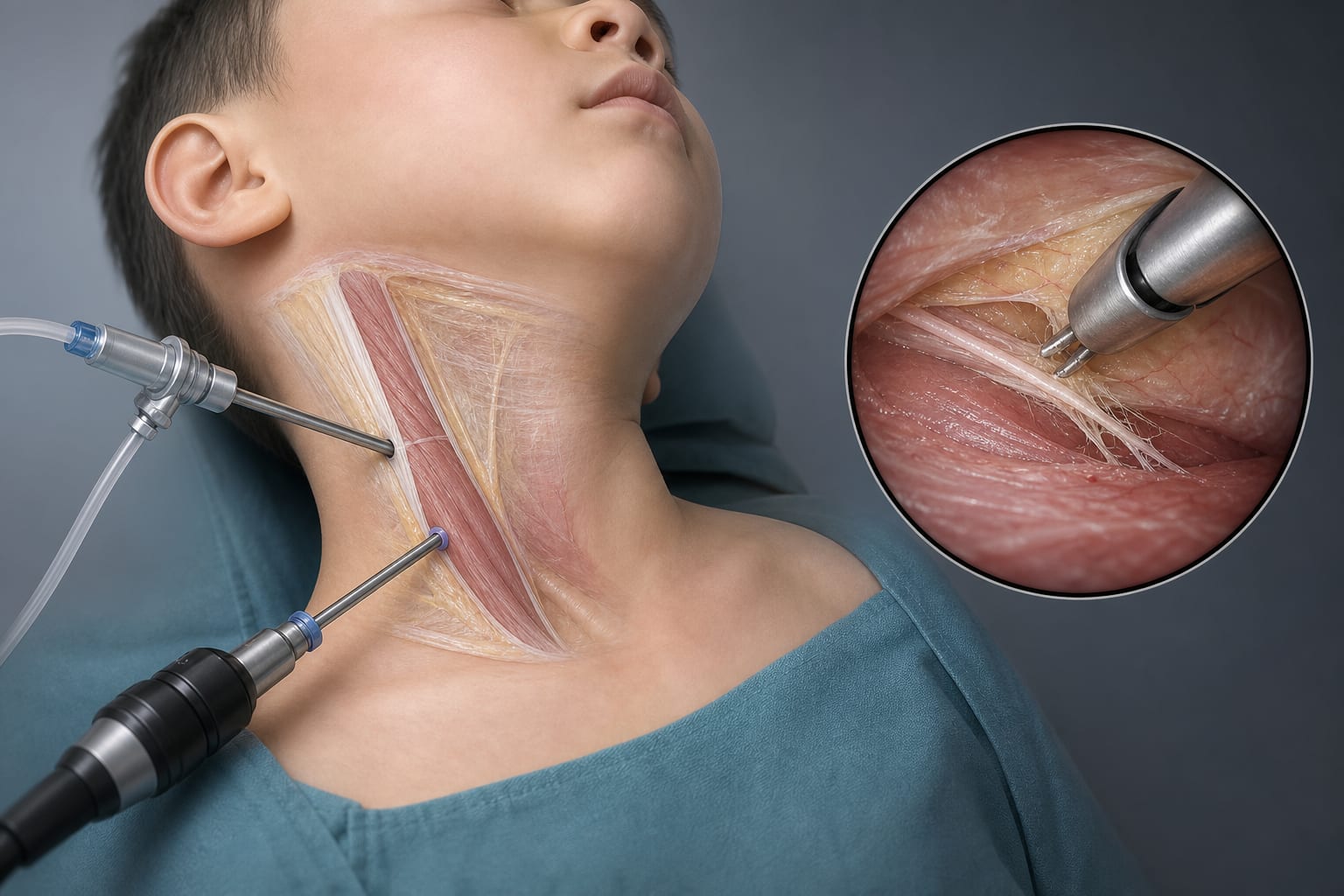
To evaluate the clinical outcomes and significance of an innovative endoscopic sub-platysmal release technique for congenital muscular torticollis (CMT) in children.
Key Findings:
44 patients (28 males, 16 females; mean age 3.88 ± 2.15 years) were analyzed with a mean follow-up of 49.3 ± 8.2 months, demonstrating significant clinical improvements.
Mean operative time was 35.2 ± 6.4 min, and mean blood loss was 4.5 ± 1.2 mL, indicating efficiency and safety.
Median neck rotation deficiency improved from 26.5° preoperatively to 3.0° postoperatively (P < 0.001), highlighting the effectiveness of the technique.
Lateral bending deficiency improved from 18.2° to 2.5° (P < 0.001), showcasing the comprehensive benefits of the procedure.
42 patients (95.4%) achieved excellent or good outcomes according to Cheng and Tang scoring, reinforcing the technique's success.
No intraoperative or postoperative complications were observed, underscoring the safety of the approach.
Interpretation:
The endoscopic sub-platysmal approach is a safe and effective minimally invasive technique for pediatric CMT, offering excellent functional recovery, minimal blood loss, and significant improvements in neck mobility.
Limitations:
Retrospective design may introduce selection bias, potentially affecting the reliability of the outcomes.
Limited to patients under 10 years, which may restrict the generalizability of the findings to older children.
Conclusion:
The endoscopic sub-platysmal approach represents a valuable addition to the surgical options for pediatric musculoskeletal disorders, particularly in enhancing cosmetic outcomes and minimizing complications.