To propose a novel framework for diagnosing autism spectrum disorder (ASD) using resting-state fMRI by explicitly modeling multi-order interactions in functional brain networks, addressing limitations in existing methods.
Approach:
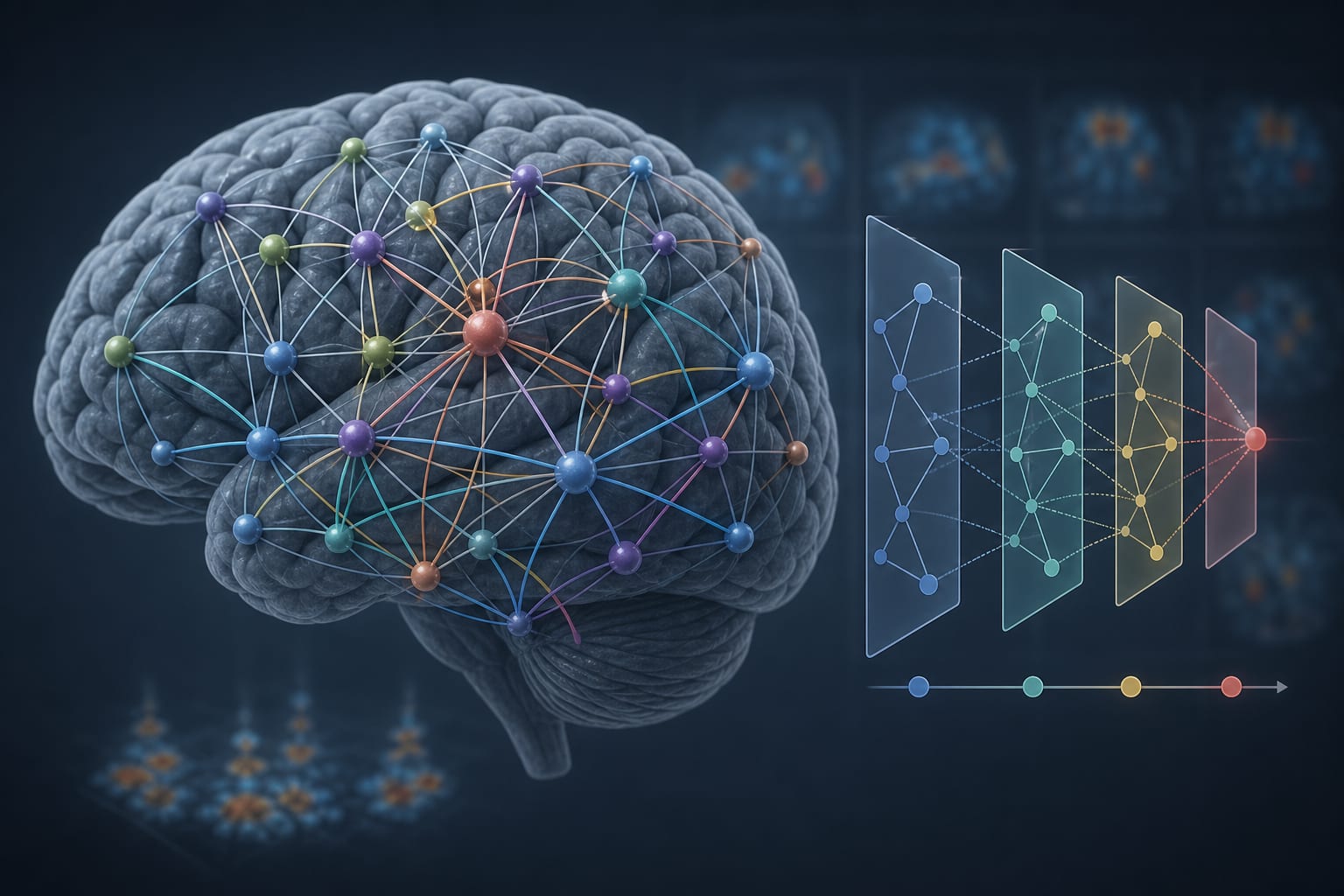
Framework Introduction: The Hierarchical Neighbor Integration Graph Attention Network (HiNIGAT) is introduced to address challenges in existing methods, such as over-smoothing of node representations and limited capture of higher-order brain interactions, by explicitly modeling multi-order interactions in functional brain networks.
Multi-order Attention Mechanism: HiNIGAT employs a multi-order attention mechanism that allows each attention head to specialize in a distinct neighborhood order, effectively capturing brain interactions from local to global structures and improving the model's interpretability.
Key Findings:
HiNIGAT effectively captures multi-order interactions in functional brain networks, as evidenced by improved diagnostic metrics.
Experiments on the ABIDE-I dataset demonstrate the effectiveness of HiNIGAT for ASD diagnosis, achieving higher accuracy compared to traditional methods.
Explicit multi-order integration is crucial for improving diagnostic accuracy in ASD, as shown by comparative analysis.
Interpretation:
The results indicate that incorporating explicit multi-order interactions enhances the model's ability to diagnose ASD effectively.
Limitations:
The study primarily focuses on the ABIDE-I dataset, which may limit generalizability and the applicability of findings to broader populations.
Further validation on diverse datasets is necessary to confirm the robustness of HiNIGAT and its effectiveness across different contexts.
Conclusion:
HiNIGAT presents a significant advancement in the application of graph neural networks for diagnosing ASD by addressing limitations in existing methods.