Impact of preoperative lumbar paraspinal muscle quality on the prognosis of open pedicle screw fixation for thoracolumbar fractures - Summary - MDSpire
Advertisement
Impact of preoperative lumbar paraspinal muscle quality on the prognosis of open pedicle screw fixation for thoracolumbar fractures
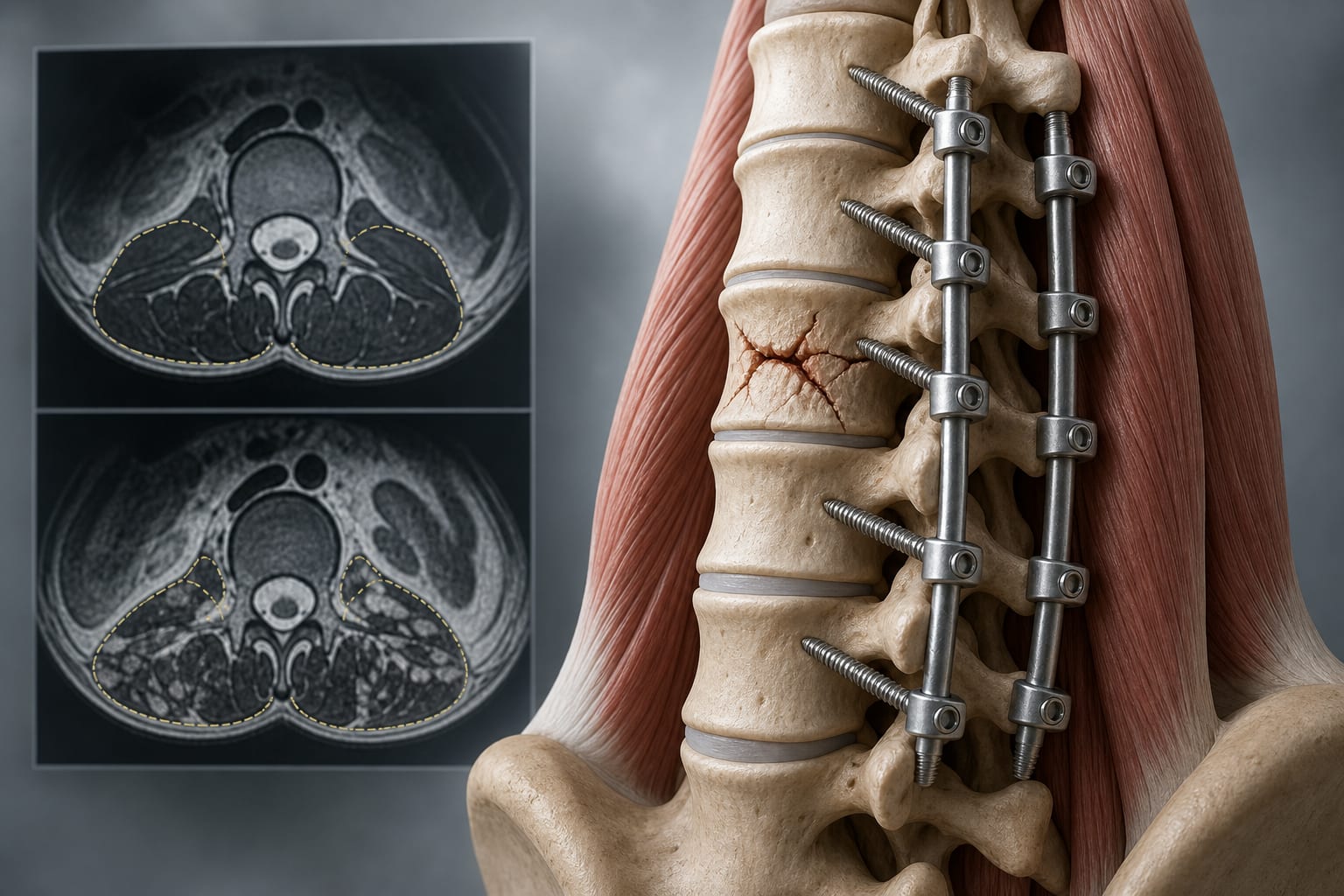
To investigate the association of preoperative paraspinal muscle quality (quantified by fat infiltration) on the clinical and radiographic outcomes following open pedicle screw fixation (OPSF) for thoracolumbar fractures, emphasizing the significance of fat infiltration in muscle quality.
HFG exhibited significantly greater loss of correction in both vertebral body angle (VBA) and regional kyphosis angle (RKA) at the 1-year follow-up (P < 0.05).
No significant differences in Visual Analogue Scale (VAS) and Oswestry Disability Index (ODI) scores at any postoperative time point (P > 0.05).
Complication rates were similar between groups (P > 0.05).
Interpretation:
Preoperative lumbar paraspinal muscle quality is significantly associated with the long-term maintenance of radiographic correction after OPSF, particularly in unstable fracture patterns, highlighting its implications for surgical planning.
Limitations:
Retrospective study design may introduce selection bias.
Small sample size limits generalizability of findings.
Lack of long-term follow-up beyond 1 year.
Potential confounding factors not addressed.
Conclusion:
Assessment of paraspinal muscle quality could serve as a valuable prognostic tool for surgical planning and patient counseling, reinforcing the importance of these findings in improving surgical outcomes.