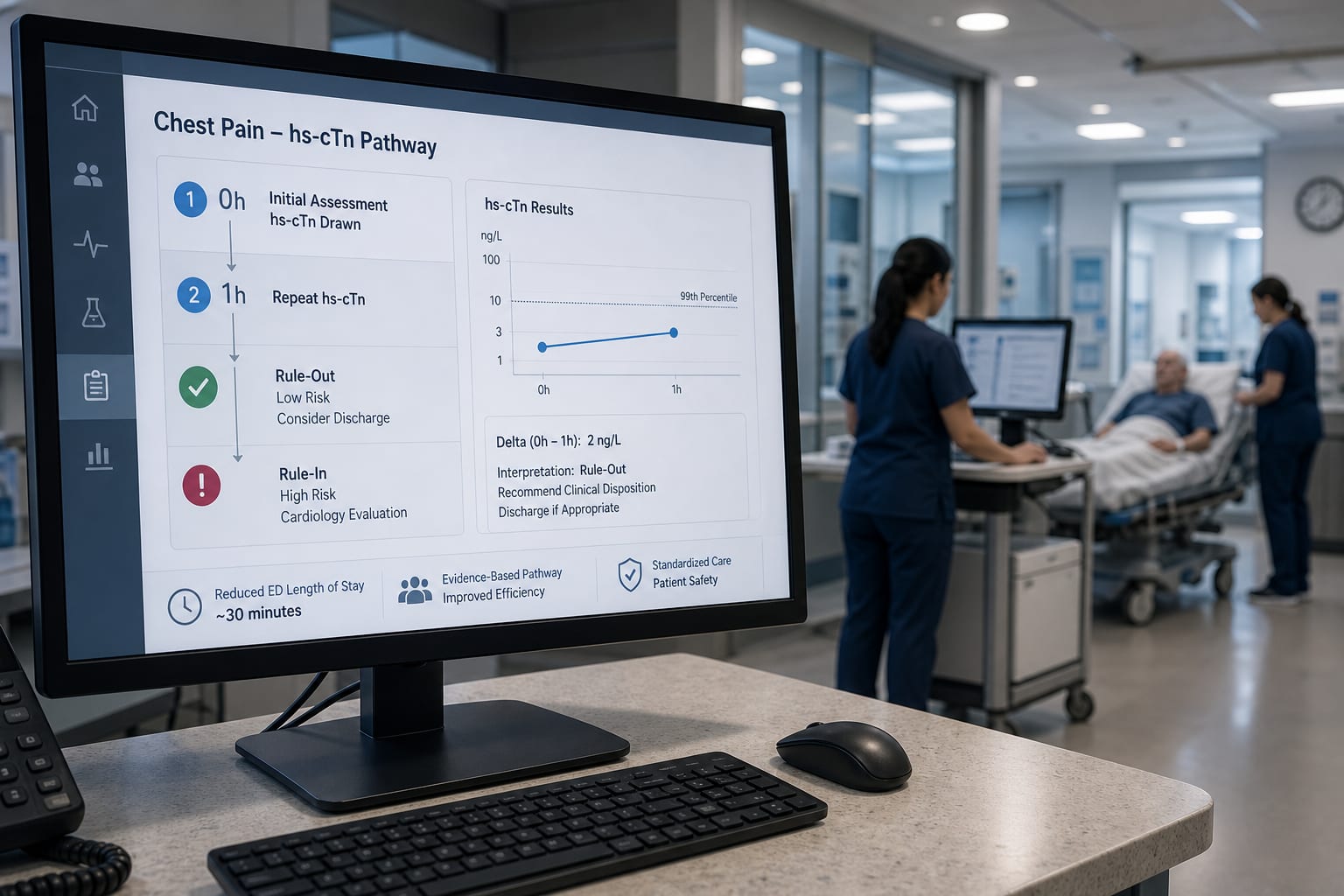
The article examines the objective, findings, and clinical context described in Implementing High-Sensitivity Cardiac Troponin Testing Pathways.
Approach:
Intervention: Jia et al. evaluated an EHR-integrated hs-cTn pathway across four urban EDs, including conditional release of serial orders, shared displays of pathway status and timing, and a final evaluation interpretation.
Context: The article compares the findings with prior studies of hs-cTn implementation and discusses diagnostic, operational, and patient-outcome considerations.
Key Findings:
Implementation was associated with an approximately 30-minute reduction in ED length of stay among patients with chest pain who underwent troponin testing; the largest reductions occurred among patients requiring serial assays.
Prior studies reported ED length-of-stay changes ranging from a 60-minute decrease to a 10-minute increase, suggesting that assay speed alone does not ensure faster care.
The hs-cTn period involved more frequent serial troponin measurement and more 30-day acute myocardial infarction diagnoses, but no corresponding increase in 30-day percutaneous coronary intervention or ED cardiology consultation.
The article cites a prior study estimating that ED length-of-stay reductions associated with an hs-cTn pathway could allow 1,600 additional ED visits across a three-hospital system.
Interpretation:
The authors characterize the findings as evidence that a thoughtfully designed, multifaceted, EHR-integrated hs-cTn pathway may reduce ED length of stay. They note that the clinical value of additional diagnoses and testing depends on downstream care and patient outcomes, which were not established by the reported efficiency findings.
Limitations:
Because hs-cTn adoption was part of a multifaceted intervention, the effects of the assay, pathway, EHR automation, and workflow redesign could not be separated.
The pre-post design is vulnerable to unmeasured influences and secular trends.
Findings from four EDs in one health system may not generalize to other settings.
The study design did not assess missed AMI, readmissions, or mortality; 30-day PCI and ED cardiology consultation captured only part of downstream care.
Conclusion:
The article argues that evaluation of hs-cTn pathways should consider ED efficiency alongside downstream testing, care, and patient outcomes.
November 3, 2026 | Gennaro Giustino, MD, structural interventional cardiologist at Atlantic Health, describes the UNICORN technique as a strategy used selectively in patients whose anatomy raises concern.