Automated Evans index measurement using deep learning in acute subarachnoid hemorrhage: reliability, agreement with experts, and association with external ventricular drainage - Summary - MDSpire
Advertisement
Automated Evans index measurement using deep learning in acute subarachnoid hemorrhage: reliability, agreement with experts, and association with external ventricular drainage
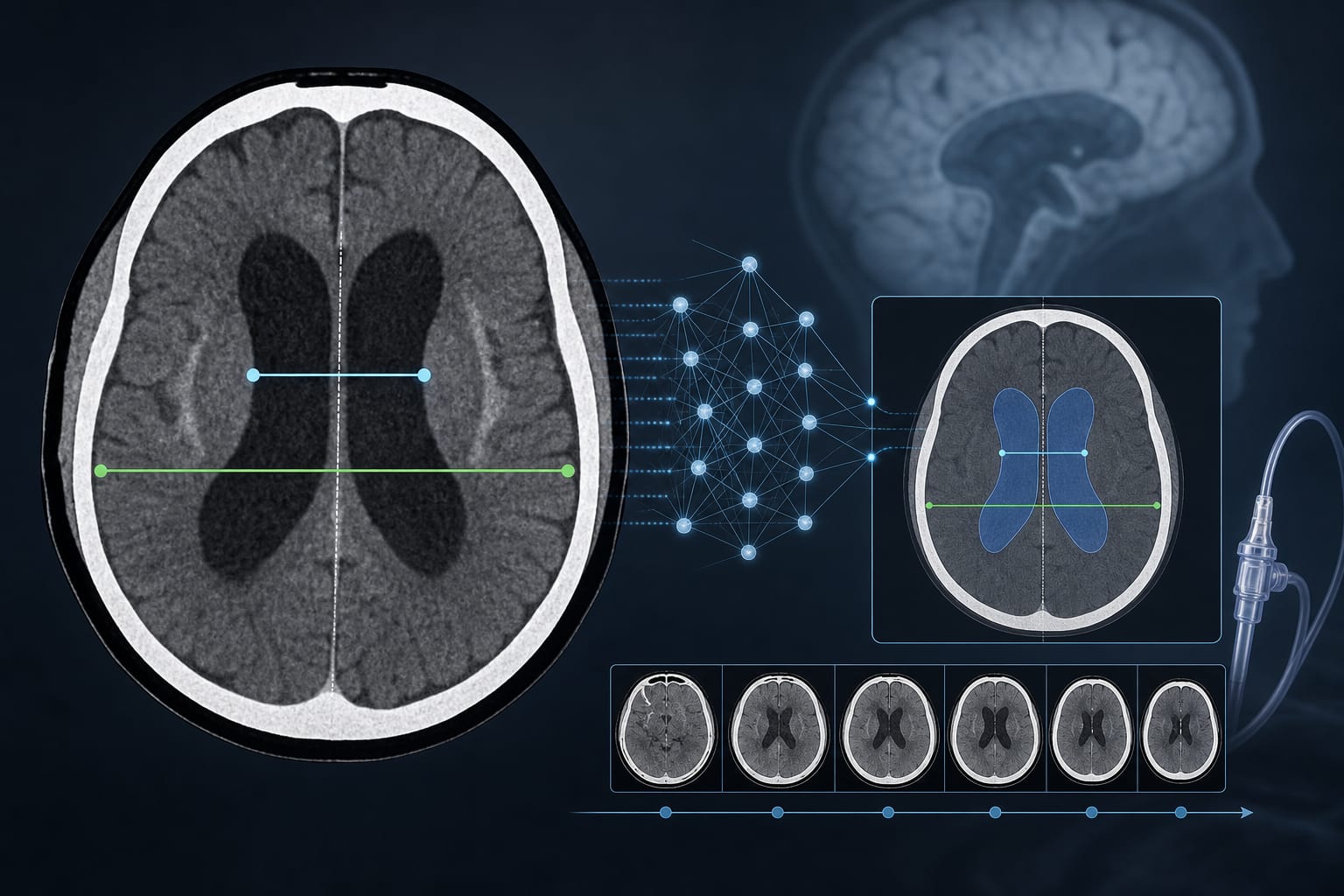
To evaluate the reliability and agreement of automated Evans index (EI) measurement using TotalSegmentator (TS) in patients with acute subarachnoid hemorrhage (SAH) and its correlation with clinical decision-making regarding external ventricular drainage (EVD).
Approach:
Key Findings:
TS demonstrated excellent reproducibility (ICC = 0.996, 95% CI 0.996–0.997).
High agreement between expert readers (ICC = 0.983, 95% CI 0.978–0.988).
Good agreement between TS and expert EI measurements (ICC = 0.76, 95% CI 0.73–0.81), improving to (ICC = 0.87, 95% CI 0.85–0.89) after excluding frontal horn hematoma.
TS identified more positive EI > 0.30 cases than expert assessment (29% vs. 17%).
TS-derived EI showed discrimination for EVD placement (AUC = 0.75, 95% CI 0.73–0.79), approaching expert-derived EI (AUC = 0.80, 95% CI 0.78–0.83).
TS-derived EI remained independently associated with EVD placement (adjusted OR = 1.09, 95% CI 1.03–1.17).
Interpretation:
Automated EI measurement using TS provides a reproducible assessment of ventricular enlargement in acute SAH, with agreement with expert assessments.
Limitations:
Threshold-sensitive disagreement occurred near EI = 0.30.
The study was conducted at a single center, which may limit generalizability.
Exclusion of certain cases (frontal horn hematoma) may affect the applicability of findings.
Conclusion:
Automated EI measurement using TS is a reliable tool for assessing ventricular enlargement in acute SAH and correlates with clinical decision-making regarding EVD placement.