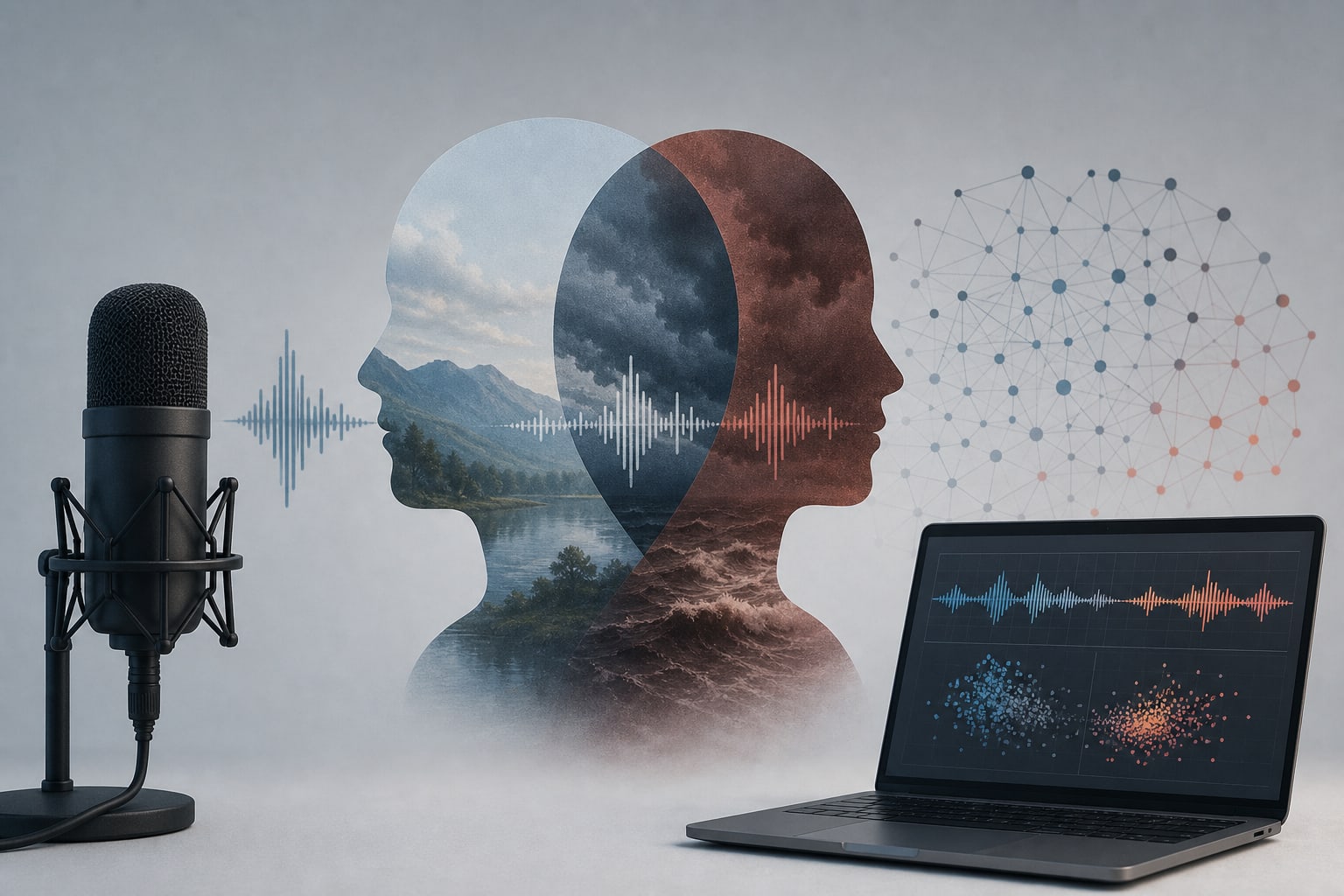
To investigate whether short spontaneous speech can provide a complementary, low-burden screening signal for anxiety in telehealth or repeated-monitoring settings.
Key Findings:
The proposed pipeline achieved 70% accuracy and 0.67 macro-F1 across leave-one-out folds.
Performance was stronger for non-anxious participants compared to anxious participants.
Bootstrap confidence intervals were 0.62–0.77 for accuracy and 0.59–0.75 for macro-F1.
The full composite representation provided the best balanced performance and strongest anxious-class detection.
The method outperformed BERT-based and lexicon-based baseline models.
Interpretation:
Limitations:
Anxious-class sensitivity was moderate.
HAM-A labels should be interpreted as screening rather than diagnostic labels.