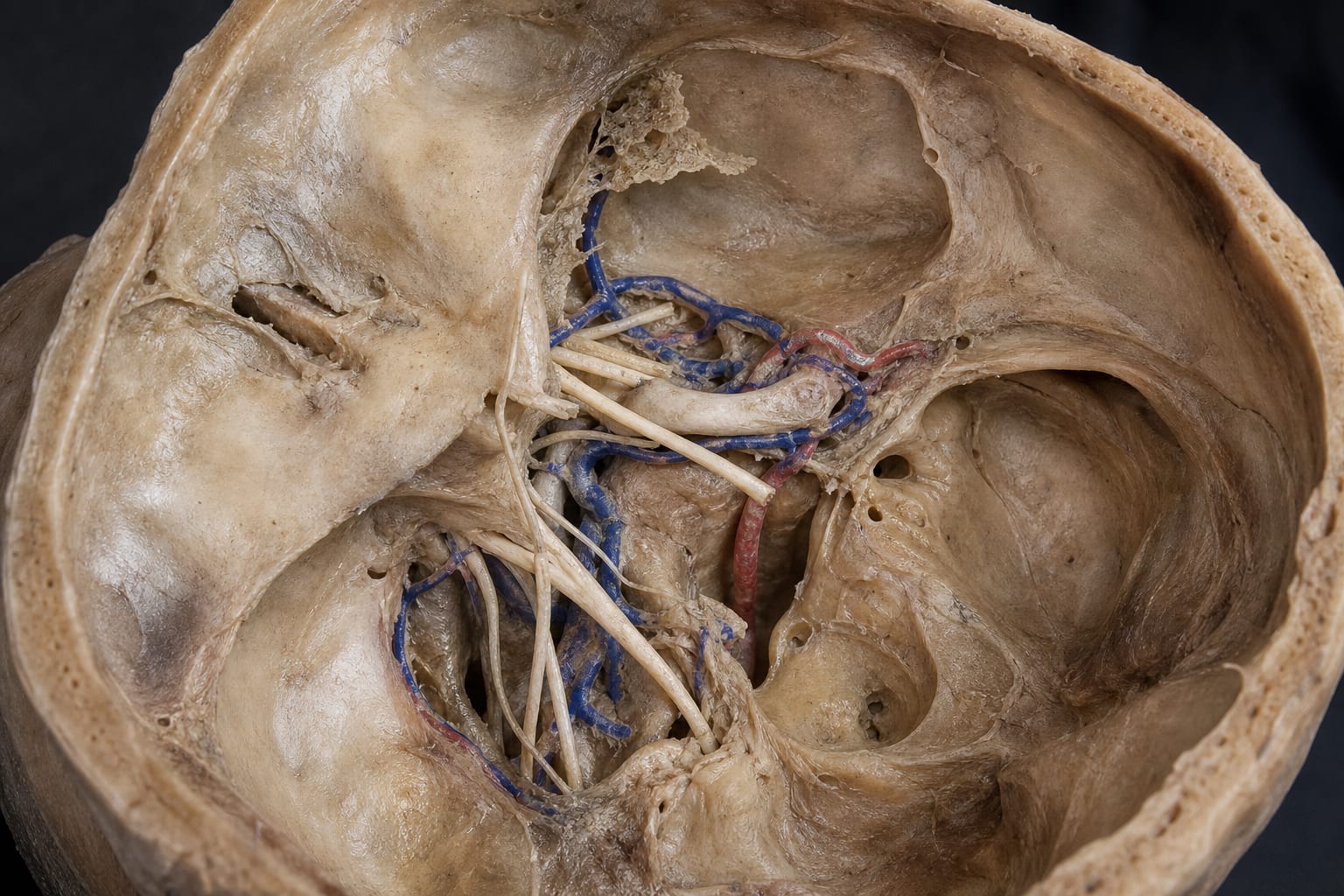
To provide a comprehensive morphometric description of the microsurgical anatomy of the middle cranial fossa through the anterior petrosal (Kawase) approach based on bilateral cadaveric dissections.
Approach:
Key Findings:
The greater superficial petrosal nerve (GSPN), trigeminal ganglion, cochlea, internal auditory canal (IAC), superior semicircular canal, and petrous internal carotid artery were consistently identified in all specimens.
Mean GSPN length was 10.66 ± 2.44 mm.
Mean distance from foramen spinosum to zygomatic root was 29.68 ± 1.97 mm.
Mean distance between foramen ovale and foramen rotundum was 11.70 ± 2.44 mm.
Mean distances to the geniculate ganglion and internal carotid artery genu were 3.39 ± 0.98 mm and 4.56 ± 1.29 mm, respectively.
Mean angles between GSPN and arcuate eminence, GSPN and superior semicircular canal, and IAC and superior semicircular canal were 121.82 ± 15.38°, 104.07 ± 13.25°, and 45.42 ± 12.09° respectively.
Overall bilateral symmetry was observed across most parameters, with a significant side-to-side difference in the IAC–SSC angle.
Interpretation:
The study provides a bilateral morphometric characterization of the middle cranial fossa via the anterior petrosal approach in a Vietnamese population, confirming the identification of key anatomical landmarks and their spatial relationships.
Limitations:
The study is limited to a specific population (Vietnamese), which may not generalize to other ethnic groups.
The sample size of 21 cadaveric heads may limit the robustness of the findings.
Conclusion:
The findings provide anatomical data specific to the population studied.