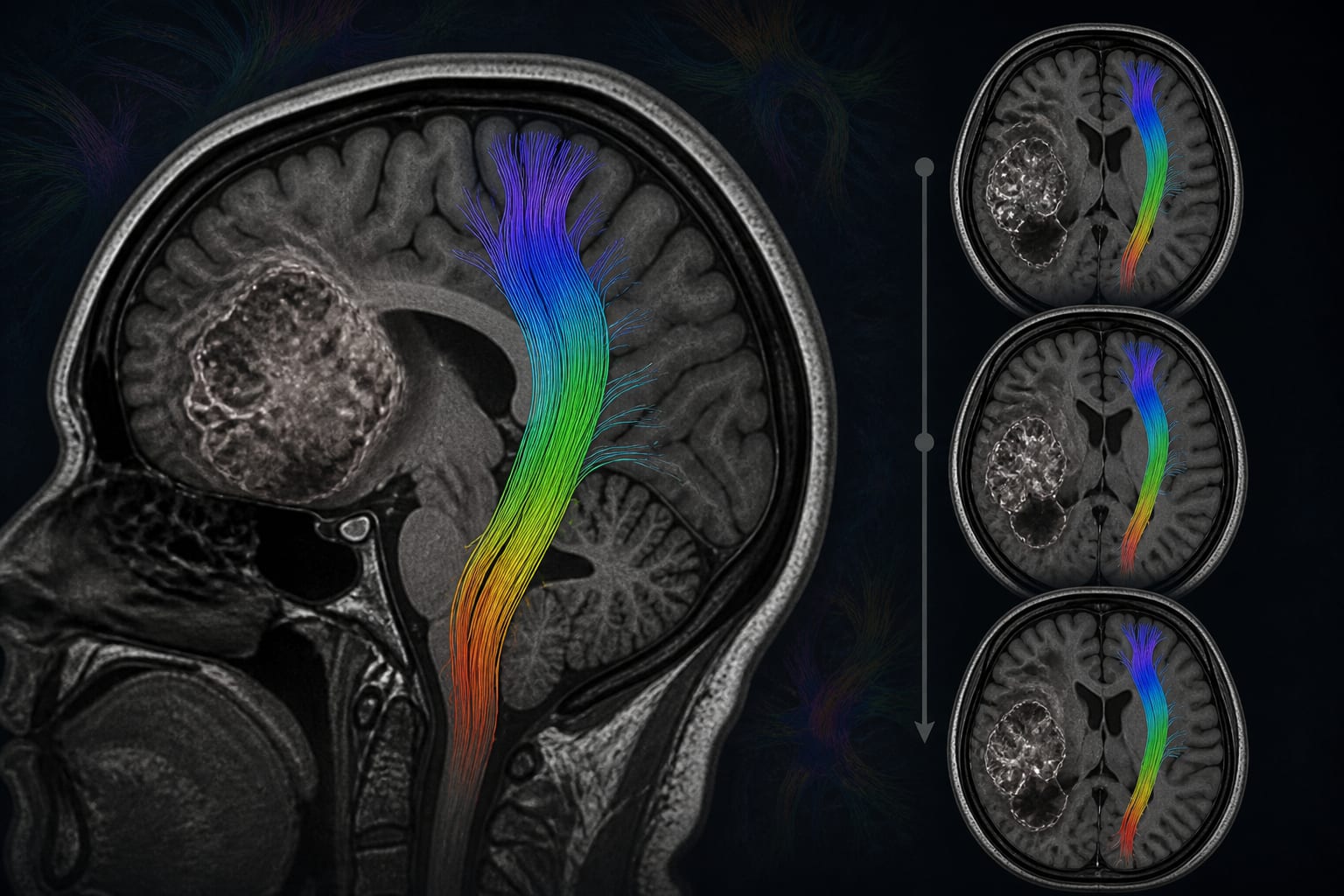
Longitudinal spatial changes of the contralesional corticospinal tract in high-grade glioma: a within-patient DTI tractography study - Summary - MDSpire
To assess within-patient changes in the contralesional corticospinal tract (CST) between primary and recurrent frontal high-grade glioma, including tract-averaged measures and spatial distribution.
Approach:
Design and cohort: Retrospective, single-center study of 29 adults with frontal high-grade glioma, documented first recurrence, preoperative DTI at both assessments, and MRC strength of 5/5 at both time points.
Tract reconstruction: Deterministic DTI tractography reconstructed the contralesional CST using the same anatomically guided protocol at both assessments. Tract-averaged fractional anisotropy, length, and volume were recorded.
Spatial analysis: CST masks were normalized to MNI152 space, harmonized for laterality, and compared within patients using slice-wise and voxel-wise spatial analyses.
Key Findings:
The supplied article context describes the study design and methods but does not provide results or numerical findings.
Interpretation:
The study was designed to test whether the contralesional CST changes between primary and recurrent disease; the provided context does not report the results needed to interpret that question.
Limitations:
The study was retrospective and single-center.
The cohort was restricted to adults with frontal high-grade glioma, preserved MRC strength, and successful CST reconstruction at both assessments.
The reconstructed pathway represented the tractography-defined motor component of the CST, not the complete anatomical CST.
The supplied excerpt does not report study results.
by Bingzhen Li, Raimunde Liang, Ghaith Altawalbeh, Lisa Hoenikl, Eugen Ursu, Axel Schroeder, Haosu Zhang, Philipp Karschnia, Chiara Negwer, Bernhard Meyer, Arthur Wagner
Breast cancer management is becoming increasingly biology-driven, with treatment decisions extending well beyond anatomic stage and conventional receptor classification.