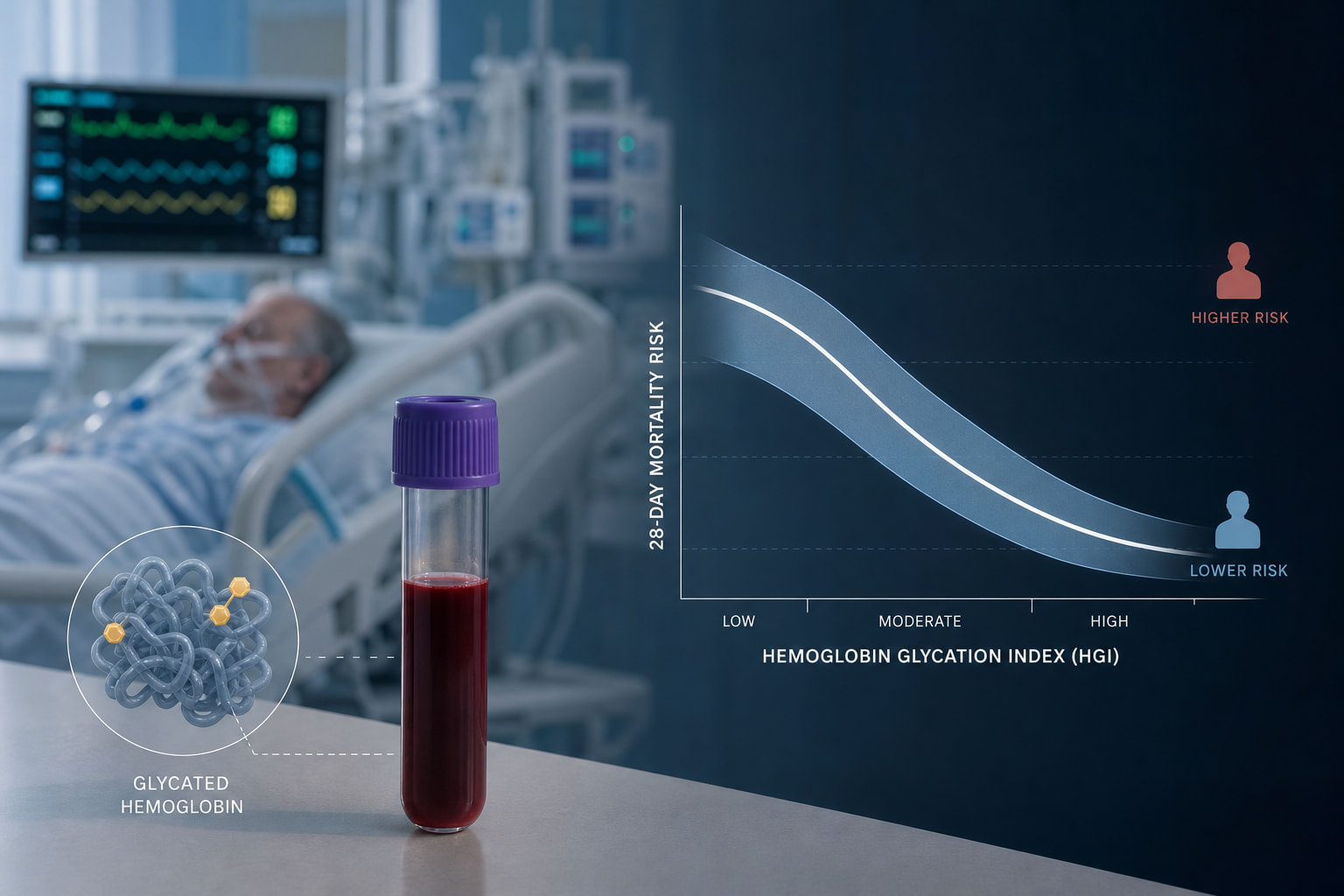
To investigate the association between hemoglobin glycation index (HGI) and short-term mortality in patients with sepsis and validate these findings in an external cohort.
Approach:
Study Design: Retrospective cohort study using the MIMIC-IV database with an external validation cohort.
Population: Included adult ICU patients with sepsis identified by Sepsis-3 criteria.
Outcome Measures: Primary outcome was 28-day mortality; HGI was calculated as the difference between observed and predicted HbA1c based on admission glucose.
Key Findings:
28-day mortality rate was 23.25% in the primary cohort.
Non-survivors had significantly lower HGI levels than survivors (p < 0.001).
Patients in the highest HGI quartile had a lower risk of 28-day mortality (HR 0.70, 95% CI 0.52–0.94, p = 0.018).
Similar trends were observed for 60-day mortality (HR 0.76, 95% CI 0.58–1.00, p = 0.050) and 90-day mortality (HR 0.80, 95% CI 0.62–1.04, p = 0.101).
External validation cohort supported the association of higher HGI with reduced 28-day mortality.
Interpretation:
The study found an association between higher HGI and lower short-term mortality in critically ill patients with sepsis, particularly for 28-day mortality.
Limitations:
Retrospective design may introduce bias.
Findings need prospective validation to determine clinical utility.
Conclusion:
The study suggests that HGI may provide information relevant to the early phase of sepsis.