Fixation height has a greater biomechanical effect than anterior tilt angle in syndesmotic fixation for weber B ankle fractures: a specific finite element study - Summary - MDSpire
Conexiant’s news site is now MDSpire News. Learn more
Advertisement
The Impact of Fixation Height Versus Anterior Tilt Angle on Biomechanics in Syndesmotic Fixation for Weber B Ankle Fractures: A Finite Element Analysis
To compare the biomechanical effects of different fixation heights and anterior tilt angles in syndesmotic fixation for Weber B ankle fractures using a finite element model.
Approach:
Model Development: A 3D finite element ankle model was created from CT/MRI data of a healthy adult, simulating residual instability by transecting ligaments after anatomical reduction and fixation.
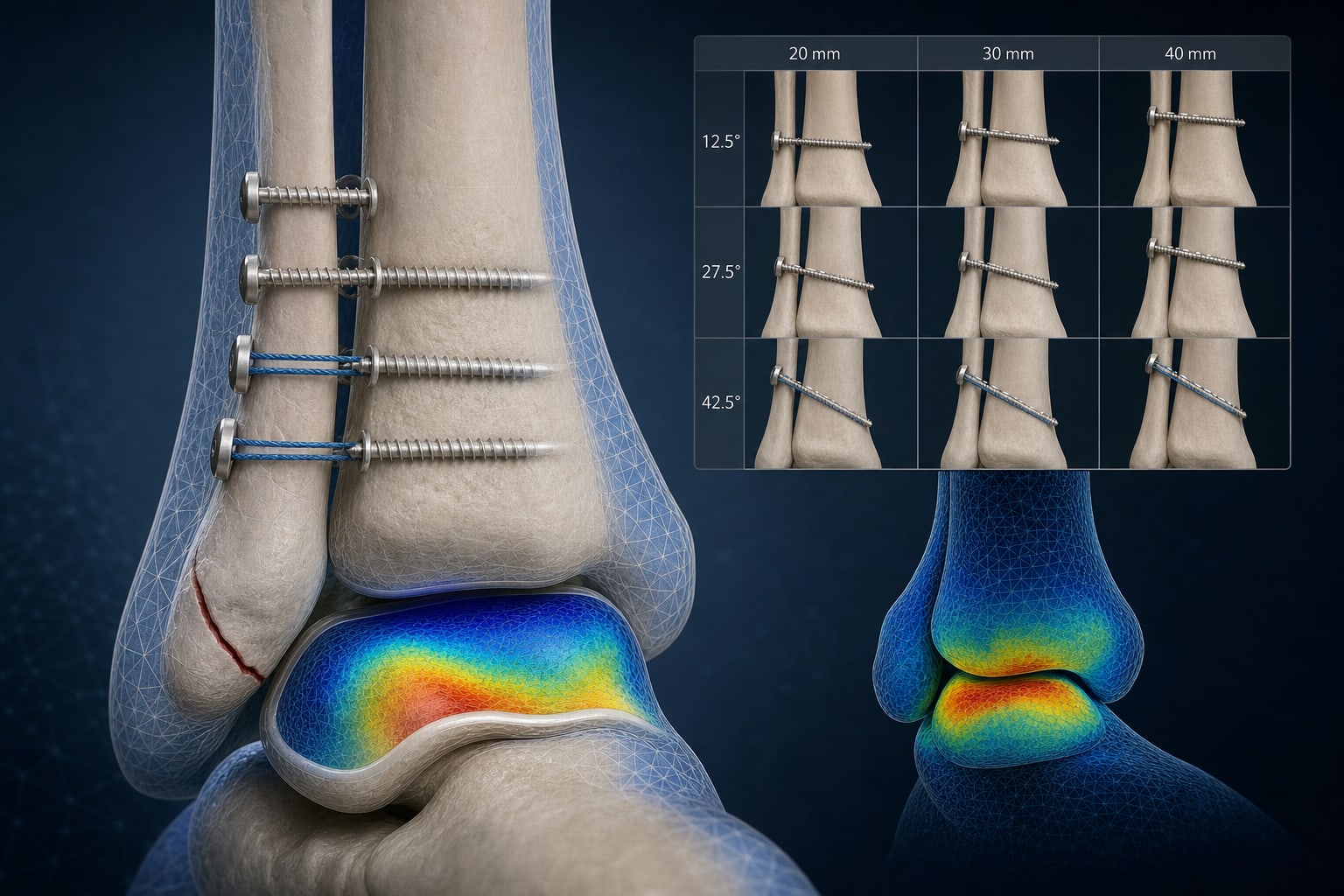
Fixation Models: Eighteen fixation models were created using tricortical screws or suture-buttons, placed at heights of 20, 30, or 40 mm above the tibial plafond with anterior tilt angles of 12.5°, 27.5°, or 42.5°.
Outcome Measures: Outcomes included peak tibiotalar contact stress, fibular displacement, and peak implant von Mises stress under axial loading and external rotation.
Key Findings:
Residual instability increased peak tibiotalar contact stress by 36.8% and fibular translation.
Fixation at 20–30 mm restored near-physiologic mechanics, while 40 mm fixation showed biomechanical deterioration.
Tricortical screws better restrained fibular translation compared to suture-buttons, which preserved more micromotion but had higher implant stress concentrations.
Interpretation:
Fixation height had a larger biomechanical effect than anterior tilt angle, with optimal fixation recommended at 20–30 mm above the tibial plafond.
Limitations:
The study was based on a single-subject model, limiting generalizability.
Material properties and loading conditions were derived from literature rather than measured from the individual.
Conclusion:
The study found that fixation height had a larger biomechanical effect than anterior tilt angle.