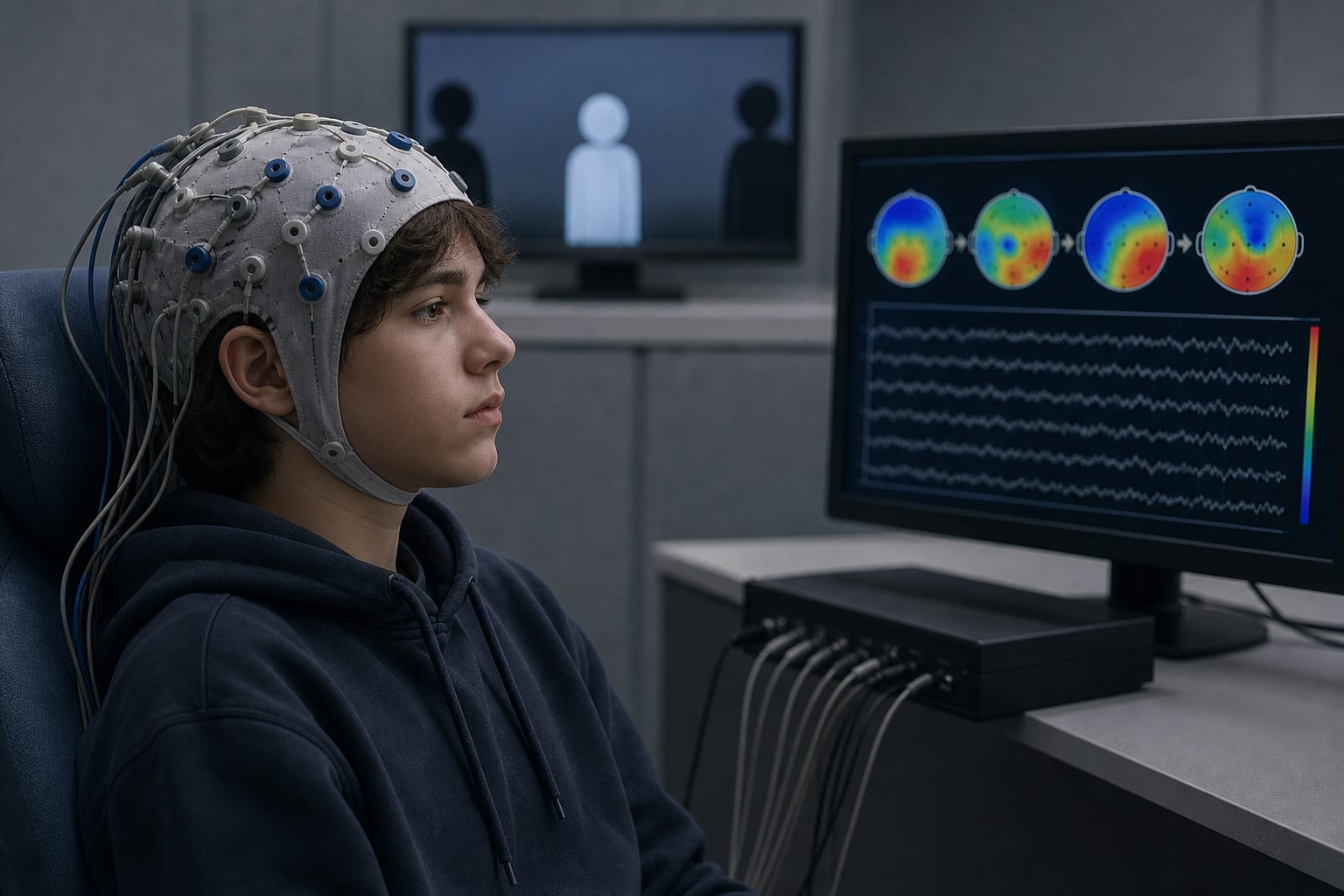
To characterize resting-state EEG microstate dynamics in adolescents with non-suicidal self-injury (NSSI) and examine state-dependent changes following acute social exclusion.
Approach:
Study Design: Resting-state EEG was recorded in hospitalized, medicated adolescents with NSSI and healthy controls (HCs).
Experimental Conditions: An NSSI subgroup completed EEG assessments before and after either Cyberball-induced social exclusion or a non-stress control condition.
Data Analysis: Microstate parameters and transition probabilities were analyzed.
Key Findings:
Reduced microstate A duration in the NSSI group compared to HCs after multiple-comparison correction.
Shorter durations of microstates B and F, higher occurrence of microstate D, and increased F→D transition probability in exploratory analyses.
Within the NSSI group, the exclusion condition showed reduced microstate A and increased microstate D expression.
Interpretation:
Resting-state microstate dynamics in adolescents with NSSI differ from HCs, particularly in microstate A duration, and reorganize after social exclusion.
Limitations:
Absence of an MDD-only clinical-control group.
Lack of healthy Cyberball comparison.
Modest sample size limits generalizability.
Conclusion:
Preliminary findings indicate distinct microstate dynamics in NSSI adolescents.
From Medicare payment updates to drug approvals and device access, these federal actions may affect reimbursement, prescribing, patient access, and clinical workflows.