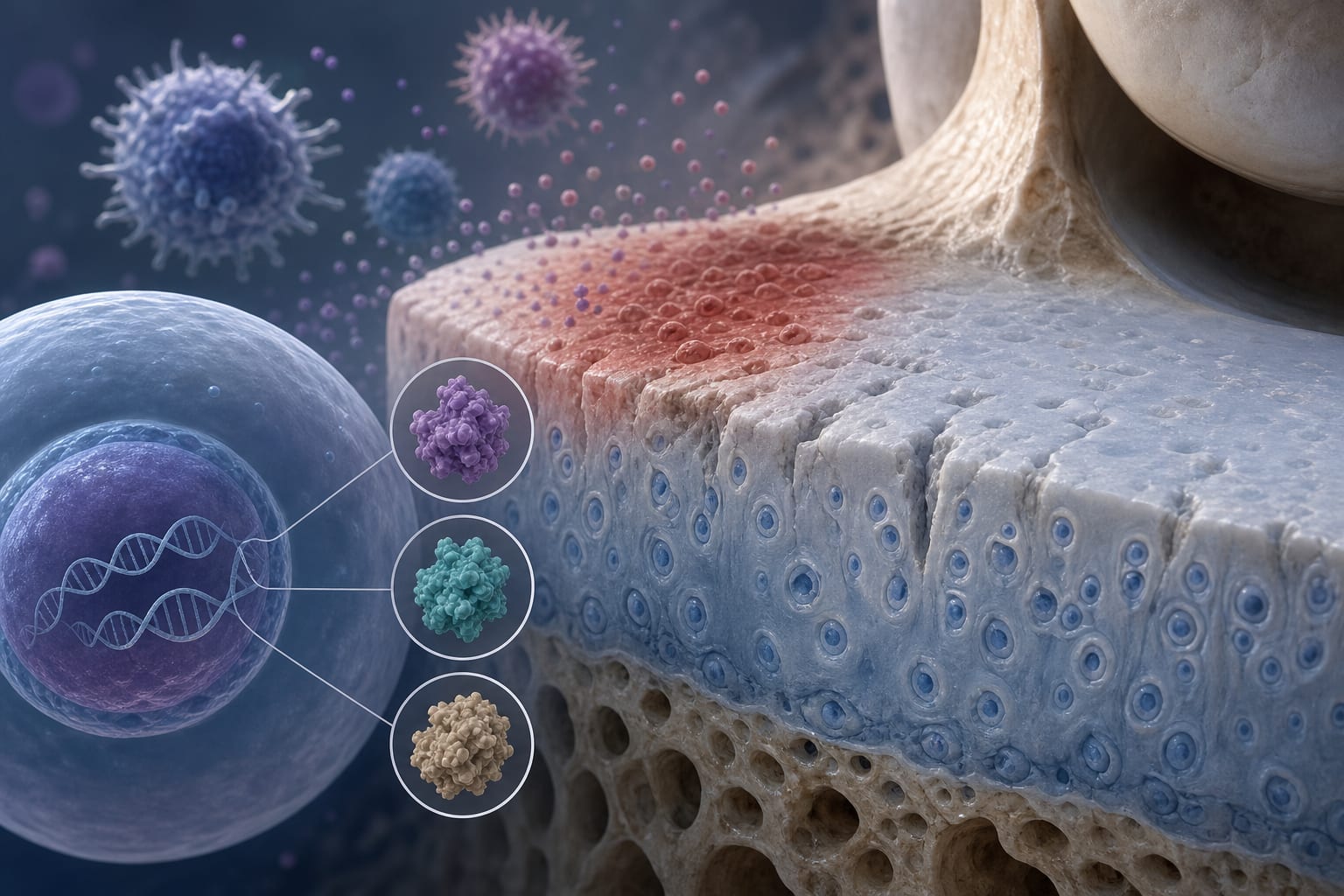
To identify Hb-associated transcriptomic biomarkers in osteoarthritis (OA) cartilage and characterize their associations with immune-related transcriptomic features.
Approach:
Data Integration: Human cartilage transcriptomic datasets were integrated from Gene Expression Omnibus (GEO) to construct a harmonized training cohort, with independent datasets used for external validation.
Gene Analysis: Weighted gene co-expression network analysis and machine-learning approaches were applied to identify hub Hb-associated OA genes.
Nomogram Construction: A multivariable logistic-regression nomogram was constructed and evaluated by receiver operating characteristic analysis.
Immune Profiling: Immune pathway activity and immune-cell-associated transcriptomic signatures were inferred using GSVA, CIBERSORT, and ssGSEA.
Experimental Validation: qRT-PCR was performed in an IL-1β-stimulated inflammatory chondrocyte model to validate findings.
Key Findings:
Three Hb-associated hub genes—LOXL1, THY1, and TYMS—were identified and consistently upregulated in OA cartilage across training and independent validation cohorts.
Immune profiling suggested an immune-activated transcriptomic state in OA cartilage, characterized by increased macrophage-associated signals and elevated activated immune cell signatures.
Expression of Hb-associated hub genes showed strong positive correlations with macrophage- and activated T-cell-related signatures.
Interpretation:
The study identifies LOXL1, THY1, and TYMS as Hb-associated transcriptomic biomarkers in OA cartilage.
Limitations:
The study relies on transcriptomic data from GEO, which may have inherent biases.
Experimental validation was limited to a specific inflammatory chondrocyte model.
Conclusion:
LOXL1, THY1, and TYMS are identified as Hb-associated biomarkers in OA cartilage.
In a small open-label randomized trial, 2 platelet-rich plasma injections were associated with greater 6-month improvements in pain and function than corticosteroid injection or oral aceclofenac among patients awaiting knee arthroplasty.
Systematic review found robotic-assisted total hip arthroplasty improved implant positioning precision without demonstrating better patient-reported outcomes or lower complication rates than conventional surgery.