Implications of different SOFA score variants for outcome prediction in emergency department patients with an infection: a multicenter cohort study - Summary - MDSpire
To compare the original Sequential Organ Failure Assessment (SOFA) score with 6 variants for predicting in-hospital mortality and/or intensive care unit (ICU) admission among emergency department (ED) patients with confirmed infection.
Approach:
Design and setting: Post hoc multicenter analysis of 3 prospective cohorts assembled at 2 academic hospitals in the Netherlands.
Eligibility and data: Adults have physician-confirmed infection and qualifying culture sampling and antibiotic administration within prespecified intervals. Clinical and laboratory data cover ED presentation through the first 24 hours.
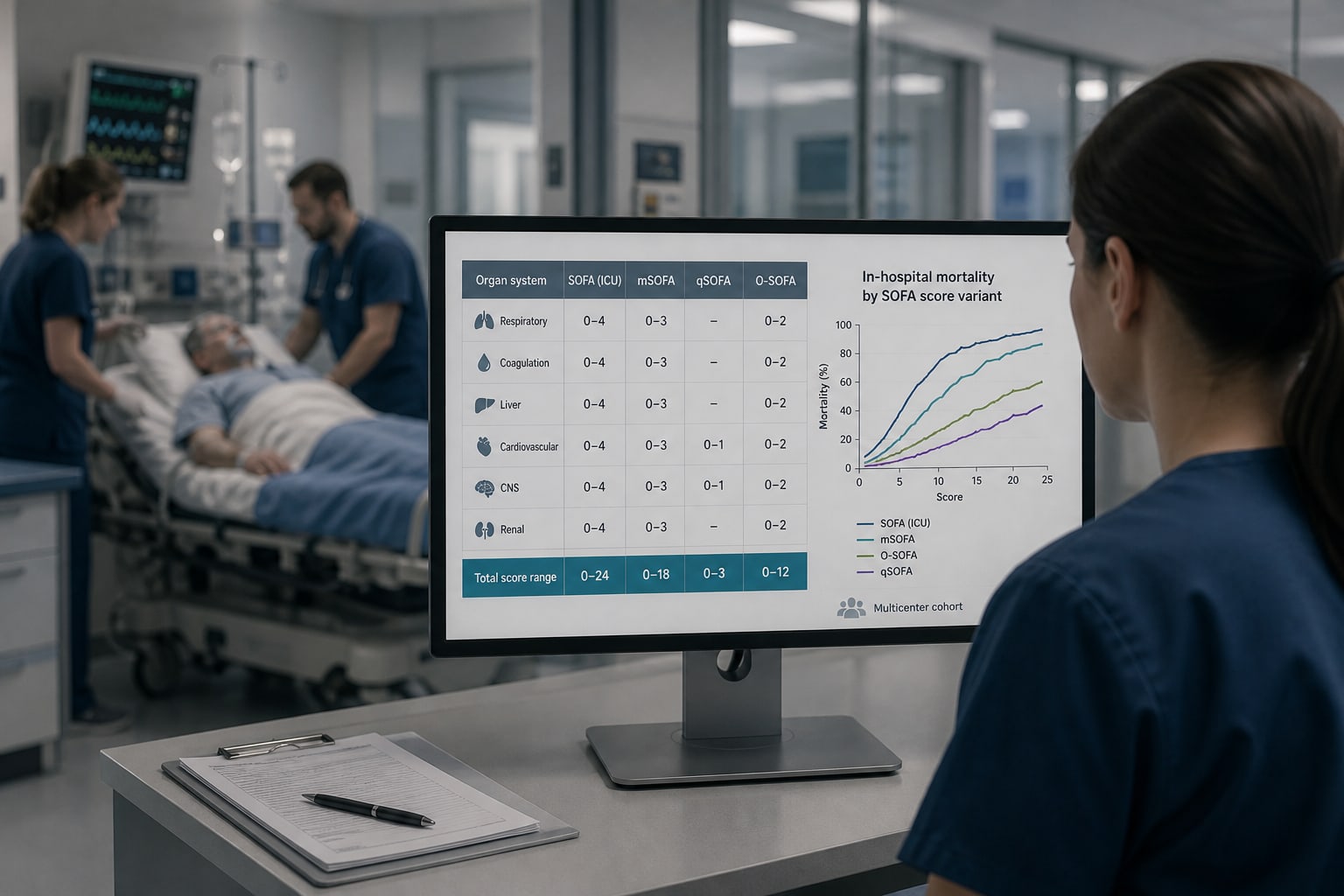
Score comparison: Original SOFA, AW-SOFA, SF-SOFA, MICE-SOFA, ΔSOFA, mSOFA, and eSOFA are evaluated. Scores generally use the worst values within 24 hours. Urine output is excluded where applicable, and any norepinephrine use receives 4 points in the primary analysis because dose recordings are unavailable.
Among 2036 patients, 348 (17%) experience the composite outcome; 236 (12%) are admitted to the ICU, and 178 (9%) die in hospital.
Discrimination is broadly similar across most variants. Areas under the receiver operating characteristic curve are 0.80 for original SOFA, 0.79 for AW-SOFA, 0.80 for SF-SOFA, 0.80 for ΔSOFA, and 0.82 for mSOFA.
MICE-SOFA and eSOFA have lower discrimination, with areas under the curve of 0.76 and 0.74, respectively.
At the evaluated thresholds, mSOFA ≥8 has high specificity (99.82%) but low sensitivity (22.99%), illustrating how threshold selection changes patient classification.
Accounting for differences between cohorts leaves discrimination materially unchanged.
Interpretation:
Missing-data handling, baseline correction, and threshold selection mainly influence feasibility and the severity profile of classified patients rather than substantially improving overall discrimination. Simplified variants may offer practical advantages when laboratory data are limited.
Limitations:
Cohorts differ in eligibility, baseline severity, and data completeness and are enriched for high-acuity illness or sepsis.
Baseline organ-function estimates rely on hospital records and exclude community laboratory data.
Missing-data assumptions and incomplete treatment records affect score implementation.
Both hospitals are high-resource Dutch academic centers, limiting generalizability.
Conclusion:
Most evaluated SOFA variants show broadly comparable discrimination for severe outcomes. Transparent reporting and selection suited to the clinical setting are important; variants requiring baseline organ-function data may be less feasible in acute care.
by Tamar J. van der Aart, Carolina Hincapié-Osorno, Isaac Santiago Arango-Gil, Konstantin Föhse, Jacobien J Hoogerwerf, Fabián Jaimes, Jacqueline Koeze, Marco van Londen, Jan C. ter Maaten, Jaap ten Oever, Renée A.M. Tuinte, Carlos E. Vallejo, Raymond J. van Wijk, Hjalmar R. Bouma, Douwe F. Postma