Association between neutrophil percentage-to-albumin ratio and bone mineral density and prevalent osteoporosis in patients with type 2 diabetes mellitus - Summary - MDSpire
Conexiant’s news site is now MDSpire News. Learn more
Advertisement
Relationship of Neutrophil Percentage-to-Albumin Ratio with Bone Mineral Density and Osteoporosis Prevalence in Individuals with Type 2 Diabetes Mellitus
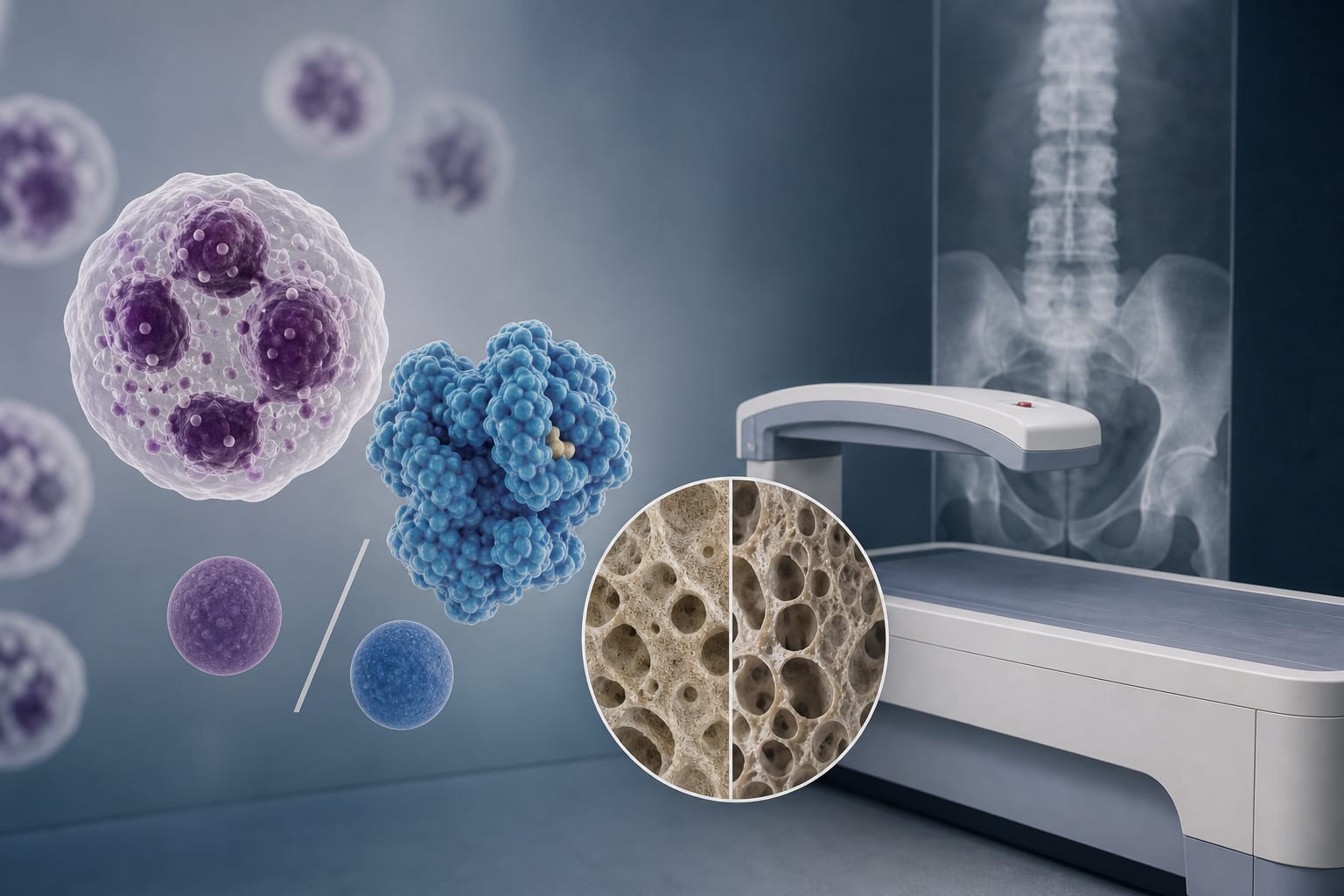
To investigate the association between neutrophil percentage-to-albumin ratio (NPAR) and bone mineral density (BMD), as well as prevalent osteoporosis, in patients with type 2 diabetes mellitus (T2DM).
Approach:
Study Design: A retrospective cross-sectional study including 259 patients with T2DM, assessing osteoporosis via WHO criteria and BMD through dual-energy X-ray absorptiometry.
Statistical Analysis: Logistic regression for osteoporosis association, linear regression for BMD relationship, and receiver operating characteristic analysis for discriminative capacity.
Key Findings:
NPAR levels were higher in the osteoporosis group (P = 0.004).
NPAR was independently associated with osteoporosis (OR = 3.42, 95% CI: 1.10-10.64, P = 0.034).
NPAR was negatively associated with femoral neck BMD (b = -0.08, 95% CI: -0.14 to -0.02, P = 0.009) and total hip BMD (b = -0.08, 95% CI: -0.14 to -0.01, P = 0.020).
The AUC for NPAR's discriminative capacity for osteoporosis was 0.62 (95% CI: 0.54-0.71, P = 0.004).
Interpretation:
NPAR may provide supplementary information regarding prevalent osteoporosis in patients with T2DM, but should not be used as an independent screening marker.
Limitations:
Retrospective design may introduce bias.
Single-center study limits generalizability.
NPAR's modest discriminative ability suggests it should be used alongside other clinical indicators.
Conclusion:
NPAR is associated with osteoporosis and BMD in T2DM patients, but its clinical utility is limited without consideration of additional factors.