Phacoemulsification with goniosynechialysis for nanophthalmos with secondary angle-closure or secondary angle-closure glaucoma: a 20-case series and stepwise management strategy - Summary - MDSpire
Conexiant’s news site is now MDSpire News. Learn more
Advertisement
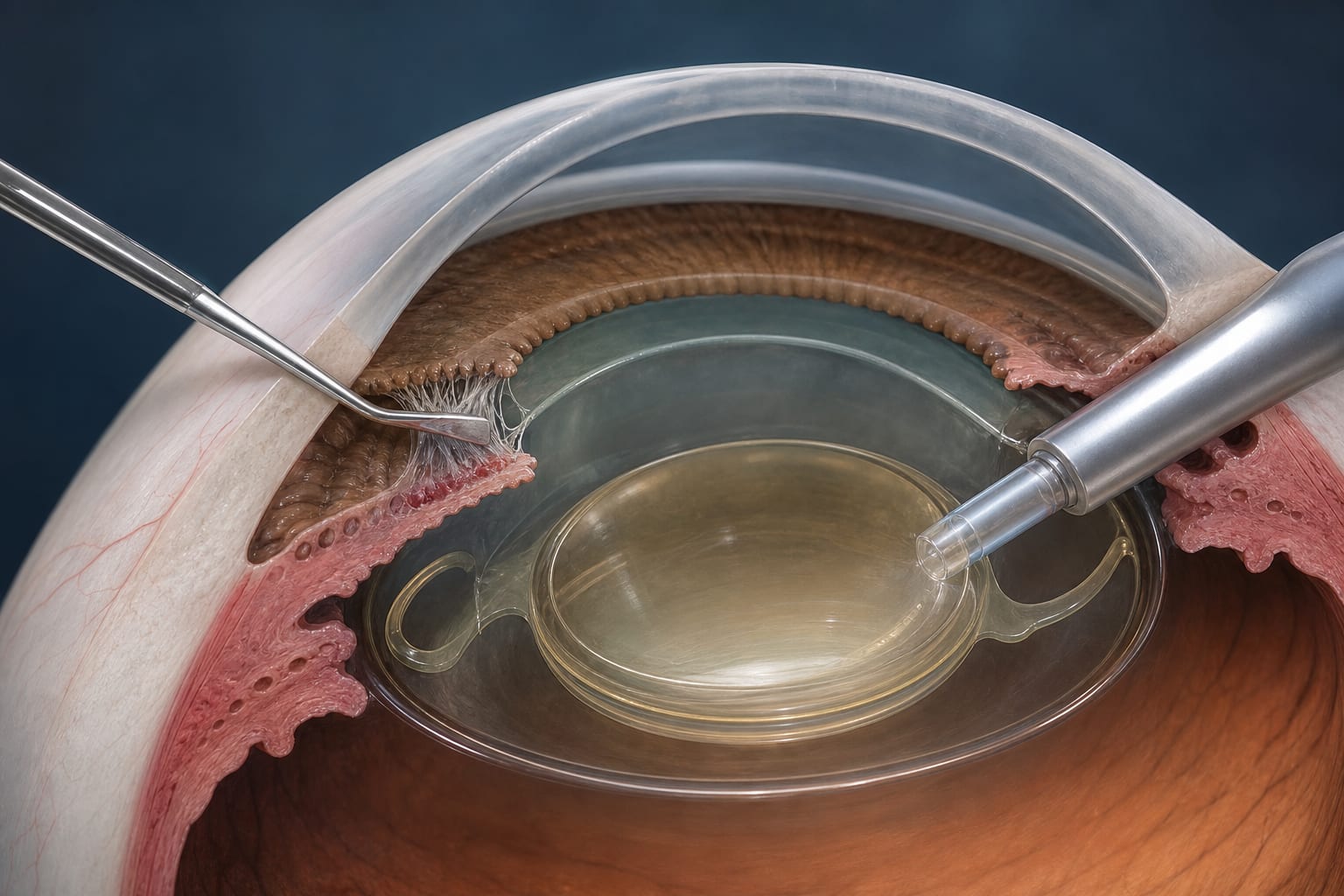
Goniosynechialysis Combined with Phacoemulsification for Managing Nanophthalmos Complicated by Secondary Angle-Closure or Angle-Closure Glaucoma: Insights from a Series of 20 Cases and a Stepwise Treatment Approach
To evaluate the feasibility and efficacy of Phaco + IOL + GSL (goniosynechialysis) for nanophthalmos with secondary angle-closure or secondary angle-closure glaucoma.
Approach:
Key Findings:
Phaco + IOL + GSL is a simpler and less invasive technique compared to complex combined surgeries, with improved patient outcomes.
The study included patients with varying degrees of nanophthalmos, confirming the technique's applicability across different axial lengths and demonstrating effective IOP control.
Interpretation:
The findings suggest that Phaco + IOL + GSL may provide effective management for patients with nanophthalmos and secondary angle-closure complications.
Limitations:
Small sample size of 20 eyes limits generalizability and may affect the reliability of the findings.
Retrospective design may introduce bias, potentially impacting the interpretation of the results.
Conclusion:
Phaco + IOL + GSL appears to be a feasible option for managing secondary angle-closure in nanophthalmos, offering a less invasive alternative to traditional methods.