Comparative outcomes of transcranial craniotomy and endoscopic endonasal surgery for craniopharyngioma: a single-center retrospective cohort study - Summary - MDSpire
Conexiant’s news site is now MDSpire News. Learn more
Advertisement
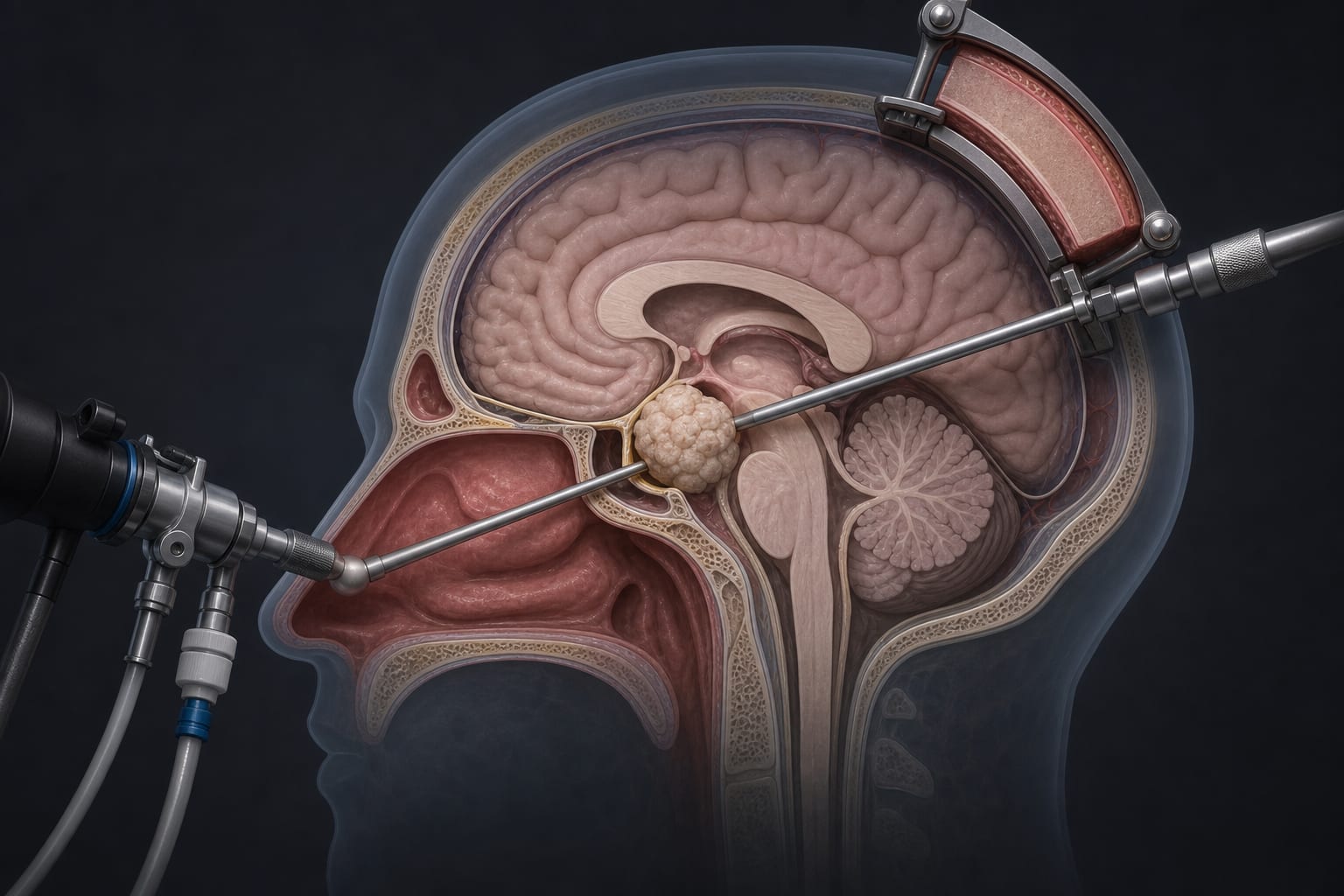
Outcomes of Endoscopic Endonasal Surgery Versus Transcranial Craniotomy for Craniopharyngioma: A Retrospective Cohort Analysis from a Single Institution
To compare perioperative and follow-up outcomes, including extent of resection, length of stay, complications, endocrine outcomes, visual outcomes, postoperative radiotherapy, and recurrence/progression, between endoscopic endonasal approach (EEA) and transcranial craniotomy (TCA) for craniopharyngioma resection.
Approach:
Outcome Measures: Outcomes included extent of resection, length of stay, complications, axis-specific endocrine outcomes and replacement burden at 6 months, objective visual outcomes at 3 months, postoperative radiotherapy, and recurrence/progression at last follow-up.
Key Findings:
EEA achieved a higher gross total resection (GTR) rate (82.4% vs. 45.5%, p=0.002).
EEA resulted in a shorter hospital stay (16.19 ± 3.97 vs. 18.76 ± 4.23 days, p=0.019).
Improvement in headache/ICP-related symptoms was seen in 90.9% of EEA patients versus 76.5% of TCA patients (p=0.047).
Objective visual outcomes were better after EEA (BCVA: 0.30 vs. 0.42, p=0.041).
EEA had lower rates of electrolyte imbalance (17.6% vs. 42.4%, p=0.021) and transient diabetes insipidus (20.6% vs. 45.5%, p=0.028).
Recurrence/progression at last follow-up was lower in EEA patients (8.8% vs. 21.2%, p=0.047).
Interpretation:
EEA was associated with better outcomes in terms of GTR, hospitalization duration, and fewer complications compared to TCA.
Limitations:
The study is observational and unadjusted, making it susceptible to confounding by indication, which may affect the validity of the findings.
Results are based on a single-center experience, which may limit generalizability.
Conclusion:
EEA is associated with improved surgical outcomes for craniopharyngioma resection.
The nearly 15,000-square-foot facility will integrate multidisciplinary care, including neurology, neurosurgery, brain imaging, and physical medicine and rehabilitation.
Qualitative interviews identified four themes involving emergency challenges and response, teamwork, psychological stress and coping, and professional growth needs in trauma surgery.