Age-Related Effects on the Transition from Pre-Myopia to Myopia: A One-Year Retrospective Study
-
By
-
Shuang Wang
-
Keke Huang
-
Xingyu He
-
Zhanfeng Wang
-
July 7, 2026
Objective:
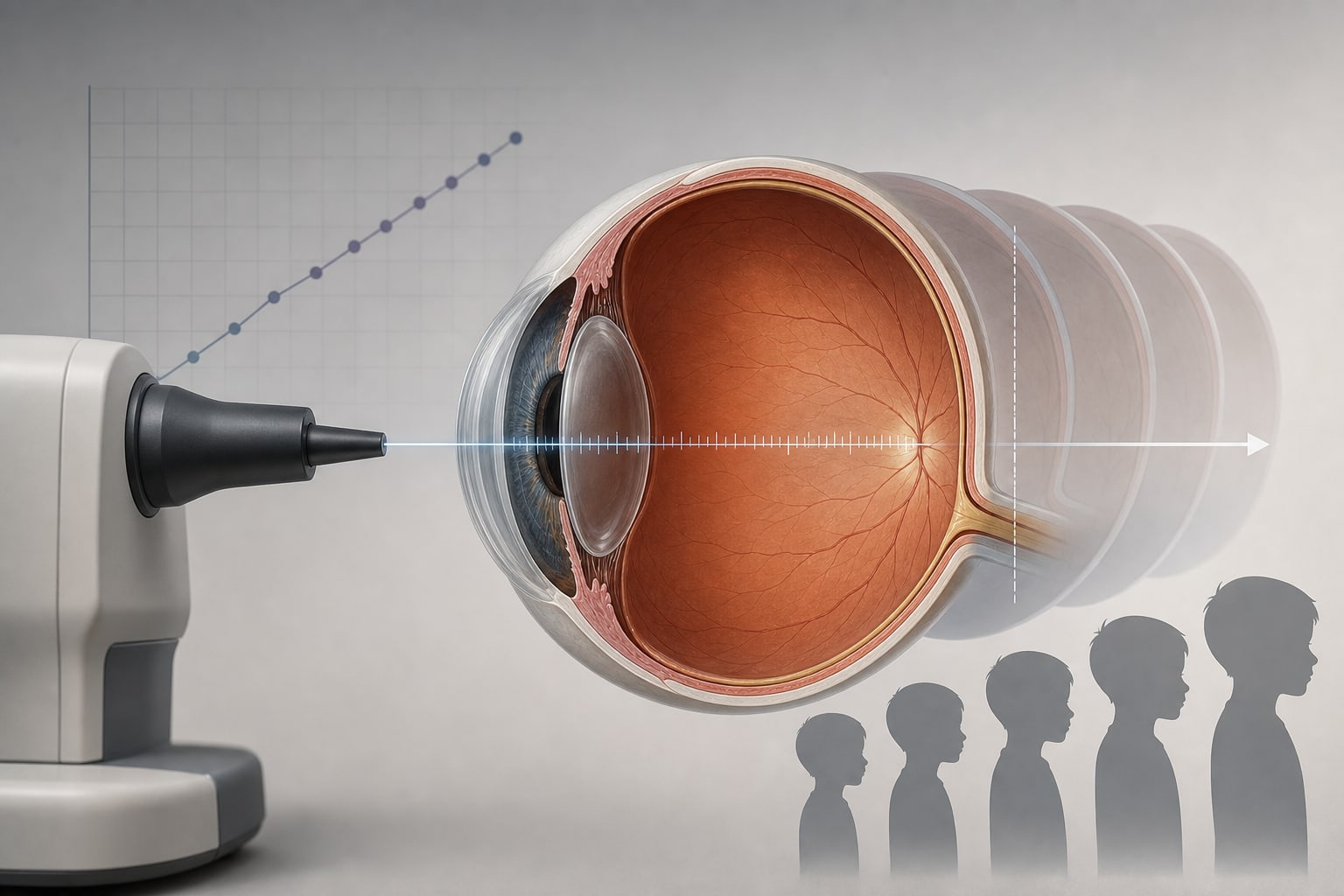
To investigate the effect of age on annual axial elongation during the transition from pre-myopia to myopia in children.
Approach:
- Study Design: A retrospective study involving 53 children aged 6–10 years who progressed from pre-myopia to myopia within 1 year.
- Data Collection: Data included age, sex, spherical equivalent refraction, and axial length, with follow-ups every 6 months.
- Statistical Analysis: Annual axial elongation was analyzed using ANCOVA, with age as a fixed factor and baseline ocular biometrics as covariates.
Key Findings:
- Annual axial elongation decreased with increasing age: 0.76 mm (6y), 0.64 mm (7y), 0.54 mm (8y), 0.37 mm (9y), and 0.38 mm (10y).
- Significant main effect of age on axial elongation was found (p = 0.019).
- Children aged 6 and 7 years had significantly greater axial elongation than those aged 9 years (p < 0.01).
- Each additional year of age was associated with a 0.093 mm decrease in annual axial elongation (p = 0.002).
Interpretation:
Limitations:
- The study is retrospective and may not account for all environmental and familial risk factors.
- Data was collected from a single hospital, which may limit generalizability.
Conclusion: