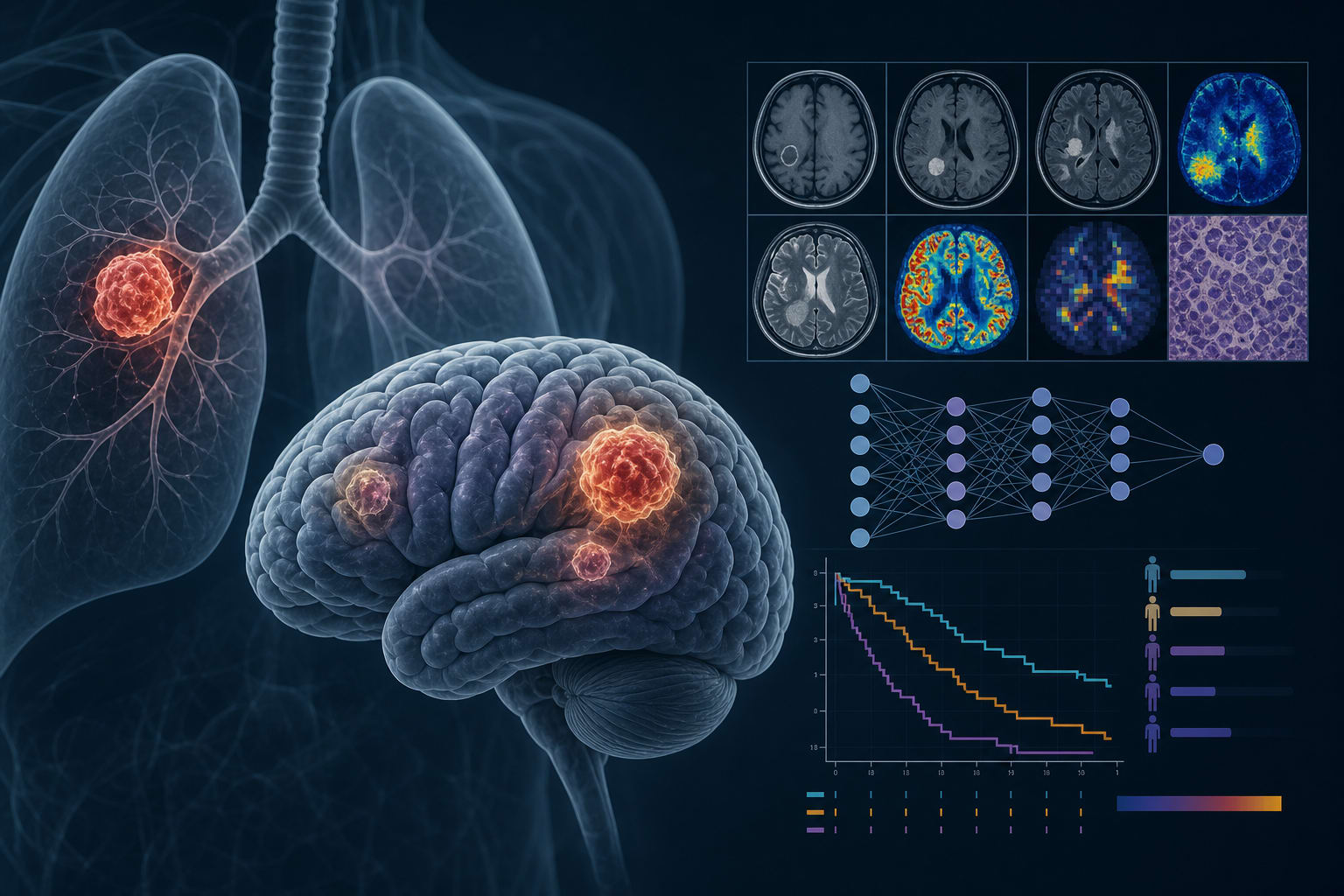
To synthesize findings from recent studies on survival prediction in lung cancer patients with brain metastases, focusing on overall survival, progression-free survival, and intracranial progression-free survival.
Approach:
Literature Review: A focused search was conducted across multiple databases for studies published between October 2020 and February 2026, resulting in the selection of fifteen relevant studies.
Key Findings:
Brain metastases occur in approximately 30-40% of lung cancer patients.
Traditional prognostic scoring systems like the Graded Prognostic Assessment (GPA) are widely used, with median overall survival varying by cancer type.
Recent data-driven approaches include radiomics-based models, machine learning survival models, and deep learning frameworks.
Interpretation:
Traditional scoring systems remain clinically useful, but advanced predictive modeling techniques may enhance survival outcome predictions.
Limitations:
Traditional models may not fully capture the complexity of patient outcomes.
The review is limited to studies published in English and may not encompass all relevant research.
Conclusion:
Advanced predictive modeling has the potential to inform personalized treatment plans and improve survival outcomes in lung cancer patients with brain metastases.
he U.S. Food and Drug Administration (FDA) has approved daraxonrasib, an oral multi-selective RAS(ON) inhibitor, for adults with metastatic pancreatic adenocarcinoma who have received at least one prior systemic therapy or are not candidates for multiagent systemic therapy.