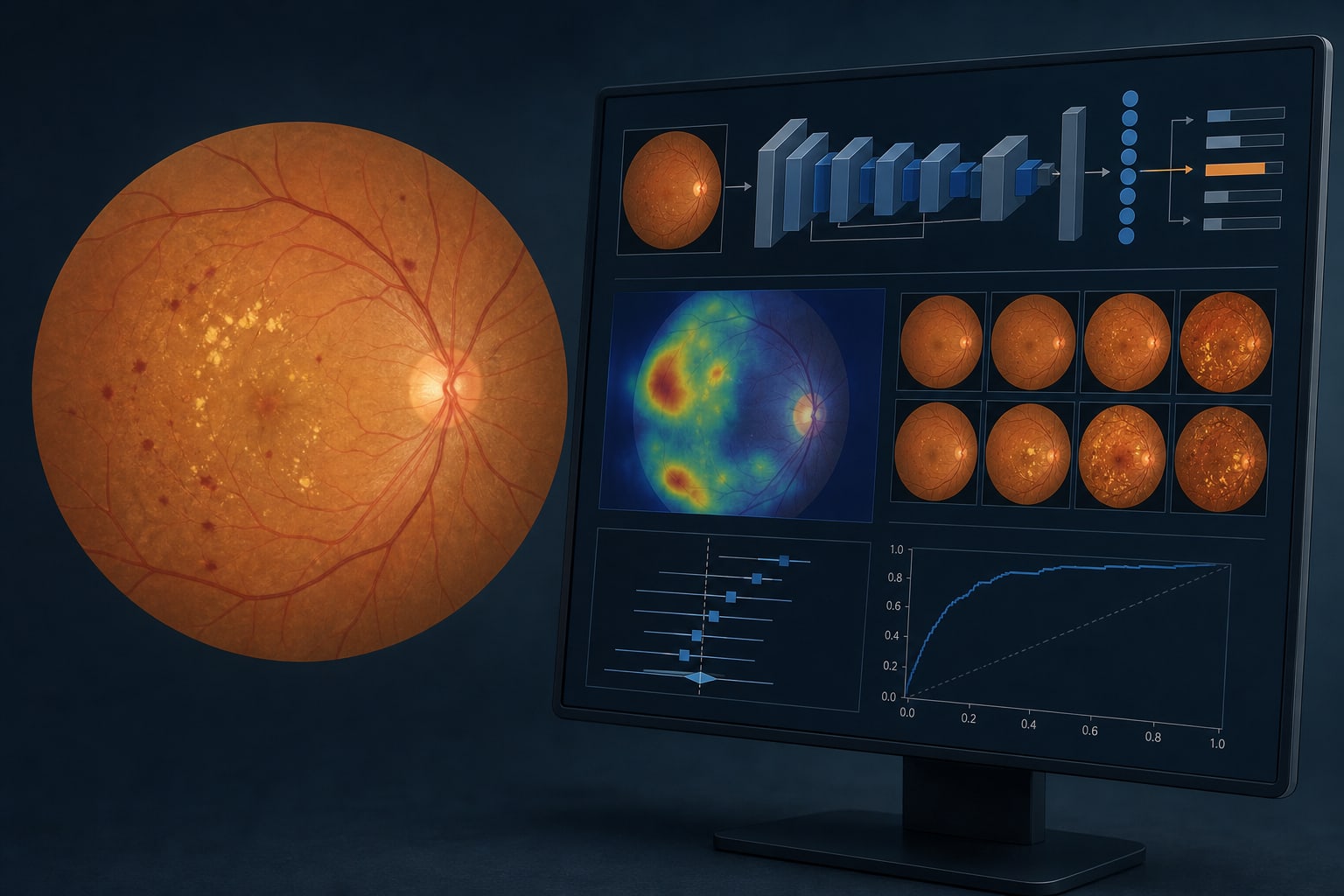
Diagnostic accuracy and clinical performance of deep learning models for grading diabetic retinopathy: a systematic review and meta-analysis - Summary - MDSpire
Advertisement
Diagnostic accuracy and clinical performance of deep learning models for grading diabetic retinopathy: a systematic review and meta-analysis
To comprehensively assess the diagnostic accuracy of fundus image-based deep learning models in the grading of diabetic retinopathy.
Approach:
Study Selection: Systematic search of PubMed, Embase, Web of Science, and Cochrane Library for studies published up to October 28, 2025, focusing on diagnostic accuracy of DL algorithms for DR grading.
Data Extraction: Literature screening and data extraction performed independently by two researchers, with bias risk assessed using the QUADAS−2 tool.
Key Findings:
41 studies included, covering various DL architectures and datasets.
Pooled sensitivities for five-class classification: 95.19% (95% CI: 93.00%–97.00%) for no DR, 72.06% (95% CI: 62.06%–81.09%) for mild NPDR, 84.33% (95% CI: 78.90%–89.10%) for moderate NPDR, 75.84% (95% CI: 68.42%–82.57%) for severe NPDR, and 78.82% (95% CI: 71.76%–85.13%) for PDR.
In four-class classification, sensitivities improved: 96.85% (95% CI: 90.18%–99.93%) for stage 0, 92.94% (95% CI: 79.50%–99.72%) for stage 1, 92.75% (95% CI: 79.31%–99.61%) for stage 2, and 88.19% (95% CI: 68.99%–98.93%) for stage 3.
Interpretation:
Deep learning shows high sensitivity for DR grading, especially in identifying no DR and vision-threatening DR, but differentiating adjacent non-proliferative stages remains challenging.
Limitations:
Observed heterogeneity in study results, indicating variability in diagnostic performance across studies.
Conclusion:
Future research should focus on enhancing clinical utility and generalizability of DL models for DR grading.