Community Optometrist–Led Monitoring of Quiescent Neovascular Age-Related Macular Degeneration: The FENETRE - Summary - MDSpire

Community Optometrist–Led Monitoring of Quiescent Neovascular Age-Related Macular Degeneration: The FENETRE

  • By

  • Anitta Sharma

  • Aljazy Jaber

  • Bishwanath Pal

  • John G. Lawrenson

  • Robert A. Harper

  • Adnan Tufail

  • Annastazia E. Learoyd

  • Emily Robinson

  • Abdel Douiri

  • Rachel Burman

  • Ashleigh Kernohan

  • Sofia Vougioukalou

  • Simon Read

  • Judit Csontos

  • Aled Jones

  • Sajjad Mahmood

  • Martin McKibbin

  • Janet L. Peacock

  • Richard Gale

  • Praveen J. Patel

  • Pearse A. Keane

  • Robin Hamilton

  • Luke Vale

  • Catey Bunce

  • Konstantinos Balaskas

  • June 15, 2026

  • 0 min

Share

Objective:

To assess whether community optometrist-led monitoring is noninferior to standard hospital-based monitoring for detecting quiescent neovascular age-related macular degeneration (QnAMD) reactivation or new neovascular AMD in the fellow eye, which is crucial for timely intervention.

Key Findings:
  • Community optometrists completed a dedicated training and accreditation program.
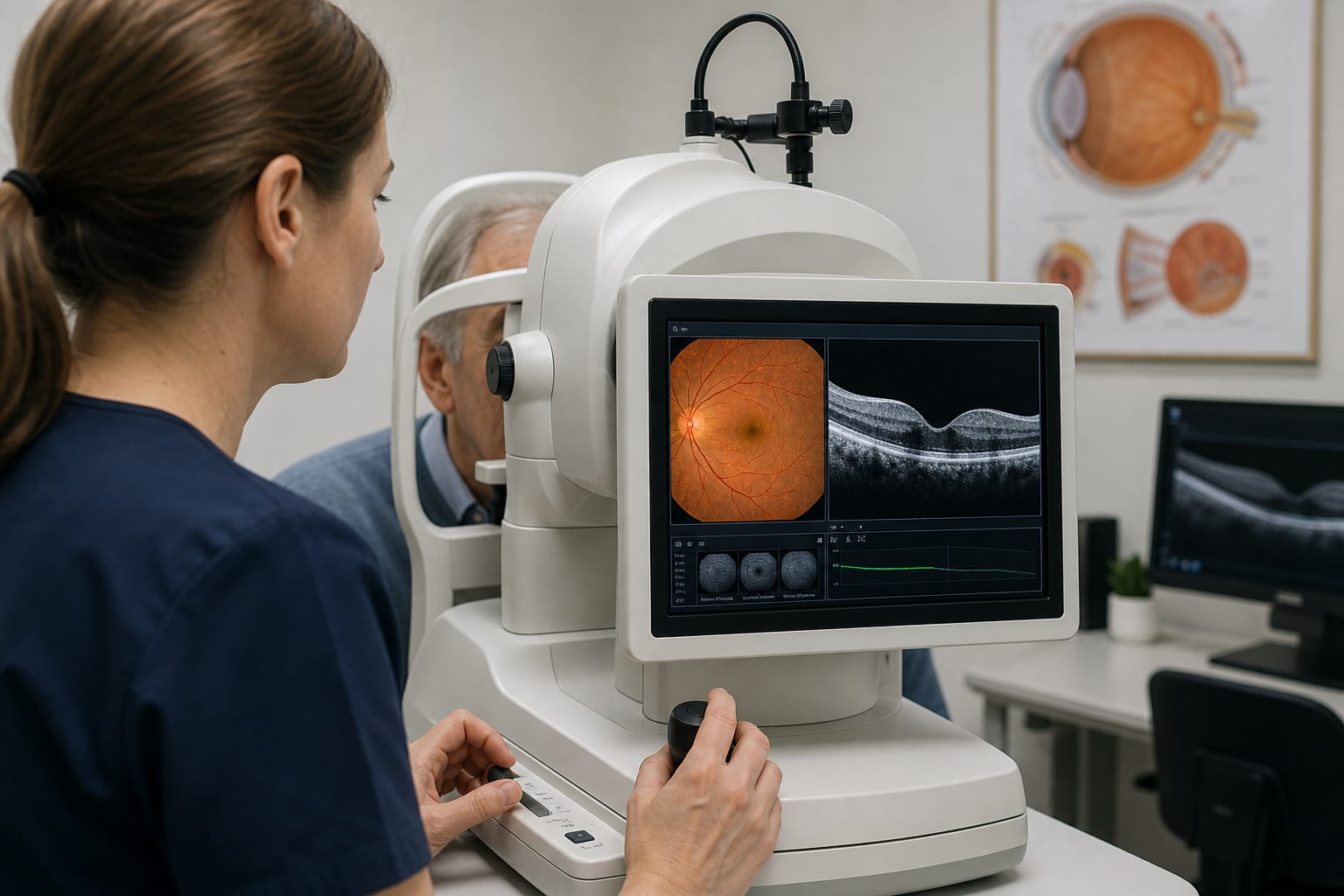
  • Monitoring relied on optical coherence tomography (OCT) imaging for detecting disease activity.
  • Both groups followed defined referral pathways for potential treatment.
Interpretation:

The study aims to provide robust evidence for community-based monitoring of QnAMD, addressing the increasing demand on hospital services.

Limitations:
  • The study's findings may not be generalizable beyond the UK healthcare setting.
  • Potential biases in outcome determination due to unmasked participants and clinicians.
Conclusion:

The FENETRE trial is designed to evaluate the effectiveness of community optometrist monitoring for QnAMD, potentially alleviating pressure on hospital services.

Original Source(s)

Related Content