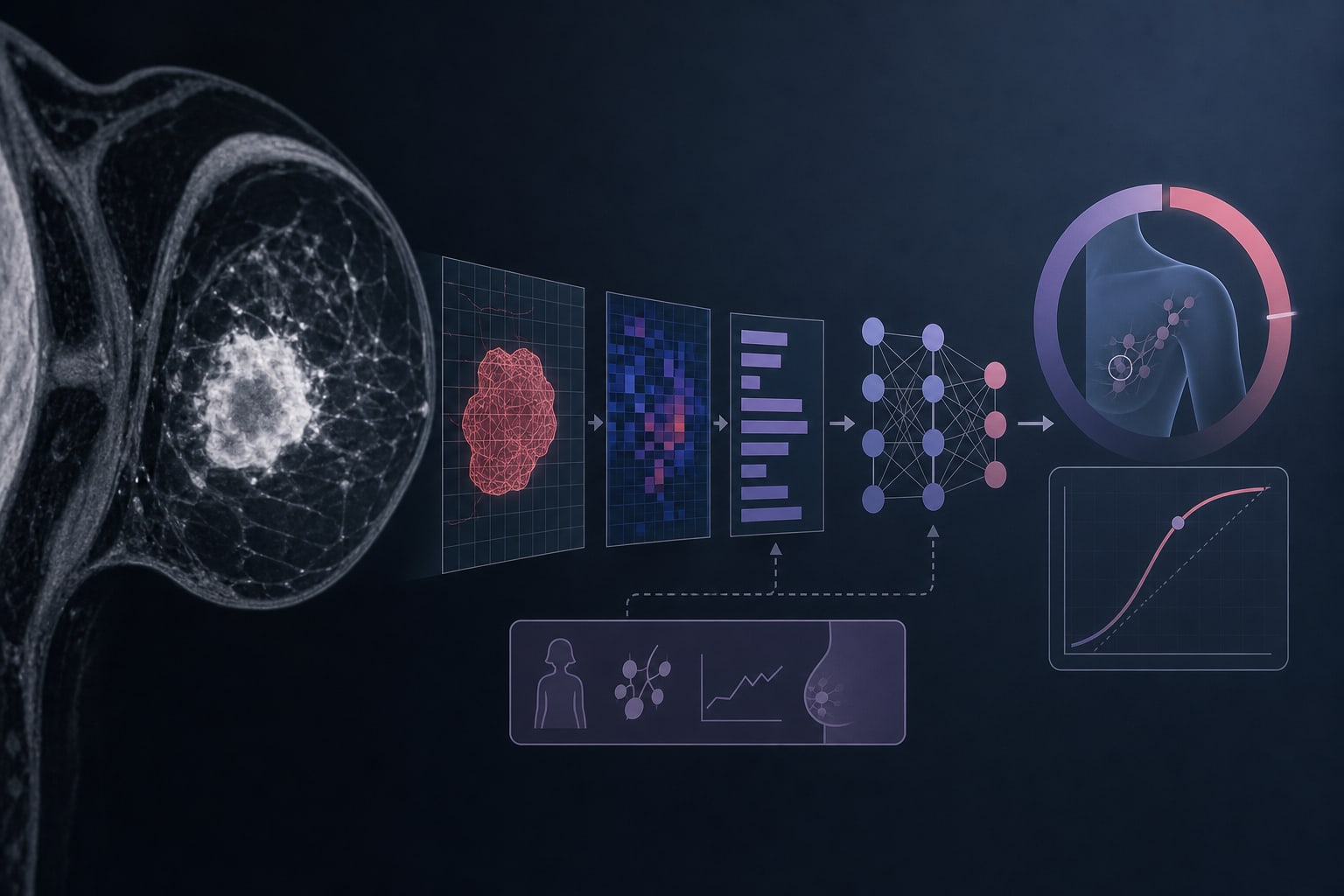
Development and internal validation of a radiomics-clinical combined model for predicting axillary pathological complete response in clinically node-positive breast cancer patients after neoadjuvant chemotherapy - Summary - MDSpire
Advertisement
Development and internal validation of a radiomics-clinical combined model for predicting axillary pathological complete response in clinically node-positive breast cancer patients after neoadjuvant chemotherapy
To develop and internally validate a combined radiomics-clinical prediction model for axillary pathological complete response (apCR) in clinically node-positive breast cancer patients after neoadjuvant chemotherapy.
Approach:
Study Design: Single-center retrospective study enrolling 386 cN+ breast cancer patients (training, n = 270; validation, n = 116).
Data Collection: Pre-NAC DCE-MRI radiomic features were extracted from primary tumors.
Model Development: LASSO regression selected eight features for Rad-score construction; clinical predictors identified via logistic regression.
Performance Evaluation: Model performance assessed using AUC, calibration metrics, and decision curve analysis.
Key Findings:
Overall apCR rate was 43.5% (168/386).
Combined model achieved a validation AUC of 0.703 (95% CI, 0.610–0.792), outperforming the radiomics-only model (ΔAUC = 0.094, P = 0.004) but not the clinical-only model (ΔAUC = 0.020, P = 0.713).
Calibration slope of the combined model was 0.811 with an intercept of 0.018, indicating moderate overfitting.
Risk stratification showed low (18.8%), intermediate (48.0%), and high (58.8%) apCR rates across tertiles.
After bootstrap bias correction, the optimism-corrected training AUC of the combined model was 0.742.
Interpretation:
The combined model demonstrated moderate discriminatory ability but did not significantly outperform clinical predictors alone.
Limitations:
Current misclassification rate precludes direct clinical application for surgical de-escalation.
External multicenter validation is warranted.
Conclusion:
The combined model shows potential but requires further validation before clinical application.