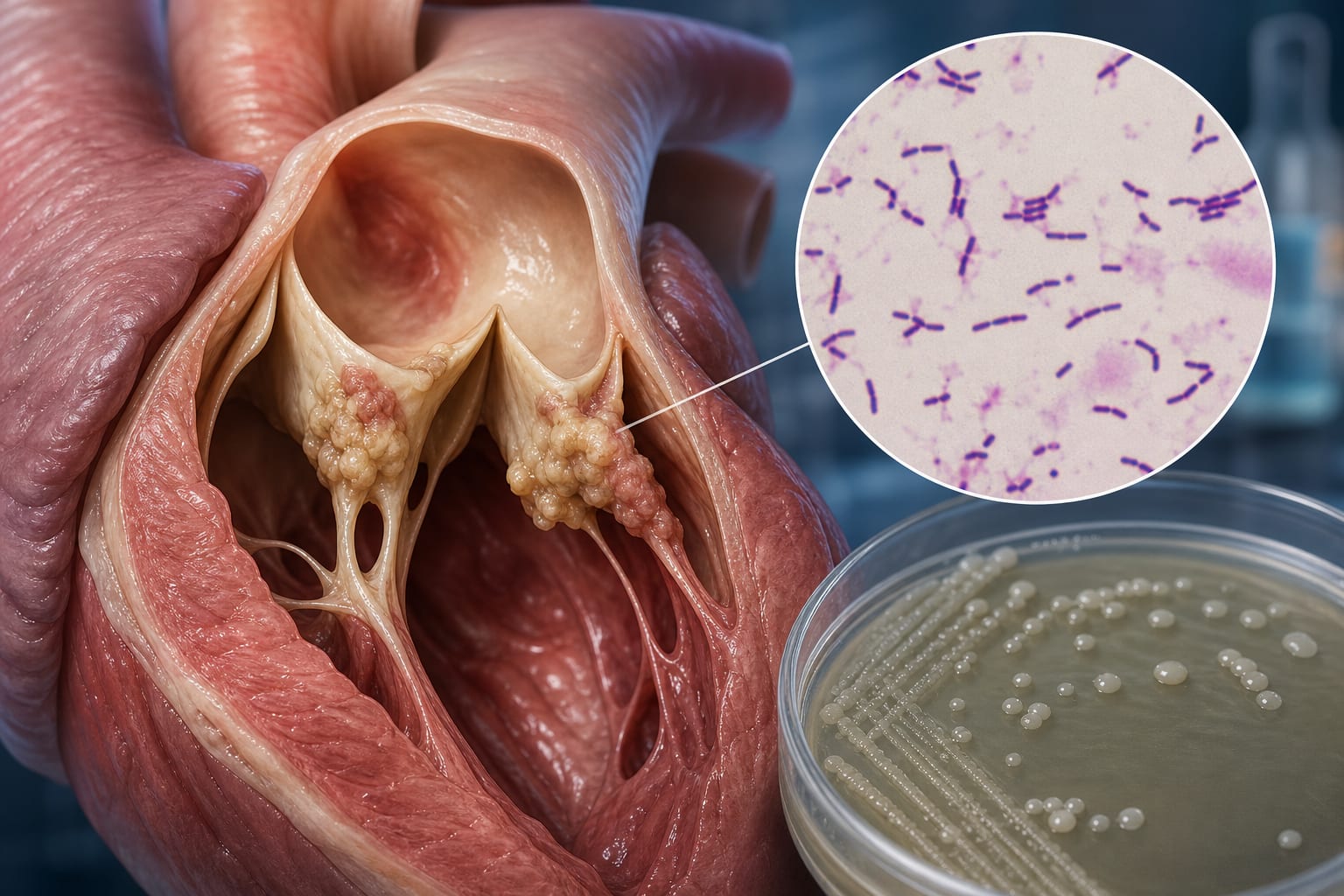
Curtobacterium oceansedimentum Endocarditis: A Plant-Associated Bacterium Linked to Acute Heart Failure and Severe Valve Dysfunction
-
October 20, 2026
Objective:
To report a case of Curtobacterium oceansedimentum infective endocarditis (IE) associated with severe aortic valve dysfunction and acute heart failure.
Approach:
- Case presentation: A 53-year-old man presented with dyspnea, edema, and cardiogenic shock associated with severe aortic insufficiency and left coronary cusp perforation.
- Microbiological diagnosis: Blood cultures remained negative. Culture of the excised valve grew gram-positive rods; an outside laboratory identified the organism as C. oceansedimentum.
- Treatment and follow-up: The patient underwent bioprosthetic aortic valve replacement and received antibiotics. He later returned with acute heart failure and a markedly reduced ejection fraction; the prosthetic valve functioned normally and no vegetation was seen.
Key Findings:
- The authors report what they describe, to their knowledge, as the first case of Curtobacterium infective endocarditis.
- The patient presented with severe aortic insufficiency, left coronary cusp perforation, and cardiogenic shock.
- Blood cultures remained negative; culture of excised valve tissue enabled identification of Curtobacterium oceansedimentum at an outside laboratory.
- The patient left rehabilitation against medical advice before completing the prescribed antibiotic course. Four weeks later, he was readmitted with acute heart failure; echocardiography showed a normally functioning bioprosthetic valve and no vegetation.
Interpretation:
The report documents C. oceansedimentum as a cause of IE and describes invasive valvular infection despite negative blood cultures. The authors note that the route of infection in this patient could not be established.
Limitations:
- This is a single case report.
- The route of infection could not be established.
- The patient left rehabilitation against medical advice before completing the initial prescribed antibiotic course.
Conclusion:
The authors state that this case broadens the differential diagnosis for culture-negative IE, particularly in patients with relevant exposure histories.
Sources:
Based on findings from:
Curtobacterium oceansedimentum Infective Endocarditis: A Plant-Associated Pathogen Causing Acute Heart Failure From Severe Valvular Dysfunction
Annals Of Internal Medicine: Clinical Cases, 2026.
https://www.acpjournals.org/doi/10.7326/aimcc.2026.0337
This content is an AI-generated, fully rewritten summary based on a published scholarly article. It does not reproduce the original text and is not a substitute for the original publication. Readers are encouraged to consult the source for full context, data, and methodology.