Association of APOBEC mutagenesis with stromal and endothelial niche remodeling and PCDH9-linked signaling alterations in colorectal cancer - Summary - MDSpire
Advertisement
Association of APOBEC mutagenesis with stromal and endothelial niche remodeling and PCDH9-linked signaling alterations in colorectal cancer
To delineate the biological and clinical consequences of APOBEC activation in colorectal cancer (CRC) and its impact on the tumor microenvironment (TME).
Approach:
Data Integration: Integrated whole-exome sequencing, bulk and single-cell transcriptomics from multi-cohort datasets, supported by functional assays and in vivo xenograft models.
Machine Learning: Utilized a machine-learning framework to derive an APOBEC activation–associated transcriptional signature (AAS).
Key Findings:
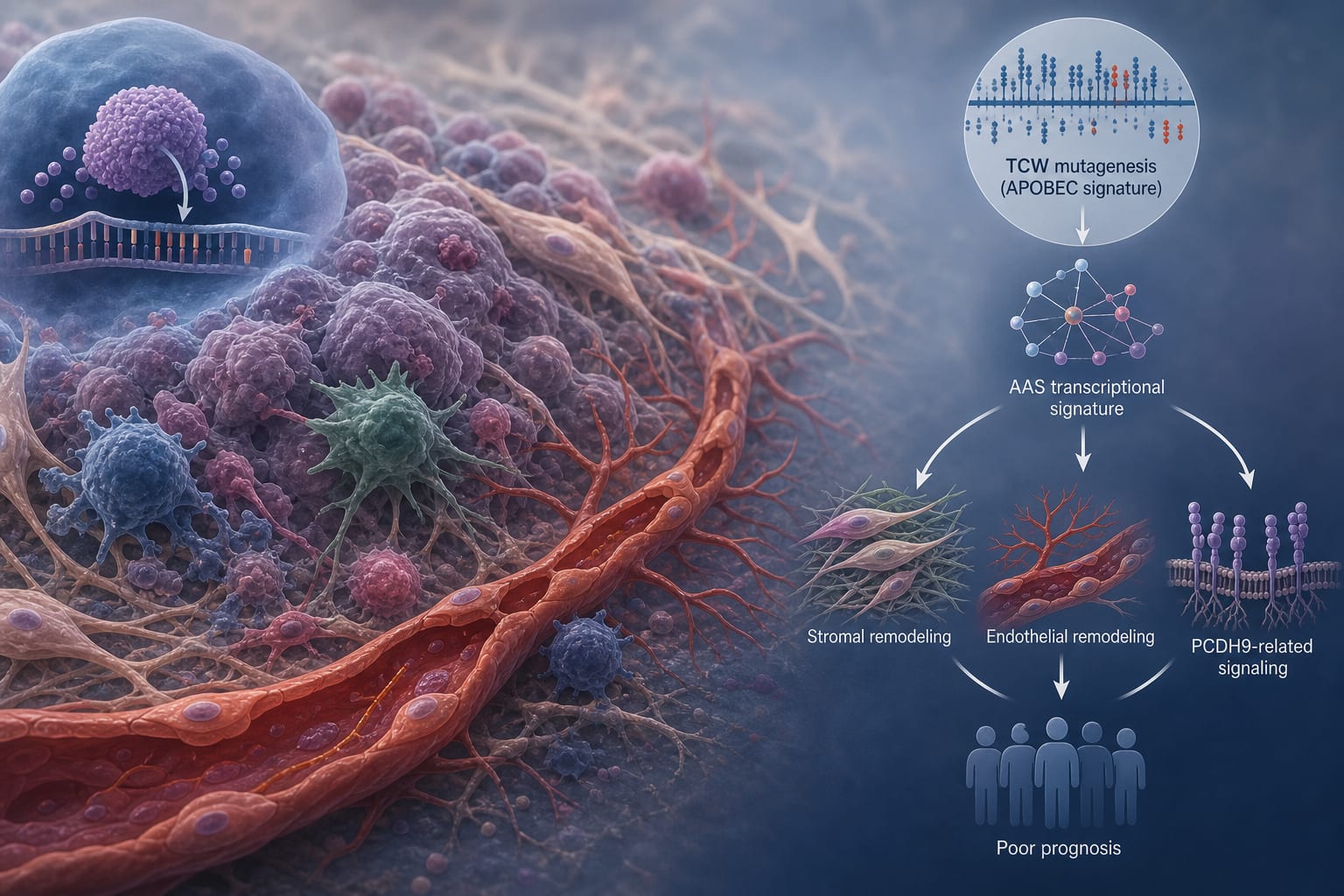
AAS defined a colorectal cancer subtype with enriched TCW mutagenesis and significantly worse survival.
High AAS tumors showed increased fibroblast and endothelial signatures and reduced cytotoxic immune infiltration.
Single-cell analyses revealed high AAS tumors enriched for endothelial states with arterial and pro-angiogenic features.
Conditioned-medium experiments suggested a link between APOBEC3B activation and endothelial transcriptional remodeling.
PCDH9 identified as a candidate APOBEC-associated target linked to Hippo, Wnt/β-catenin, and TGF-β signaling alterations.
Interpretation:
Limitations:
Mutation-specific causality remains to be experimentally validated.