Comparison of the association and discriminatory ability of CVAI, LAP, CI, and AVI for type 2 diabetes in Chinese adults aged ≥ 50 years: a sex-specific analysis - Summary - MDSpire
Advertisement
Comparison of the association and discriminatory ability of CVAI, LAP, CI, and AVI for type 2 diabetes in Chinese adults aged ≥ 50 years: a sex-specific analysis
To compare the associations of four visceral adiposity indices with prevalent type 2 diabetes mellitus (T2DM) in Chinese adults aged ≥ 50 years and evaluate their discriminatory ability, considering sex differences.
Key Findings:
All four indices (CVAI, LAP, CI, AVI) were positively associated with prevalent T2DM after full adjustment.
CVAI and CI showed significant associations across Q2-Q4, while LAP and AVI were significant only in Q3-Q4.
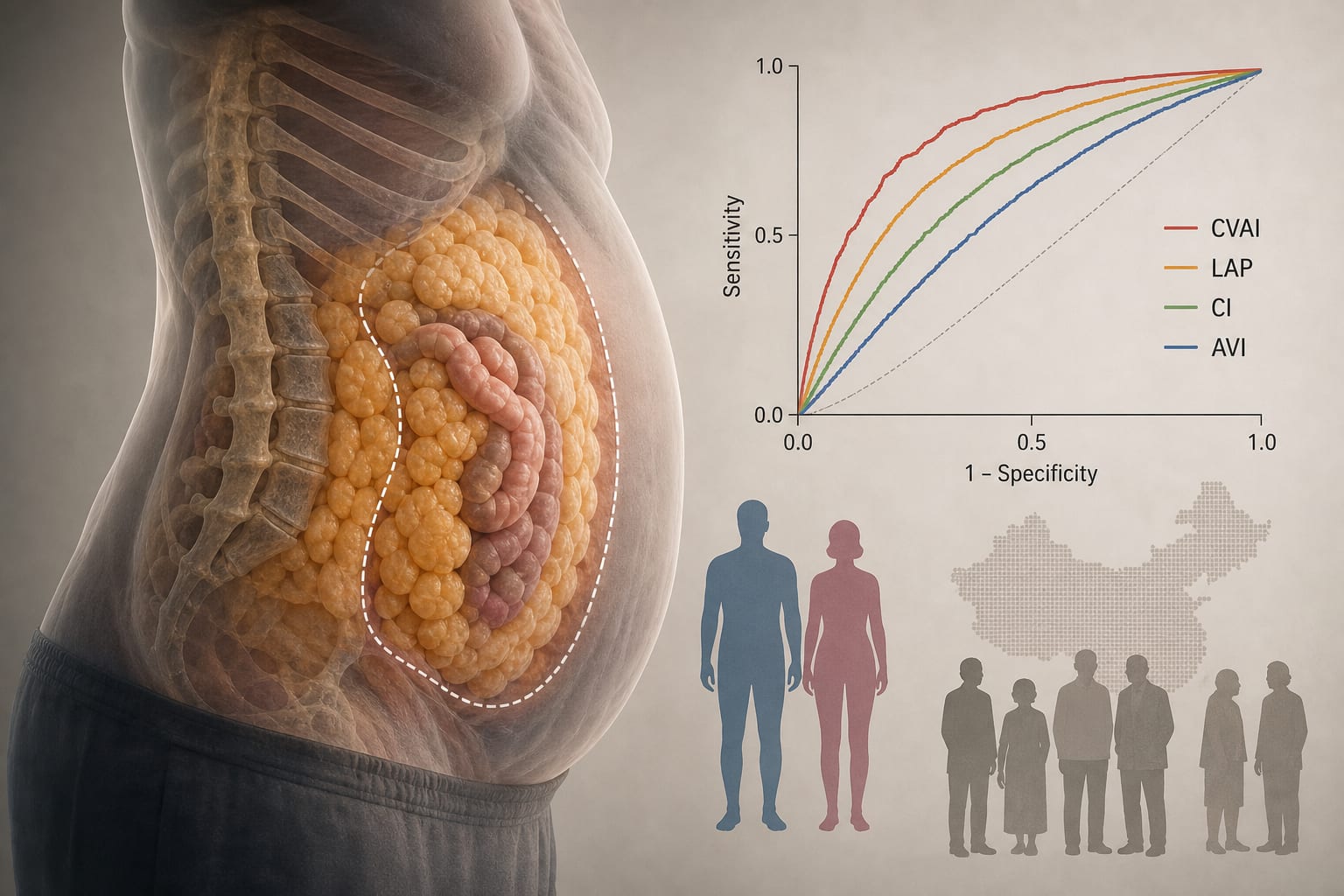
CVAI had the highest AUC (0.634) in the overall population, followed by LAP (0.633), AVI (0.612), and CI (0.591).
Sex differences: CVAI, CI, and AVI had stronger associations in males; LAP had a stronger association in females.
Discriminatory ability mirrored these patterns, with CVAI showing the highest AUC in males (0.658) and LAP in females (0.642).
Interpretation:
CVAI, LAP, CI, and AVI are independently associated with prevalent T2DM in adults aged ≥50 years, with significant sex modifications in both association and discriminatory ability.
Limitations:
Findings are based on a case-control study from a single province, limiting generalizability.
The study design does not establish causality or predictive utility.
Conclusion:
The study highlights the importance of considering sex-specific differences in adiposity indices when assessing T2DM risk in older adults. Prospective studies are needed to validate these findings.