Conexiant’s news site is now MDSpire News. Learn more
Advertisement
The Connection Between Liver and Eye Health in Metabolic Syndrome: Comprehensive Insights from Mendelian Randomization, Single-Cell Sequencing, and Clinical Sample Analysis
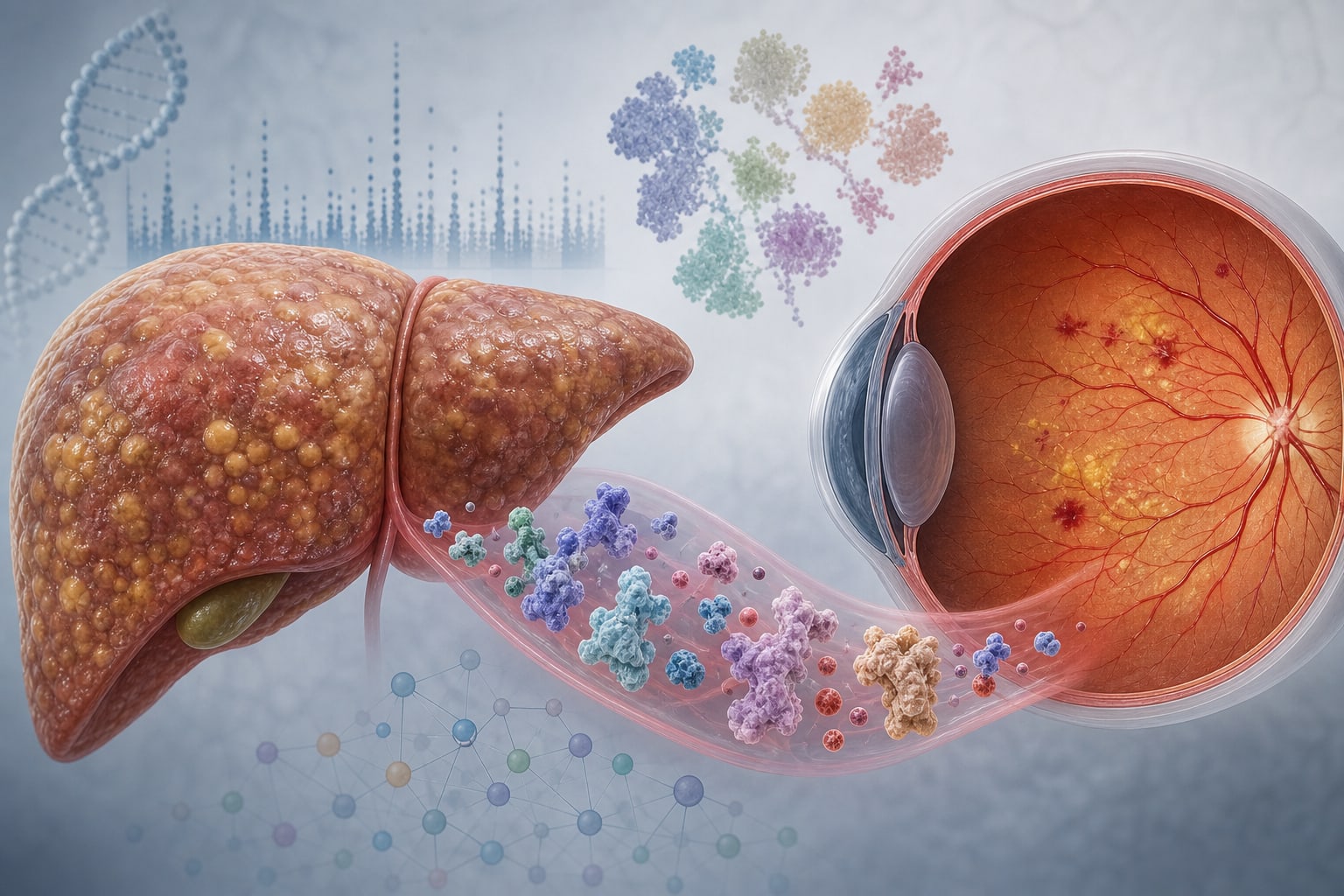
To examine the causal association between non-alcoholic fatty liver disease (NAFLD) and diabetic retinopathy (DR) and identify circulating proteins that may mediate this association.
Approach:
Mendelian Randomization Framework: Utilized a multistage network MR framework incorporating NAFLD/DR genome-wide association study data and blood proteome-wide datasets.
Statistical Analysis: Applied inverse-variance weighted regression and multimodal models to evaluate causal effects, alongside proteome-wide MR to identify proteins associated with DR.
Single-Cell Sequencing: Verified transcriptional expression of identified mediator proteins in liver tissue.
Clinical Sample Analysis: Measured mediator-protein levels in serum, aqueous humor, and vitreous humor samples from clinical patients.
Key Findings:
NAFLD is associated with an increased risk of DR (OR = 1.04, 95% CI: 1.01-1.08) and specifically with progression of non-proliferative DR (NPDR) (OR = 1.26, 95% CI: 1.05-1.52).
Four proteins were identified as candidate mediators of the NAFLD-DR association, with LTB showing the strongest effect.
Increased LTB protein levels were found in the aqueous humor, vitreous humor, and serum of NAFLD patients with DR compared to those without.
Interpretation:
The study suggests a causal link between NAFLD and an increased risk of developing DR, particularly in early NPDR stages, with LTB potentially mediating this relationship.
Limitations:
The study relies on genetic instruments, which may not capture all confounding factors.
The findings are based on observational data, which may limit causal inferences.
Conclusion:
NAFLD is associated with a heightened risk of developing DR, with LTB as a potential mediator in this relationship.