Anthropometry, sex, and age at diagnosis affect pulmonary blood volume quantification from computed tomography pulmonary angiography in pulmonary hypertension assessment - Summary - MDSpire
Conexiant’s news site is now MDSpire News. Learn more
Advertisement
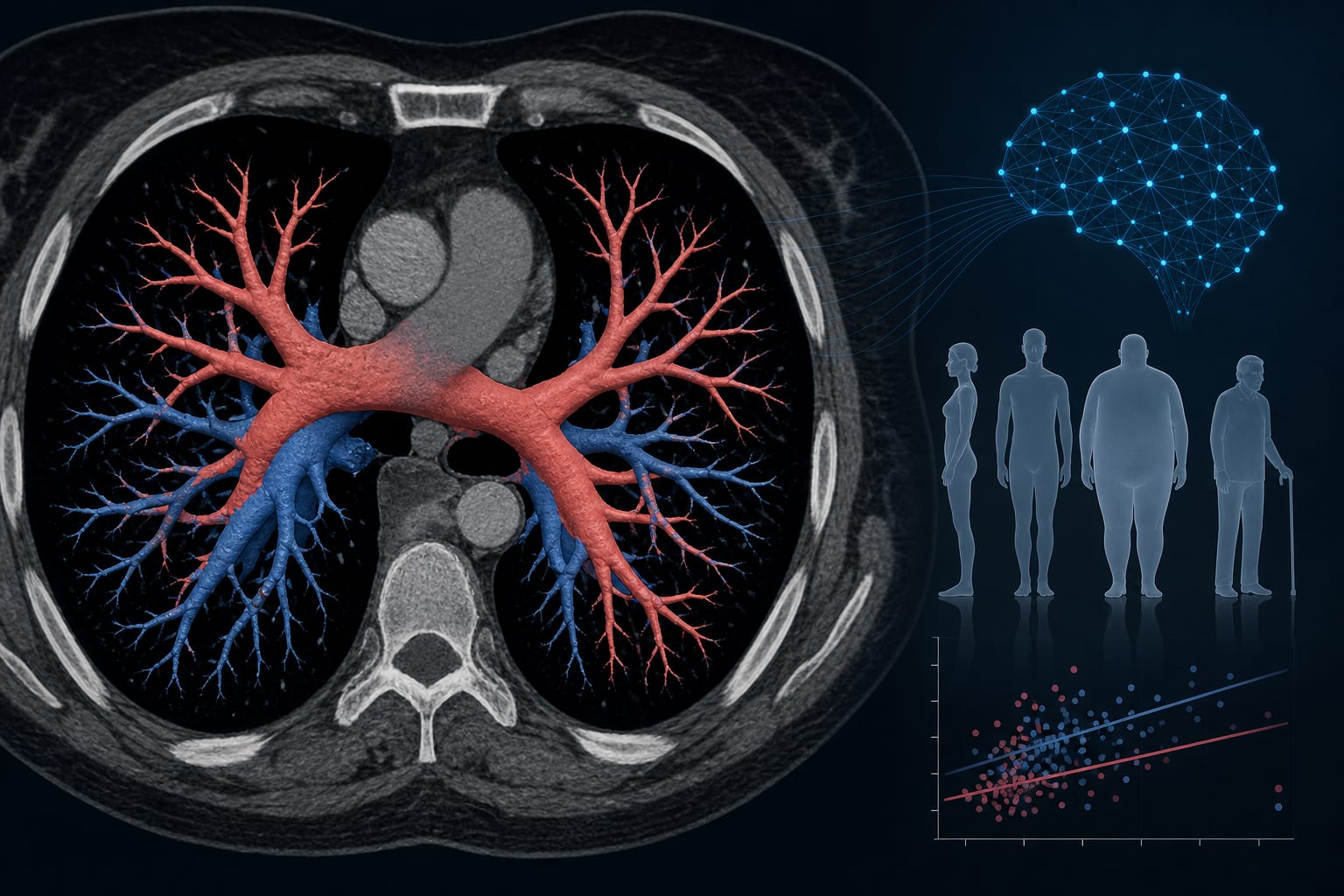
Impact of Anthropometric Factors, Gender, and Age at Diagnosis on Pulmonary Blood Volume Measurement via Computed Tomography Pulmonary Angiography in Evaluating Pulmonary Hypertension
To investigate how anthropometric factors, gender, and age at diagnosis influence AI-derived pulmonary blood volumes (PBV) from computed tomography pulmonary angiography (CTPA) in the context of pulmonary hypertension (PH).
Key Findings:
Pulmonary artery volume positively correlated with height, weight, BMI, and body surface area (BSA), with a stronger effect in males.
Older age at diagnosis was linked to larger pulmonary artery volumes, especially in patients with higher weight, BMI, and BSA.
Pulmonary vein volume increased with anthropometrics, with older age disproportionately affecting females with higher weight, BMI, and BSA.
Normalization of PBV to anthropometrics reduced sex-related differences.
Larger pulmonary artery volume and lower pulmonary vein volume were associated with higher PVR, while larger pulmonary vein volume correlated with higher CO.
Interpretation:
The study highlights the complex interplay between anthropometric factors, gender, and age at diagnosis in determining PBV, which is crucial for accurate PH prediction and phenotyping.
Limitations:
The study is based on a specific patient cohort from the Cambridge PH Registry, which may limit generalizability.
Potential confounding factors not accounted for in the analysis could influence the results.
Conclusion:
Understanding the interactions of anthropometrics, gender, and age at diagnosis is vital for effectively utilizing AI-derived PBV in clinical PH assessment and management.
The nurse practitioner profession claims the No. 1 spot across three categories in the U.S. News & World Report 2026 Best Jobs rankings for the third consecutive year.
Joint clinical consensus outlines evaluation and management considerations for arrhythmias, coronary atherosclerosis, aortic dilatation, myocardial fibrosis, and related findings in older competitive athletes.