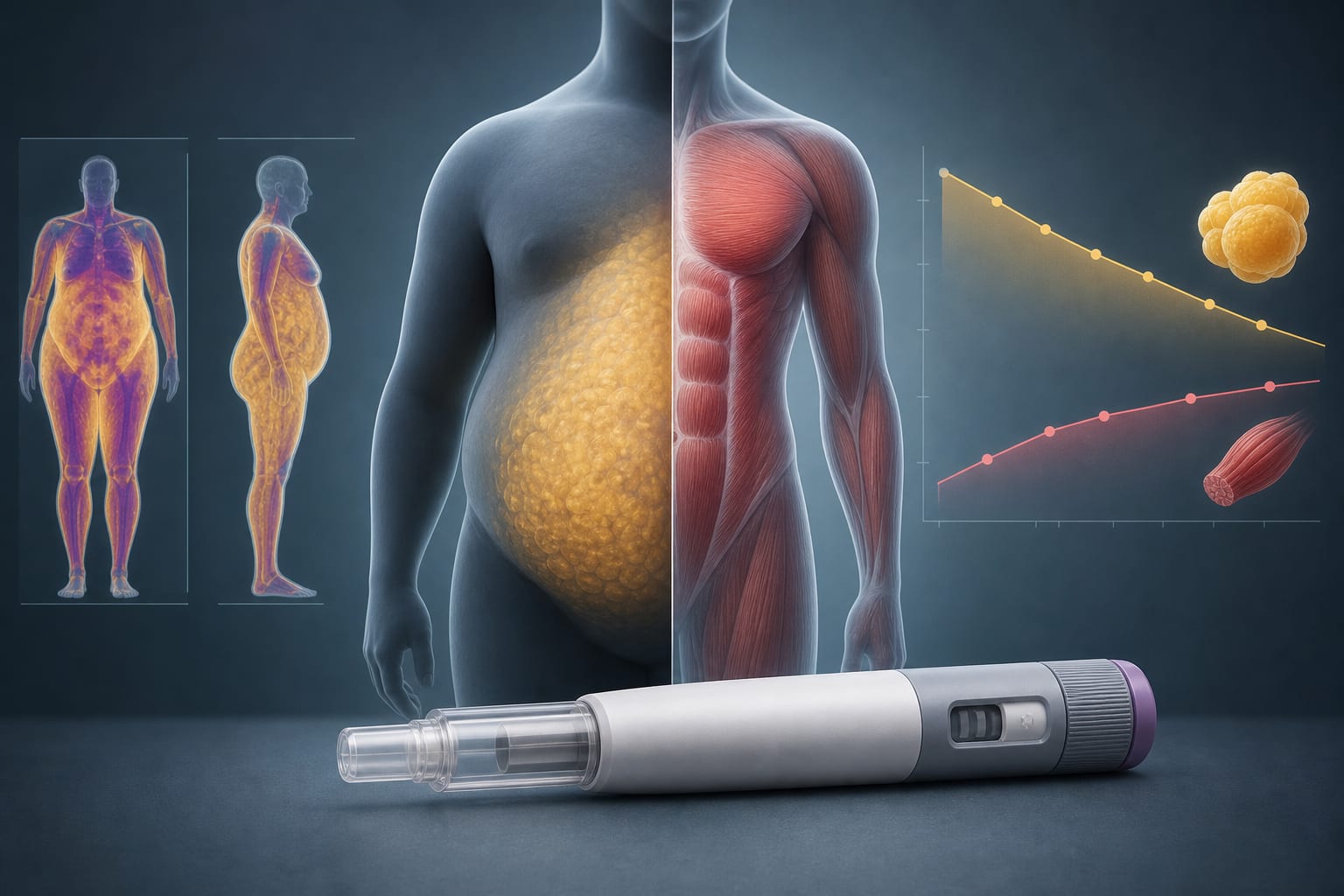
To examine real-world longitudinal changes in body weight, body mass index, body fat percentage, fat mass, fat-free mass, and skeletal muscle mass among adults with obesity receiving tirzepatide.
Approach:
Study Design: Retrospective study evaluating 35 adults receiving tirzepatide therapy within a clinical obesity medicine program.
Data Collection: Body weight and composition were measured at baseline and follow-up using standard procedures and bioelectrical impedance analysis.
Statistical Analysis: Linear mixed models and ANOVA were used to analyze the effects of time, sex, and baseline weight status.
Key Findings:
Significant reductions in body weight (−31.1 kg; −27.8%, p < 0.001), BMI (−10.4 kg/m²; −27.8%, p < 0.001), body fat percentage (−16.2%; −37.6%, p < 0.001), fat mass (−26.4 kg; −54.2%, p < 0.001), fat-free mass (−4.5 kg; −7.3%, p < 0.001), skeletal muscle mass (−2.8 kg; −8.3%, p < 0.001), and total body water (−3.5 kg; −7.7%, p < 0.001).
Weight loss was predominantly from fat mass, comprising 85.7% of total weight loss.
Females experienced greater percentage reductions in fat mass, fat-free mass, skeletal muscle mass, and total body water compared to males (p < 0.05).
Participants with higher baseline BMI showed significantly greater percentage reductions in weight, BMI, fat mass, and body fat percentage compared to those with lower baseline BMI (p < 0.05).
Interpretation:
The study provides evidence of significant changes in body composition among adults with obesity receiving tirzepatide, highlighting the importance of monitoring both fat and lean mass during treatment.
Limitations:
Retrospective design may limit causal inferences.
Small sample size may affect generalizability.
Lack of long-term follow-up data.
Conclusion:
Tirzepatide treatment resulted in substantial reductions in body weight and fat mass, with varying effects based on sex and baseline BMI.
In two population-based cohorts, metabolically unhealthy status generally showed higher dementia risk estimates, while metabolically healthy obesity was not associated with increased risk in primary analyses.