Mechanopriming by vascular stiffness and phenotypic reprogramming by disturbed flow: mechanobiology and clinical translation in atherosclerosis - Summary - MDSpire
Advertisement
Mechanopriming by vascular stiffness and phenotypic reprogramming by disturbed flow: mechanobiology and clinical translation in atherosclerosis
To elucidate the molecular mechanisms of vascular wall-mediated mechanopriming and endothelial mechanotransduction in atherosclerosis.
Approach:
Mechanistic Insights: The review discusses the role of Piezo1 ion channel and 5-HT1B receptor as coincidence detectors integrating fluid shear stress and matrix stiffness signals.
Pathological Reprogramming: It highlights how dysregulation of mechanopathways leads to endothelial cell senescence, pyroptosis, and endothelial-to-mesenchymal transition.
Clinical Applications: The integration of multimodal imaging and computational fluid dynamics for quantifying wall shear stress is explored.
Future Directions: The review proposes shear stress-targeted therapeutic strategies and a precision cardiovascular medicine framework.
Key Findings:
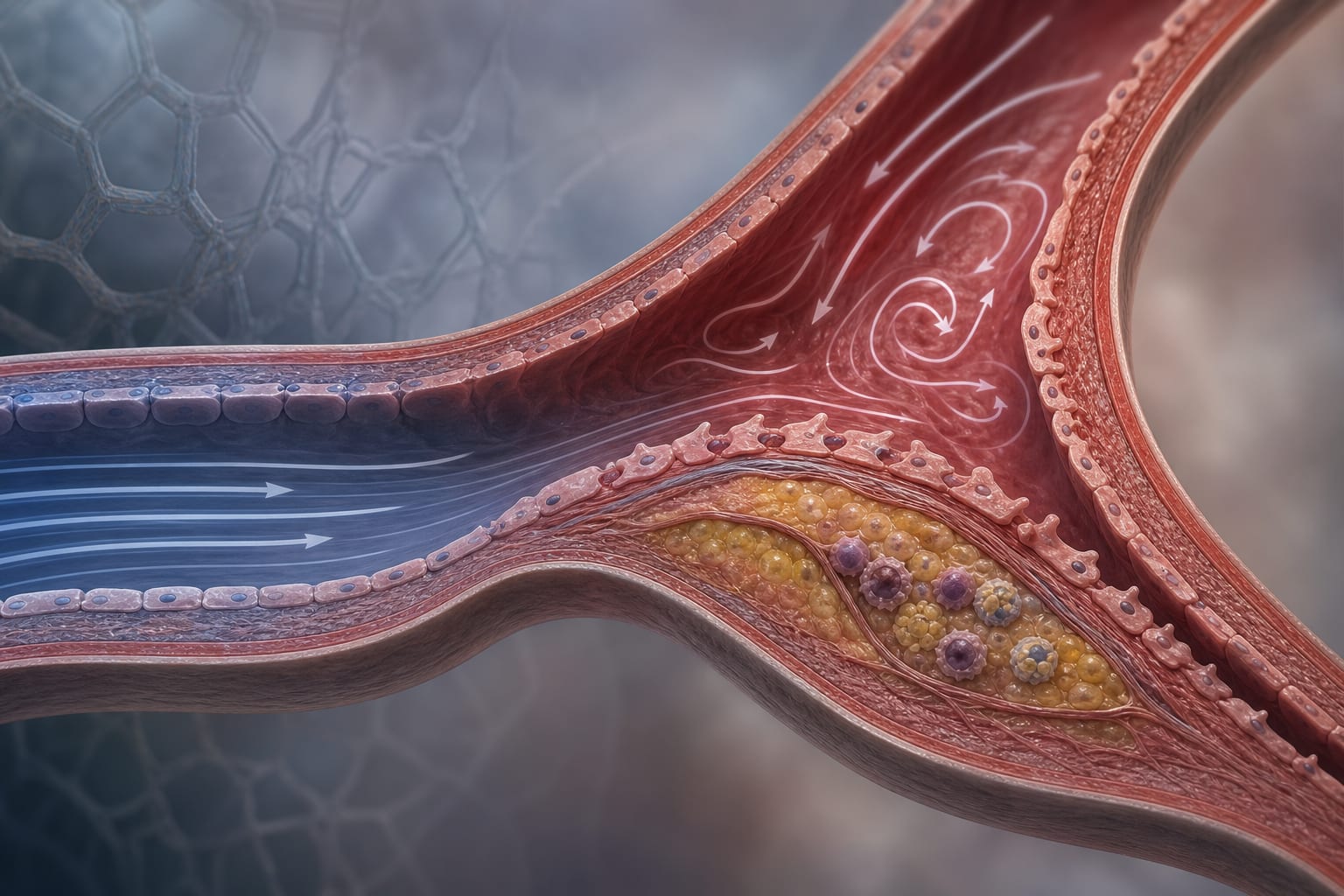
Atherosclerosis exhibits a focal distribution at arterial bifurcations and curvatures, indicating that systemic risk factors alone do not explain its pathogenesis.
Disturbed flow and oscillatory shear stress are critical mechanical drivers of plaque progression.
Low shear stress and OSS promote plaque growth and pathological remodeling, while high shear stress influences plaque vulnerability.
Current clinical risk stratification models may benefit from incorporating localized hemodynamic parameters.
Interpretation:
Limitations:
The review primarily focuses on mechanobiological mechanisms without extensive clinical trial data to support the proposed therapeutic strategies.
Further research is needed to validate the clinical applicability of the discussed imaging and therapeutic approaches.