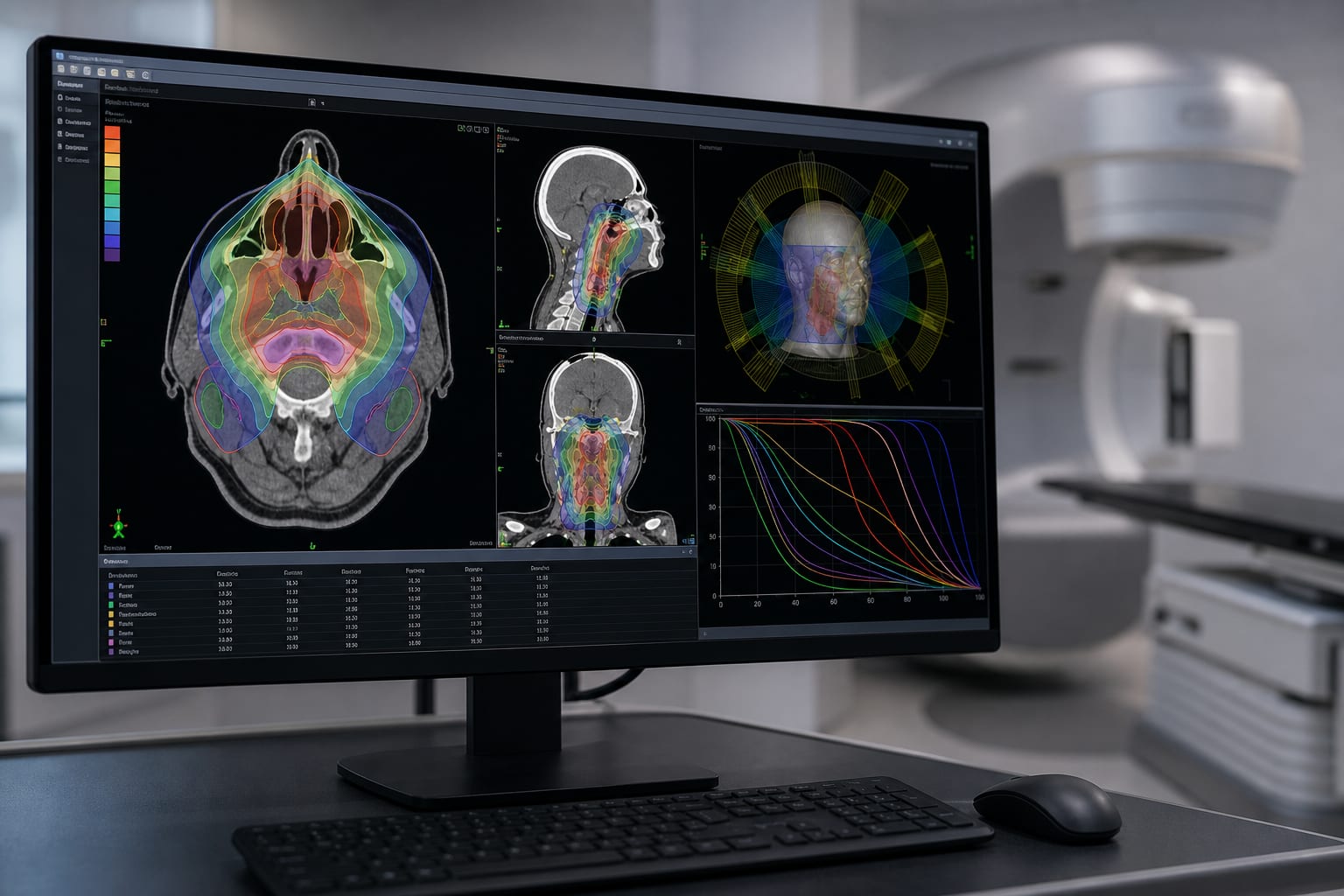
To assess the impact of implementing an in-house automated volumetric modulated arc therapy (VMAT) planning script for patients with head and neck (HN) cancer.
Approach:
Implementation and Validation: The automated planning script was implemented in April 2020. Validation involved comparing 10 auto-plans with 10 manual plans for dosimetric indices and clinical acceptability reviewed by five radiation oncologists.
Clinical Evaluation: Dosimetric indices from 1000 HN patients treated between 2017 and 2023 (500 manual pre-implementation, 500 automated post-implementation) were compared using t-tests.
Key Findings:
In validation, auto-plans maintained PTV D95% coverage (107.4% vs 107.3%) and similar global Dmax while reducing maximum doses to critical structures: brainstem (-5.1 Gy, p < 0.03) and spinal cord (-2.9 Gy, p < 0.03).
In clinical evaluation, auto-plans achieved PTV D95% coverage and similar global Dmax, with significant reductions in doses to various organs at risk: brainstem (-3.6 Gy, p < 0.001), spinal cord (-2.1 Gy, p < 0.001), contralateral submandibular gland (-4.1 Gy, p < 0.04), ipsilateral parotid (-3.9 Gy, p < 0.04), oral cavity (-2.5 Gy, p < 0.04), cochleae (-2.4 Gy, p < 0.04), larynx (-2.0 Gy, p < 0.04), contralateral parotid (-1.5 Gy, p < 0.04), and maximum doses to the mandible (-2.9 Gy, p < 0.04) and lips (-2.3 Gy, p < 0.04).
94% of automated plans and 86% of manual plans were rated clinically acceptable, with a preference for 7 auto-plans.
Interpretation:
Automated planning improved organ-at-risk sparing without compromising target coverage or dose homogeneity, with high clinical acceptability.
Limitations:
The study is limited to a single institution's experience, which may affect the generalizability of the findings.
Long-term impacts beyond three years were not assessed.
Conclusion:
Automated planning demonstrated significant benefits in dosimetric outcomes for patients with head and neck cancer.
by Nataliya Kovalchuk, Peng Dong, Caressa Hui, Ignacio Romero, Ziyi Wang, Lina Shah, Raveena Pandya, Michael Xiang, Everett J. Moding, Michael F. Gensheimer, Beth M. Beadle, Quynh-Thu Le, Lei Xing, Yong Yang