Preclinical translational screening of palladium(II)-porphyrin photosensitizers across human and Oncopig bladder cancer cell lines - Summary - MDSpire

Preclinical translational screening of palladium(II)-porphyrin photosensitizers across human and Oncopig bladder cancer cell lines

  • By

  • Valentina G. Ferreira

  • Maria Eduarda Ehlert

  • Bruna S. Pacheco

  • Fernanda S. S. Souza

  • Isadora Tisoco

  • Lucas Damé Simões

  • Bernardo A. Iglesias

  • Claudia Ó. Pessoa

  • Fabiana K. Seixas

  • Maria Lucia Z. Dagli

  • Laurie A. Rund

  • Kyle M. Schachtschneider

  • Lawrence B. Schook

  • Tiago Veiras Collares

  • July 9, 2026

  • 0 min

Share

Objective:

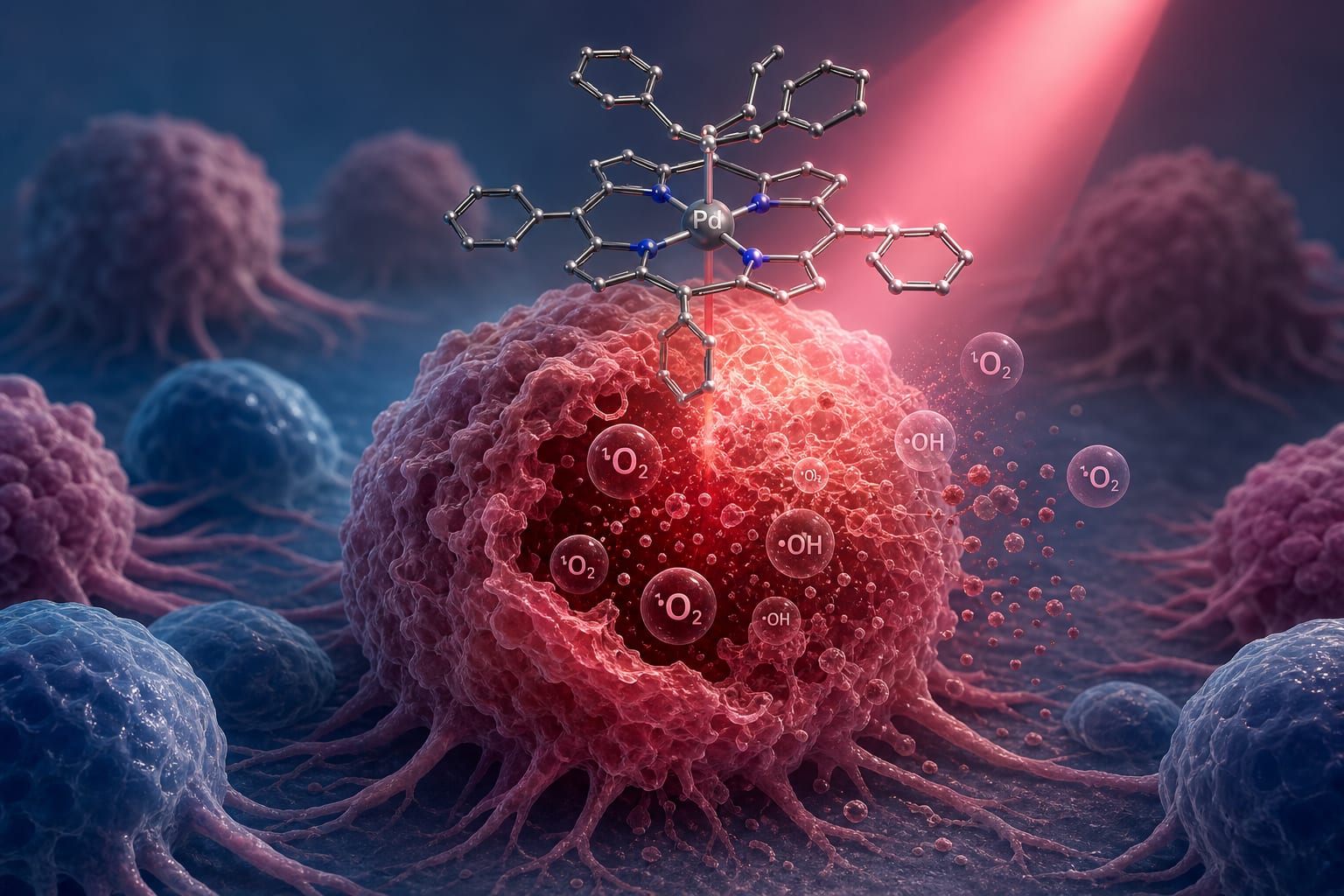
To perform a preclinical in vitro screening of three palladium(II)-porphyrins in human and Oncopig-derived bladder cancer cell models.

Approach:
  • Cytotoxicity Assessment: Cytotoxicity was evaluated under light and dark conditions using MTT and LIVE/DEAD assays.
  • ROS Generation Measurement: Intracellular ROS generation was quantified via DCFH-DA fluorescence.
  • Gene Expression Profiling: Gene expression profiling targeted oxidative stress and apoptosis markers using qRT-PCR.
  • Nuclear Morphology Analysis: Nuclear morphology was analyzed using DAPI staining.
Key Findings:
  • All three compounds exhibited light-dependent cytotoxicity with minimal dark toxicity.
  • 3-Pd(PPh3) and 3-Pd(dppf) demonstrated potent photodynamic activity with nanomolar IC50 values.
  • 3-Pd(PEPSI) showed higher IC50 values, indicating lower photodynamic potency.
  • Photoactivation triggered significant ROS production and upregulation of CAT and CASP3.
  • Oncopig-derived cells exhibited responses closely matching those of human bladder cancer cell lines.
Interpretation:

Limitations:
  • The study is limited to in vitro models and may not fully replicate in vivo conditions.
  • Further validation in large-animal studies is required to confirm findings.
Conclusion:

Original Source(s)

Related Content