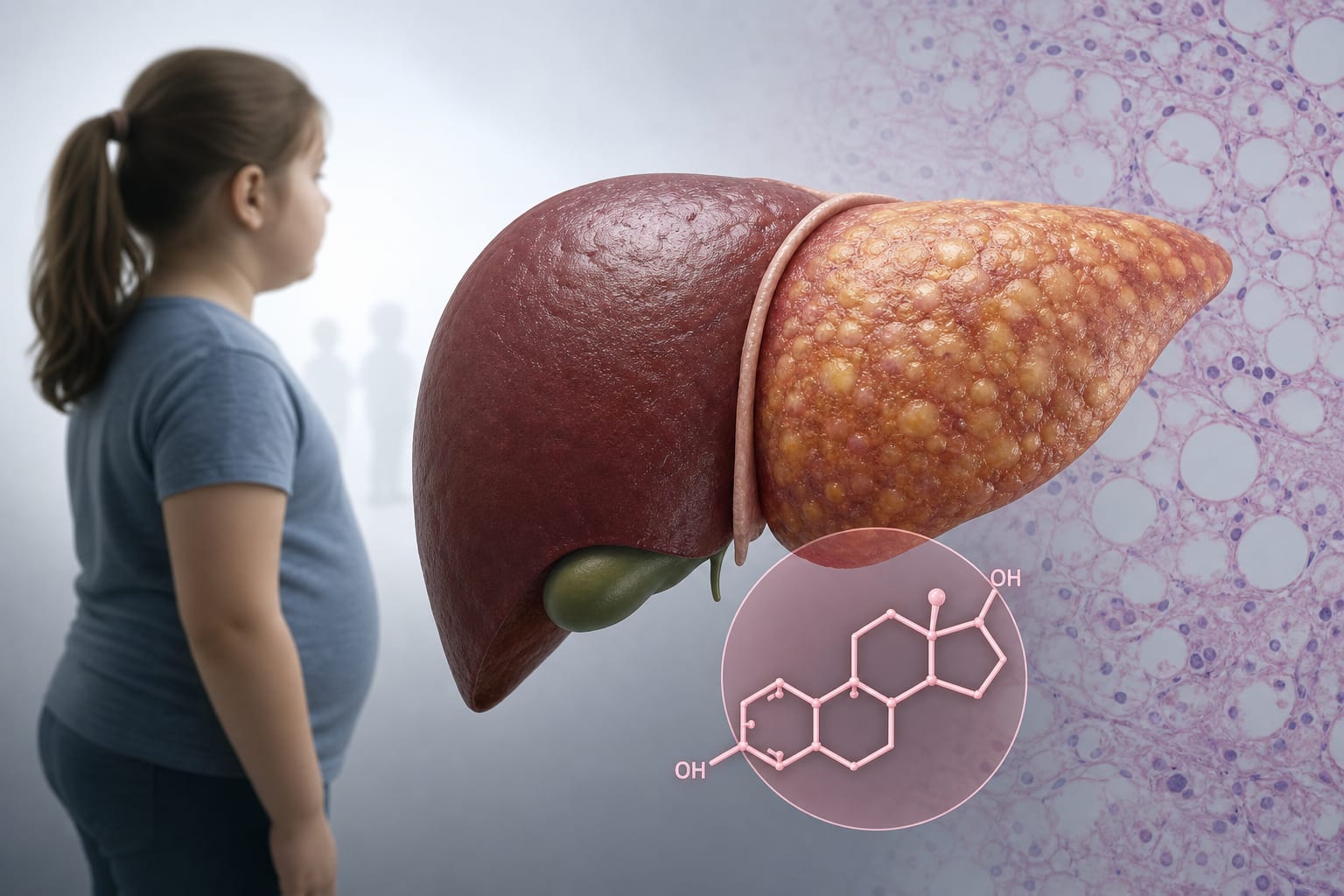
To investigate associations between sex hormones and metabolic dysfunction-associated steatotic liver disease (MASLD) in children with overweight and obesity.
Approach:
Study Design: A cross-sectional study was conducted in children with overweight and obesity at a tertiary care center, involving a comprehensive serum sex hormone panel and assessments of serum alanine aminotransferase (ALT) and hepatic steatosis via ultrasound.
Participants: 290 children aged 4–18 years with overweight, obesity, or severe obesity were recruited, with specific exclusions applied.
Measurements: Serum sex hormones, ALT, and hepatic steatosis were measured, with Controlled Attenuation Parameter (CAP) data available for 75 participants.
Key Findings:
Estradiol, Anti-Müllerian hormone (AMH), and sex hormone-binding globulin (SHBG) inversely associated with ALT (p=0.018, p=0.048, p<0.001).
Free testosterone (FT), bioavailable testosterone (BT), and dehydroepiandrosterone sulfate (DHEAS) positively associated with ALT (p=0.006).
AMH and SHBG inversely associated with hepatic steatosis (HS) (p=0.028, p<0.001), while FT, BT, and DHEAS positively associated with HS (p=0.024, p=0.024, p=0.042).
AMH and SHBG inversely associated with CAP (p=0.04, p<0.001), whereas follicle stimulating hormone, total testosterone (TT), FT, BT, androstenedione, and DHEAS positively associated with CAP (p=0.034, p=0.04, p=0.032, p=0.032, p=0.007, p=0.003).
Interpretation:
The study indicates that estradiol, AMH, and SHBG may have protective roles against MASLD parameters, while androgens are associated with increased MASLD parameters in children with overweight and obesity.
Limitations:
The study is cross-sectional, limiting causal inferences.
Findings may not be generalizable beyond the European cohort studied.
Potential confounding factors not fully accounted for.
Conclusion:
The findings suggest a complex relationship between sex hormones and MASLD in pediatric patients, warranting further investigation.