Can Blind South Africans Rely on AI-Powered Glasses for Navigation?
-
By
-
Sharon Muzaki
-
November 25, 2026
Objective:
The article examines the objective, findings, and clinical context described in Can Blind South Africans Rely on AI-Powered Glasses for Navigation?.
Approach:
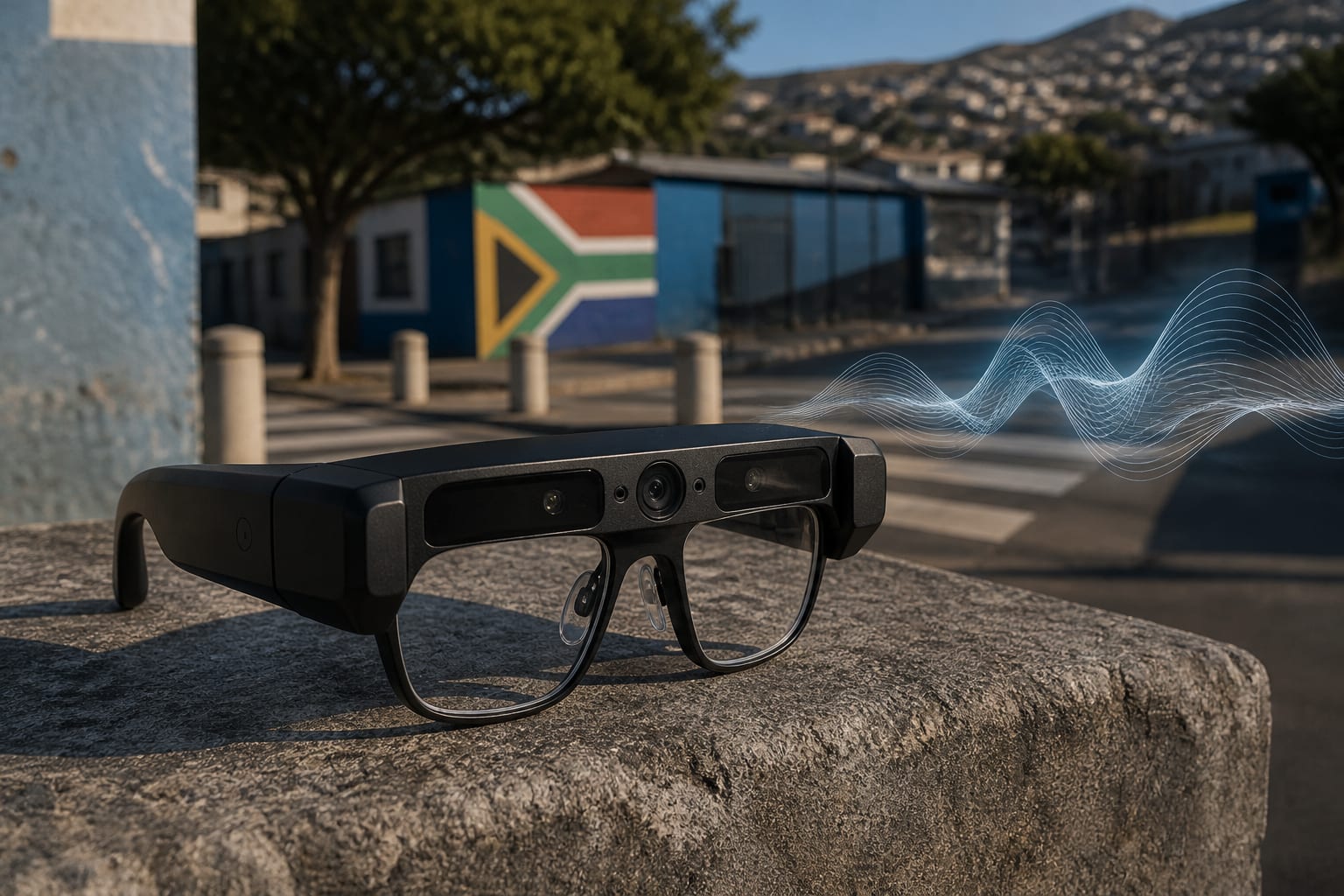
- Technology: Spectacles4TheBlind SA is developing glasses that use computer vision to detect and track people and objects, then provide spoken guidance in English, isiXhosa, isiZulu, Sesotho, Sepedi, and Afrikaans.
- Planned pilot: The company plans to test 15 prototypes, assessing comfort, safety, navigational precision, language capabilities, and dependability. The glasses have not yet undergone structured user testing.
- Related research: Research cited in the article includes 25 semistructured interviews and 37 online survey responses about intelligent assistive technologies, as well as a 2025 systematic review of 58 navigation-technology studies.
Key Findings:
- More than 100 automated software tests have been completed, but these do not establish whether the glasses can guide users safely.
- Demonstrations with blind people revealed earlier alerts that identified a nearby object without specifying what it was; the company says it improved object descriptions and detection speed.
- Participants in Nombakuse’s research saw potential benefits for mobility, communication, information access, and employability, while cost and restricted employment prospects remained barriers.
- The article identifies varied infrastructure, language pronunciation, and possible theft as issues relevant to real-world use.
- Stali estimates a future price of about 8,000 South African rand, but the retail price has not been decided.
Interpretation:
The article presents the glasses as a technology still awaiting structured pilot testing. Its reliability and usefulness across different environments and languages, and its affordability, remain unresolved.
Limitations:
- The glasses have not undergone structured user testing; software tests alone cannot establish safe guidance.
- The planned pilot involves 15 prototypes, and Nombakuse questions whether testing in one geographic area would represent South Africa’s varied conditions.
- The article does not report pilot results or a finalized retail price.
Conclusion:
The company plans to evaluate the prototypes with users, while researchers cited in the article emphasize the need to account for diverse environments, language support, and access barriers.
Based on findings from:
Can South Africans Who Are Blind Trust AI to Guide Them?
Sharon Muzaki. Journal Of Medical Internet Research, 2026.
https://www.jmir.org/2026/1/e117666
This content is an AI-generated, fully rewritten summary based on a published scholarly article. It does not reproduce the original text and is not a substitute for the original publication. Readers are encouraged to consult the source for full context, data, and methodology.