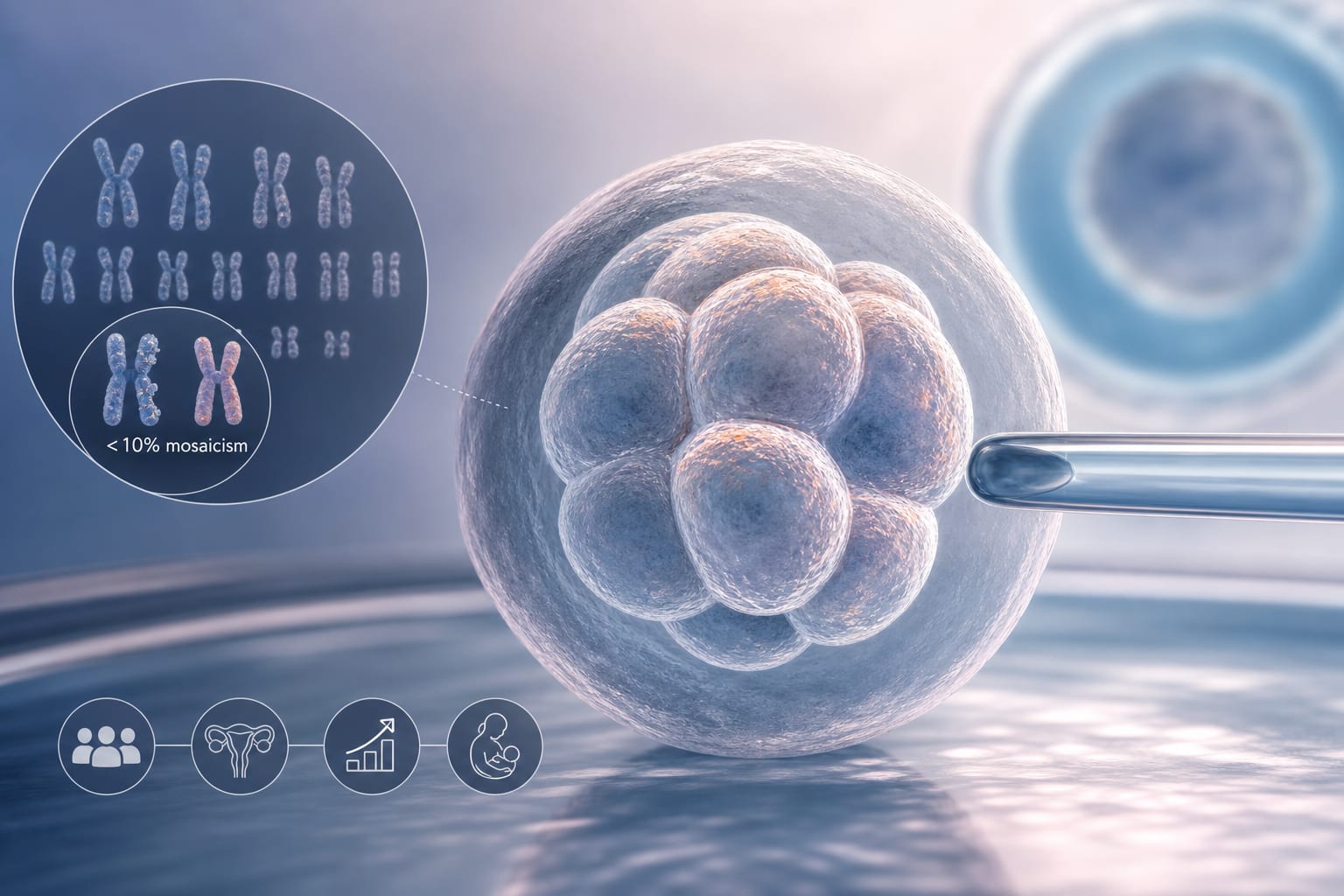
Impact of low-level sex chromosome mosaicism (<10%) on clinical outcomes of first fresh embryo transfer: a propensity score-matched retrospective cohort study - Summary - MDSpire
Advertisement
Impact of low-level sex chromosome mosaicism (<10%) on clinical outcomes of first fresh embryo transfer: a propensity score-matched retrospective cohort study
To determine whether low-level sex chromosome mosaicism (SCM) affects clinical outcomes in the first fresh embryo transfer cycle.
Approach:
Study Design: Single-center retrospective cohort study including 3,216 infertile patients undergoing their first IVF or ICSI-ET cycle.
Propensity Score Matching: 1:4 nearest-neighbor propensity score matching was performed to balance baseline demographic, ovarian reserve, and stimulation parameters.
Outcomes Measured: Primary outcome was live birth rate; secondary outcomes included clinical pregnancy rate and early miscarriage rate.
Statistical Analysis: Multivariable logistic regression was applied to calculate adjusted odds ratios and 95% confidence intervals.
Key Findings:
No significant differences in live birth rate (34.39% vs. 40.75%), clinical pregnancy rate (45.25% vs. 49.72%), or early miscarriage rate (20.00% vs. 16.44%) between SCM and control groups.
Multivariable logistic regression showed no independent association between SCM status and live birth (aOR 0.890, P = 0.503) or clinical pregnancy (aOR 0.915, P = 0.591).
Female age was a significant predictor of ART outcomes, with each additional year reducing live birth odds by 12.8%.
Interpretation:
Low-level sex chromosome mosaicism (<10%) does not significantly affect live birth, clinical pregnancy, or early miscarriage rates in the first fresh ART transfer cycle, with consistent null findings across all age strata.
Limitations:
The study is limited to a single center, which may affect generalizability.
Potential confounding factors not fully controlled for despite propensity score matching.
A nationwide birth cohort found lower odds of short sleep at 1 year among infants breastfed during the first 6 months of life, regardless of formula supplementation.