Is a central cavity necessary for bioactive glass-ceramic spacers in plated ACDF? A retrospective comparison of solid versus cavity designs - Summary - MDSpire
Advertisement
Is a central cavity necessary for bioactive glass-ceramic spacers in plated ACDF? A retrospective comparison of solid versus cavity designs
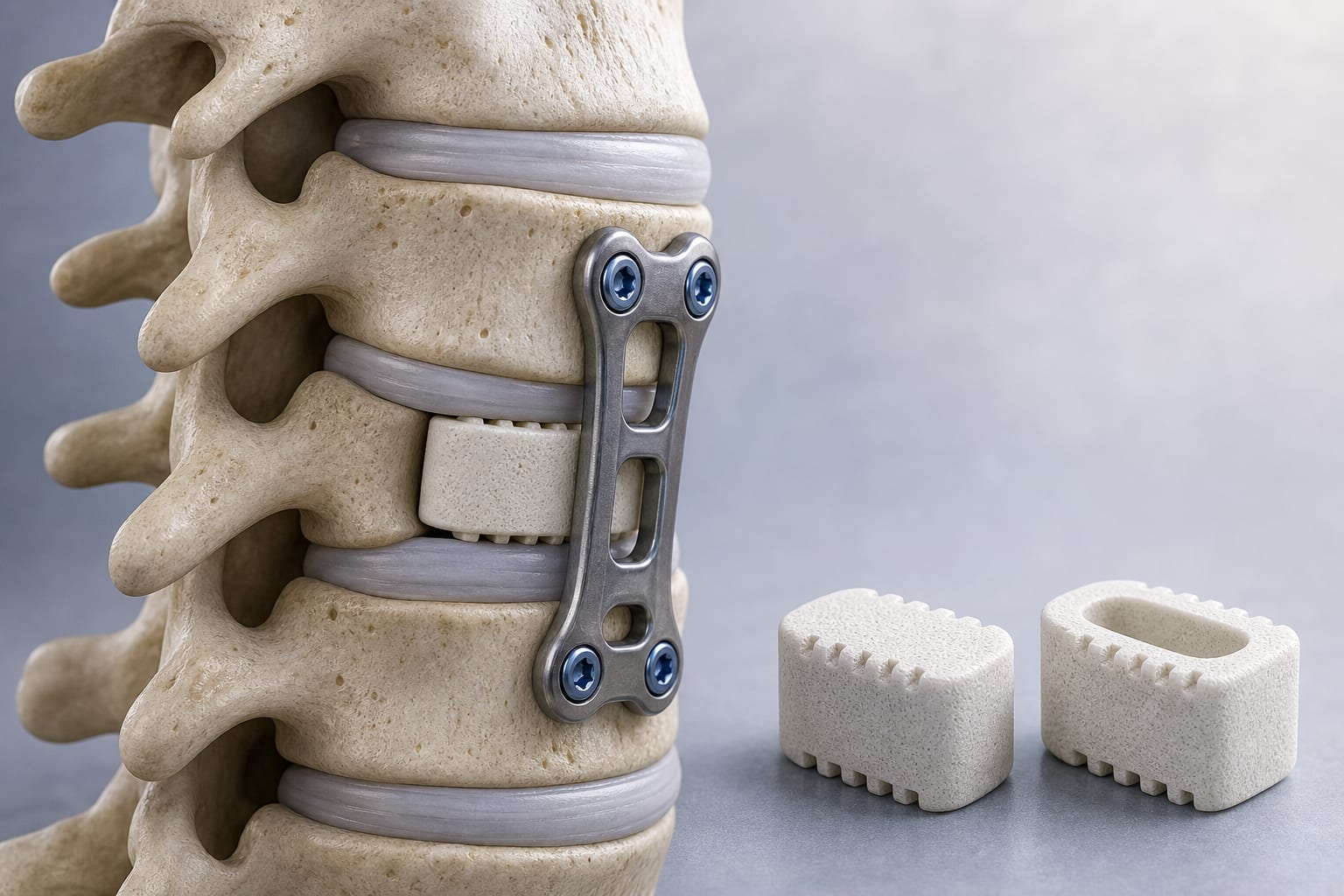
To compare the clinical and radiologic outcomes of anterior cervical discectomy and fusion (ACDF) using non-cavity versus central-cavity bioactive glass-ceramic (BGS-7) spacers.
Approach:
Key Findings:
No prior studies have compared outcomes of non-cavity and central-cavity BGS-7 spacers in ACDF.
The central-cavity design was introduced without evidence of superiority over the non-cavity design.
The central cavity may reduce the load-bearing area, potentially increasing the risk of structural failure.
Interpretation:
The study evaluates whether the design modification of BGS-7 spacers impacts fusion rates, mechanical stability, and clinical recovery.
Limitations:
The retrospective design may introduce biases.
The single-center study limits generalizability.
There was no randomization between spacer designs.
Conclusion:
The study aims to clarify the necessity of a central cavity in BGS-7 spacers for optimal clinical outcomes in ACDF.