Baseline 18F-FDG PET/CT habitat radiomics versus dual-channel deep learning for predicting interim PET early metabolic response in diffuse large B-cell lymphoma: a comparative study - Summary - MDSpire

Baseline 18F-FDG PET/CT habitat radiomics versus dual-channel deep learning for predicting interim PET early metabolic response in diffuse large B-cell lymphoma: a comparative study

  • By

  • Yu He

  • Shun Wang

  • Yingchun Li

  • Xinyang Li

  • Jingkai Yi

  • Dan Wang

  • Kailin Qi

  • Yongjiang Li

  • Xiao Jiang

  • Yutang Yao

  • Ping Wu

  • Meng Zhao

  • Hao Lu

  • Taipeng Shen

  • Zhuzhong Cheng

  • Ying Kou

  • June 4, 2026

  • 0 min

Share

Objective:

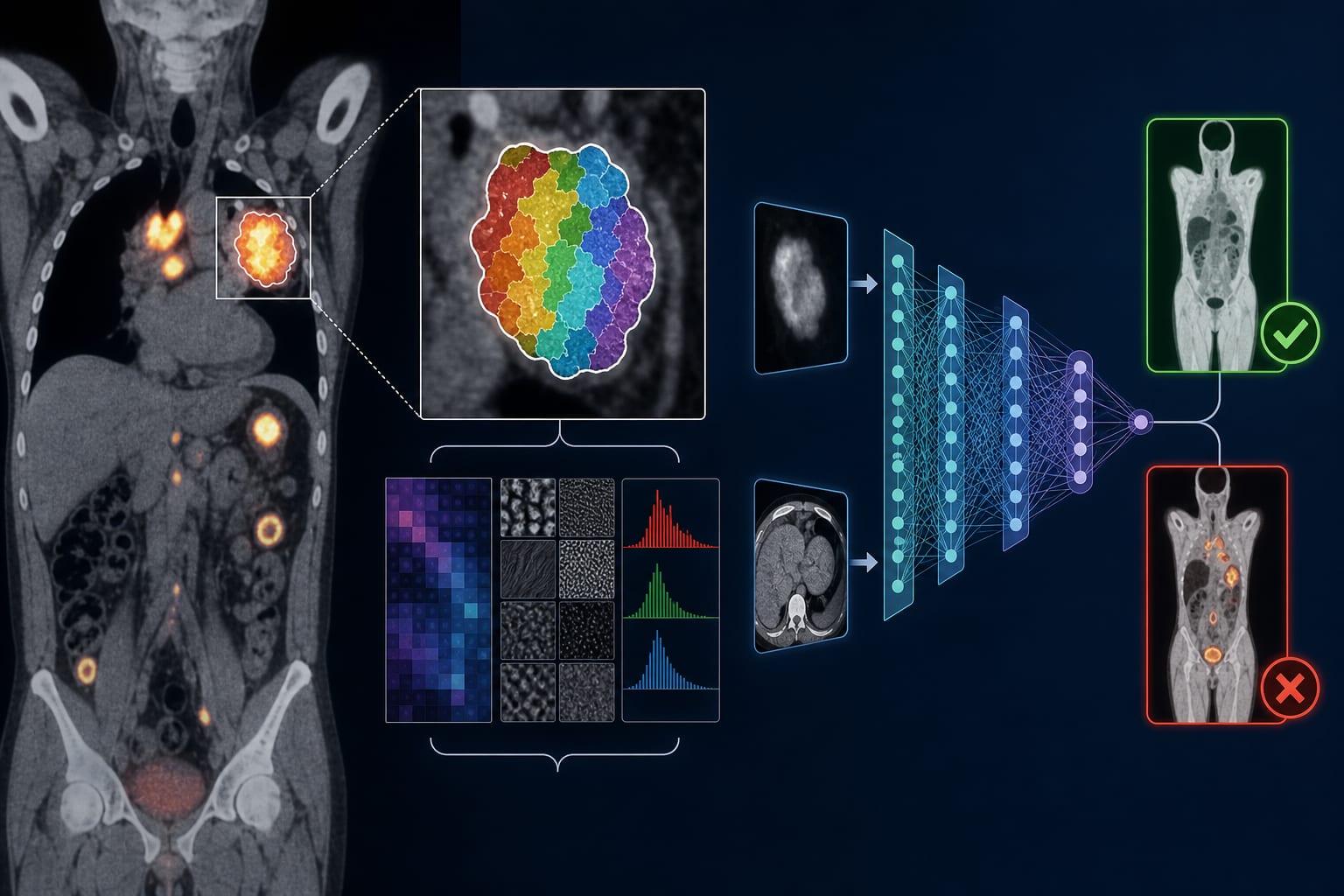
To develop baseline ¹8F-FDG PET/CT habitat radiomics and dual-channel deep learning models for predicting early metabolic response (EMR) on interim PET in patients with DLBCL and compare their performance, specifically addressing the classification of EMR based on Deauville scores.

Key Findings:
  • The habitat radiomics model (Habitat_MLP) achieved an AUC of 0.871 (95% CI: 0.7563–0.9857) with a specificity of 0.903 and accuracy of 0.822.
  • The dual-channel deep learning model (DL_DenseNet161) achieved an AUC of 0.793 (95% CI: 0.6409–0.9444) with a specificity of 0.677 and accuracy of 0.711.
  • Habitat_MLP showed better calibration and higher net benefit on decision curve analysis compared to DL_DenseNet161.
Interpretation:

The habitat radiomics model demonstrated superior performance and robustness for predicting EMR on iPET in patients with DLBCL.

Limitations:
  • The study was retrospective and conducted at a single center, which may limit the generalizability of the findings.
  • The sample size may limit the generalizability of the findings.
Conclusion:

The habitat radiomics model derived from baseline 18F-FDG PET/CT shows potential as a decision-support tool for pretreatment risk stratification in DLBCL.

Original Source(s)

Related Content