Evaluation of cerebral hemodynamic assessment from time-of-flight magnetic resonance angiography using a topological network-based model with Transcranial Doppler measurements - Summary - MDSpire
Advertisement
Evaluation of cerebral hemodynamic assessment from time-of-flight magnetic resonance angiography using a topological network-based model with Transcranial Doppler measurements
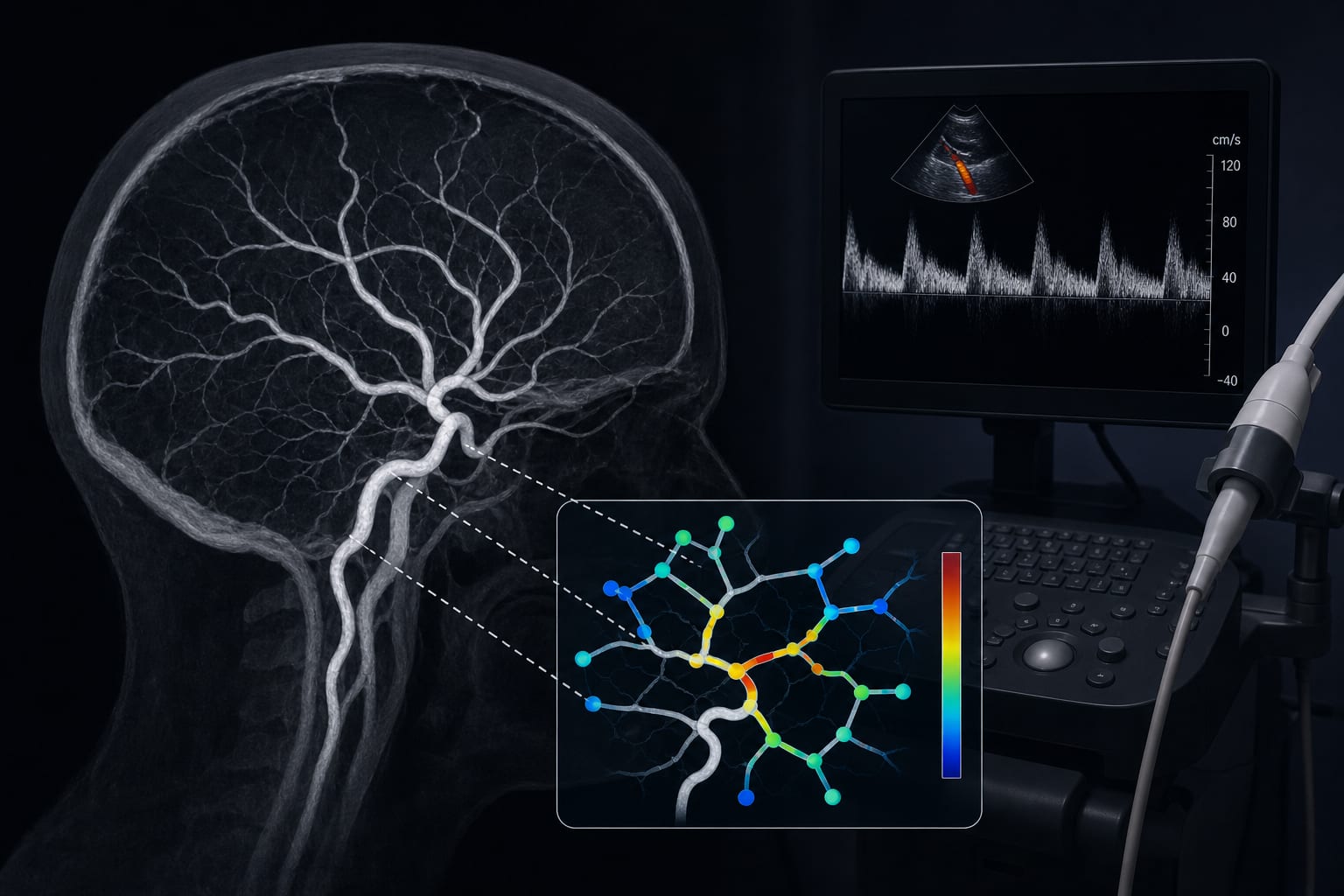
To evaluate the performance of Dr. NEAR flow (DNF) in estimating hemodynamic parameters from time-of-flight magnetic resonance angiography (TOF-MRA) and to compare DNF-calculated velocities with Transcranial Doppler (TCD) measurements.
Approach:
Study Design: A single-center retrospective study involving 113 patients.
Methodology: Comparison of DNF-calculated velocities with TCD-measured velocities across seven major cerebral arteries.
Data Analysis: Patient-specific inflow boundary conditions were defined using TCD measurements to ensure physiologically consistent comparisons.
Key Findings:
Statistically significant positive correlation between DNF-calculated velocities and TCD measurements (Pearson’s r = 0.74, p < 0.0001), indicating a strong relationship between the two methods.
DNF provides a non-invasive alternative for comprehensive cerebrovascular assessment.
Interpretation:
DNF overcomes limitations associated with conventional TCD by integrating anatomical context with hemodynamic assessment.
Limitations:
Study conducted at a single center, which may limit generalizability.
Retrospective design may introduce biases.
Conclusion:
DNF offers a robust method for assessing cerebral hemodynamics.