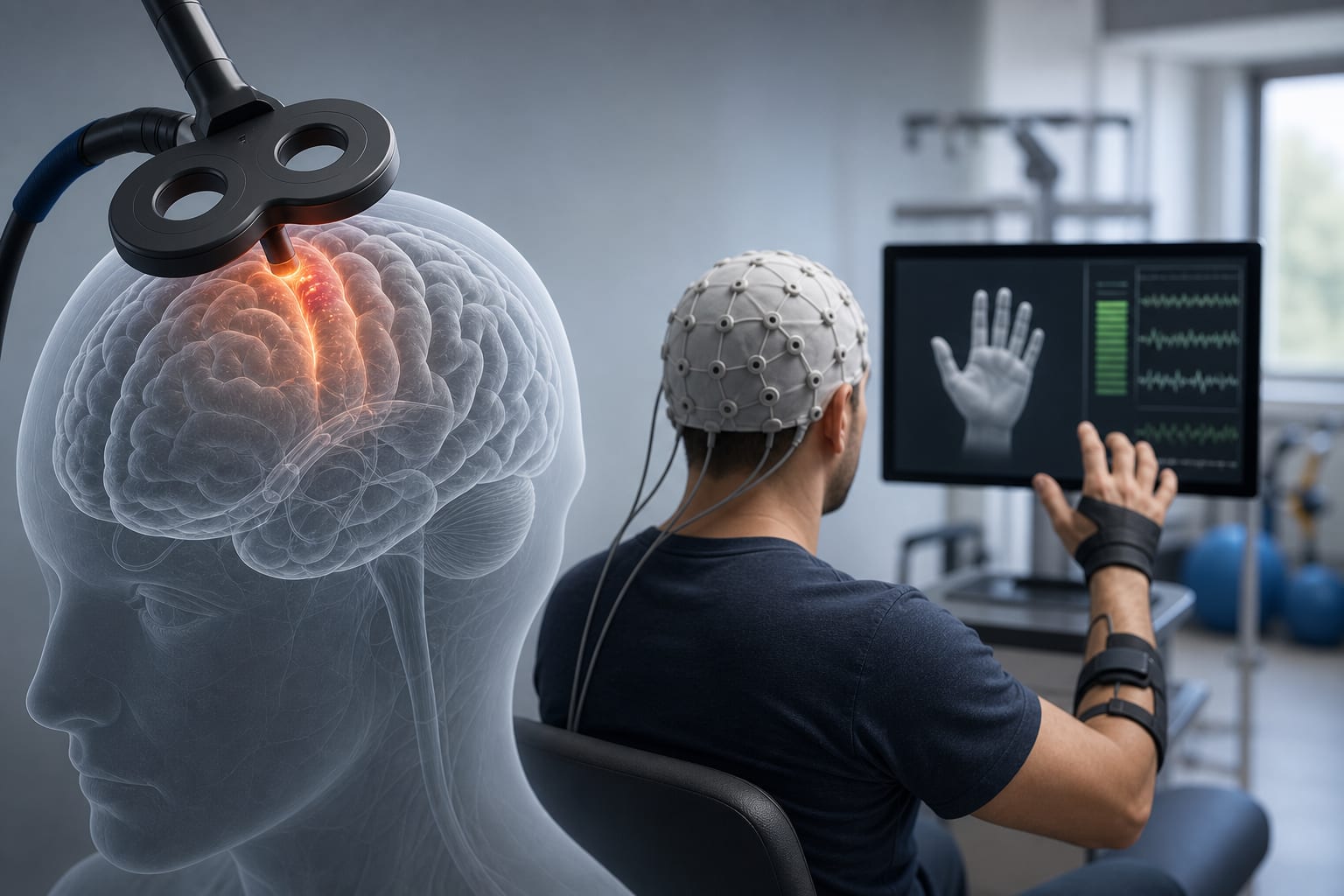
To investigate whether sequential application of intermittent Theta Burst Stimulation (iTBS) over the affected primary motor cortex before Brain-Computer Interface (BCI) training enhances cortical activation and improves upper limb motor recovery in stroke patients.
Approach:
Key Findings:
The iTBS + BCI group showed greater improvement in FMA-UE scores at week 4 (Z = 2.569, p = 0.008).
The iTBS + BCI group had a greater increase in BCI-TA (87.22 ± 10.83% vs. 68.24 ± 5.75%, p = 0.041).
Only the iTBS + BCI group demonstrated deeper ERD over the affected sensorimotor cortex (C4; p = 0.001) and a shift in LI towards the affected side (p = 0.017).
Interpretation:
The findings indicate that sequential application of iTBS combined with BCI may enhance upper limb function in stroke patients by boosting cortical excitability and improving BCI decoding efficiency.
Limitations:
The study is exploratory with a small sample size (n=18), limiting generalizability.
The single-center design may introduce bias and affect the applicability of results.
Conclusion:
Sequential iTBS combined with BCI may offer a new strategy to enhance upper limb rehabilitation post-stroke.
Federal prosecutors allege that a Florida physician and research staff fabricated clinical trial records that were submitted into database systems used to evaluate investigational drugs.