The immunome of mobilized peripheral blood stem cells is predictive of long-term outcomes and therapy-related myeloid neoplasms in patients with multiple myeloma undergoing autologous stem cell transplant - Summary - MDSpire
Advertisement
The immunome of mobilized peripheral blood stem cells is predictive of long-term outcomes and therapy-related myeloid neoplasms in patients with multiple myeloma undergoing autologous stem cell transplant
To explore the immune composition of mobilized peripheral blood stem cells (PBSC) and its relationship with subsequent multiple myeloma (MM) relapse and therapy-related myeloid neoplasms (t-MN) development, highlighting its potential as a predictive marker.
Key Findings:
Pre-existing immune abnormalities in mobilized PBSC are linked to an immunosuppressive tumor microenvironment, suggesting a need for targeted interventions.
Patients with t-MN showed a reduced number of immune effector cells and increased regulatory T-cells and myeloid-derived suppressor cells, indicating a shift in immune balance.
Immune reconstitution post-ASCT is critical for long-term outcomes, emphasizing the importance of monitoring immune profiles.
Interpretation:
The immune profile of mobilized PBSC can serve as a predictive marker for relapse and t-MN development in MM patients post-ASCT.
Limitations:
Study limited to a single institution, which may affect generalizability; further multicenter studies are needed to validate findings.
Potential biases in patient selection and retrospective analysis may influence the reliability of the results.
Conclusion:
Identifying immune abnormalities in PBSC may help in stratifying patients at high risk for relapse and t-MN, potentially guiding pre-ASCT interventions to improve patient outcomes.
by Saurabh Zanwar, Eapen K. Jacob, Carl Greiner, Kevin Pavelko, Michael Strausbauch, Emilie Anderson, Arini Arsana, Megan Weivoda, Mithun Vinod Shah, Taxiarchis Kourelis
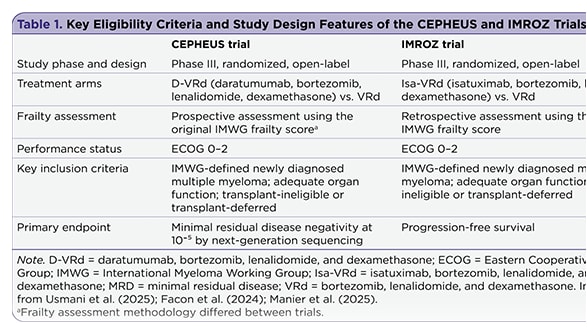
The management of newly diagnosed transplant-ineligible multiple myeloma remains challenging, in part due to the complexity of treatment decisions for frail patients. Recent subgroup analyses provide insight into whether quadruplet therapy may offer advantages over triplet therapy in this population.